
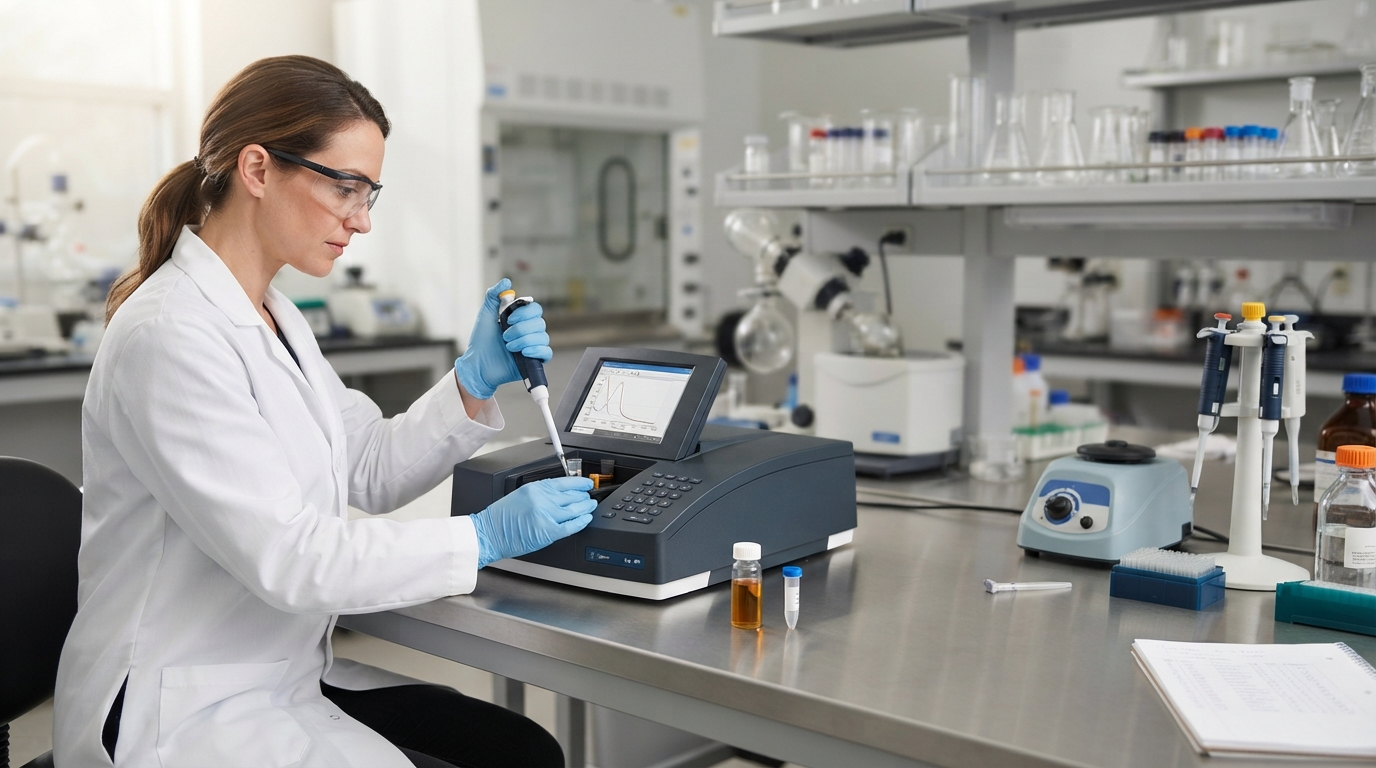
UV-tested herbal extracts are herbal extracts evaluated using ultraviolet (UV) spectroscopy. “UV-tested” is not a single regulated certification. The phrase can mean direct UV–Vis spectroscopy or HPLC-UV, and the strength of the evidence depends on the method used, the marker compound measured, the reference standard, and the validity of the test method.
If you are evaluating a botanical-extract supplier, do not stop at the phrase “UV-tested.” Ask what method was used, what compound was measured, whether a reference standard was used, and whether the result is attached to a specific batch.
What Does “UV-Tested” Mean for a Herbal Extract?
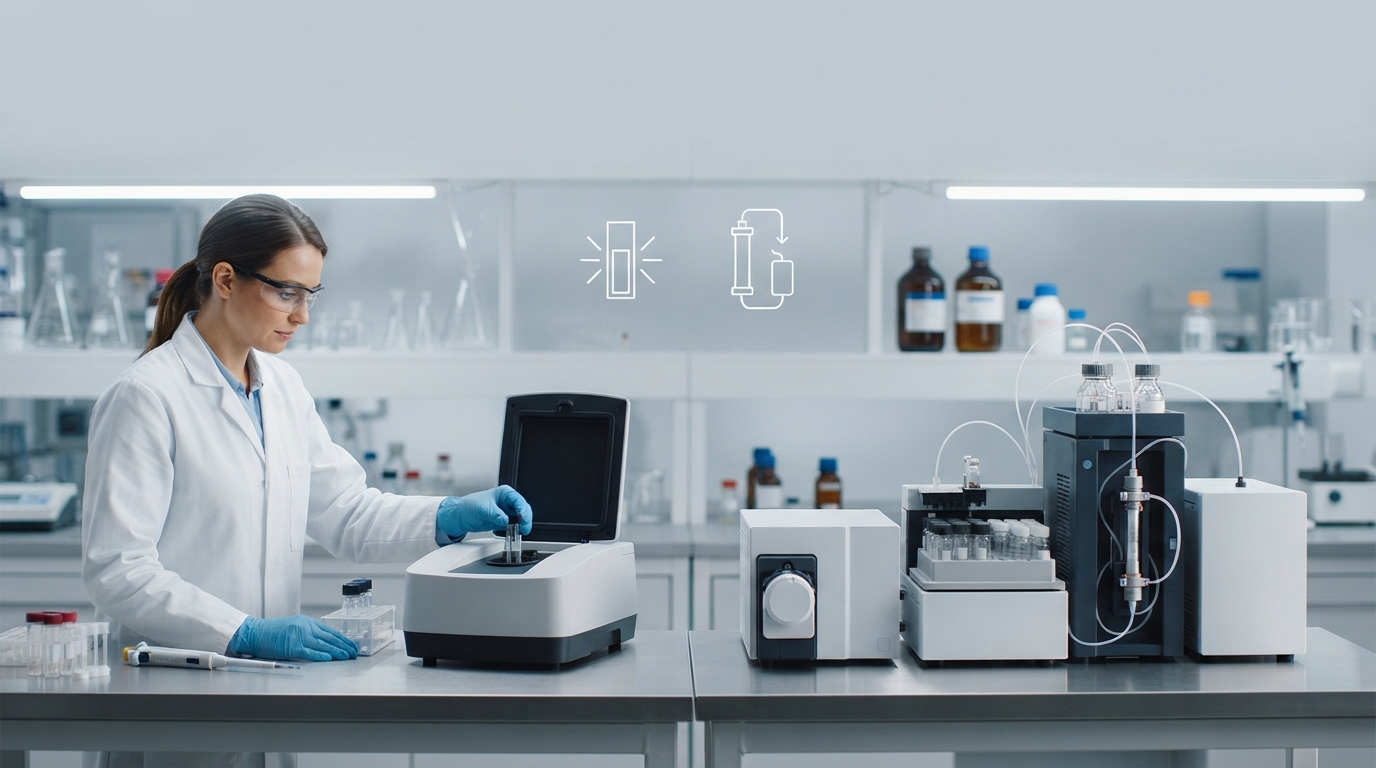
Ultraviolet-visible (UV–Vis) spectroscopy measures how much ultraviolet and visible light an extract absorbs at different wavelengths. Every molecule has a characteristic absorbance pattern, so a UV spectrum can be used as a general chemical profile of a sample. However, a herbal extract is a complex mixture. In direct UV–Vis spectroscopy, the sample is not separated before measurement, so overlapping compounds can produce a spectrum that is difficult to interpret.
When UV detection is combined with chromatographic separation, the method is usually called HPLC-UV. In this technique, the extract is first separated into individual constituents, and then each separated component passes through a UV detector. This gives much more specific information about a single compound. HPLC-UV is a more targeted approach than direct UV–Vis because the target marker is separated from other extract constituents before it is measured.
| Feature | Direct UV–Vis Spectroscopy | HPLC-UV |
|---|---|---|
| What it measures | Total UV absorbance of the sample | UV absorbance of separated compounds |
| Sample separation | No | Yes |
| Best for | Screening, fingerprint comparisons, process monitoring | Quantifying or confirming a specific marker compound |
| Specificity | Lower, because compounds can overlap | Higher, because constituents are separated before detection |
| Reference standard | Needed for quantitative work | Needed for calibration and quantification |
| Typical buyer question | “What does the overall spectrum look like?” | “How much of the target marker is present?” |
Direct UV–Vis and HPLC-UV are not interchangeable. A supplier may use either method and describe the result as “UV-tested,” which is why the method matters more than the label.
What UV Spectroscopy Can and Cannot Verify
What UV Testing Can Support
Used correctly, UV spectroscopy can provide useful supporting evidence:
- Process monitoring during extraction. UV spectroscopy has been used to monitor herbal-medicine extraction processes in real time, helping manufacturers track when the process is complete. A 2021 study demonstrated this approach during percolation of herbal materials (PubMed).
- Batch-to-batch comparison. A UV spectrum can help a manufacturer compare an extract against a reference sample under controlled conditions.
- Fingerprint studies as part of a broader method set. UV–Vis data can be combined with chromatographic data to classify or authenticate botanical materials. A 2023 study used UV–Vis and chromatographic data together to distinguish several soothing herbs (ScienceDirect).
- Quantitative assay of a marker compound when a validated method is used. This is more common with HPLC-UV than with direct UV–Vis because separation removes interfering compounds.
In short, UV testing is a legitimate analytical tool, but it rarely works well as the only test for a complex botanical extract.
What UV Testing Cannot Verify Alone
UV testing has clear limits that buyers should understand before trusting a UV-tested claim:
- Botanical identity. A UV spectrum alone is not enough to prove that an extract comes from a specific plant species and plant part.
- Purity. Absorbance can come from multiple compounds, so a UV result does not prove that a sample is free from unrelated plant material or impurities.
- Contaminant absence. UV spectroscopy does not detect heavy metals, pesticides, microbiological contamination, mycotoxins, or residual solvents. These require separate, specific tests.
- Absence of adulteration. UV may flag a sample that looks unusual, but it cannot identify every possible adulterant by itself.
- Safety. A UV result provides no information about toxicity, allergens, or regulatory compliance.
For a closer look at the broader authenticity question, see our guide: how do i know if the plant extract im purchasing is authentic.
How to Evaluate a UV Test Result or CoA

A Certificate of Analysis (CoA) is a batch-specific document that records the results of testing carried out on a particular lot. A Technical Data Sheet (TDS) is different: it describes the general specifications and handling information for a product. Both are useful, but only a CoA gives you evidence for a specific batch.
When you receive a UV test result or CoA, check whether it includes the following:
| CoA Element | Why It Matters |
|---|---|
| Product name and botanical name | Confirms the expected plant species |
| Plant part used | Different plant parts can have very different chemical profiles |
| Batch number | Ties the result to a specific lot |
| Test method | Tells you whether UV–Vis, HPLC-UV, or another method was used |
| Wavelength or scan range | Shows what the instrument measured |
| Marker compound | Identifies which compound was targeted |
| Reference standard | Shows what the result was compared against |
| Result and specification | Confirms whether the batch met the accepted range |
| Date and laboratory | Provides context for the testing event |
Also be careful with specification language. An assay percentage refers to the amount of a named marker compound measured by a specific method. Purity is a separate claim. An extract ratio such as 10:1 describes the relationship between the starting material and the extract, not the potency percentage. These terms are not interchangeable.
When to Request Additional Testing
If a supplier only provides a UV spectrum, you may need more evidence depending on your application and risk tolerance.
| Buyer Need | Recommended Test | Why |
|---|---|---|
| Confirm botanical identity | HPTLC or LC-MS | More specific than UV alone |
| Quantify a marker in a complex extract | HPLC-UV | Separates the marker from other compounds |
| Look for unknown adulterants | LC-MS or GC-MS | Provides better structural information |
| Verify microbial safety | Microbiological testing | UV does not detect microbes |
| Check heavy metals | Heavy-metal testing | Requires dedicated analytical methods |
| Check pesticides or mycotoxins | Pesticide residue and mycotoxin tests | Separate safety tests are required |
| Confirm batch-to-batch consistency | CoA for each batch with same method | One batch result does not prove consistency |
The European Medicines Agency guidance for herbal medicinal products describes the need for appropriate test methods, including contaminant testing, to support the quality of botanical materials (EMA guideline). The same principle applies to many botanical extracts used in supplements, foods, and cosmetics.
FAQ: UV Testing for Botanical Extracts
Is “UV-tested” a recognized certification?
No. It is a general description of testing, not an official certification. You need to know which method was used and what was measured.
Does a UV test prove a plant extract is safe?
No. UV testing does not detect contaminants such as heavy metals, pesticides, or microbes. Safety requires additional, specific testing.
Are UV-tested extracts the same as standardized extracts?
Not automatically. A standardized extract contains a defined level of a marker compound. UV testing may be used to measure that marker, but the term “UV-tested” alone does not confirm standardization.
Should I request HPLC testing instead of a UV test?
It depends on your goal. If you need to confirm a specific marker compound, HPLC-UV is usually more informative than direct UV–Vis. If you are comparing overall profiles or monitoring a process, UV can still be useful — but it should be supported by other evidence.
UV-Tested Herbal Extracts and B-Thriving Quality Documentation
B-Thriving presents itself as a supplier of botanical/plant extracts, APIs, and natural ingredients for pharmaceutical, supplement, and cosmetic applications. When evaluating any botanical-extract supplier, including B-Thriving, the same documentation principles apply.
Ask for:
- the exact test method used;
- the marker compound tested;
- the wavelength or scan range;
- the batch number;
- a current CoA for the specific batch;
- the general TDS for product specifications.
Bringing this checklist to a supplier conversation will give you a much clearer picture than accepting “UV-tested” at face value. The goal is not to reject UV data. It is to make sure the data actually supports the claim being made.

