
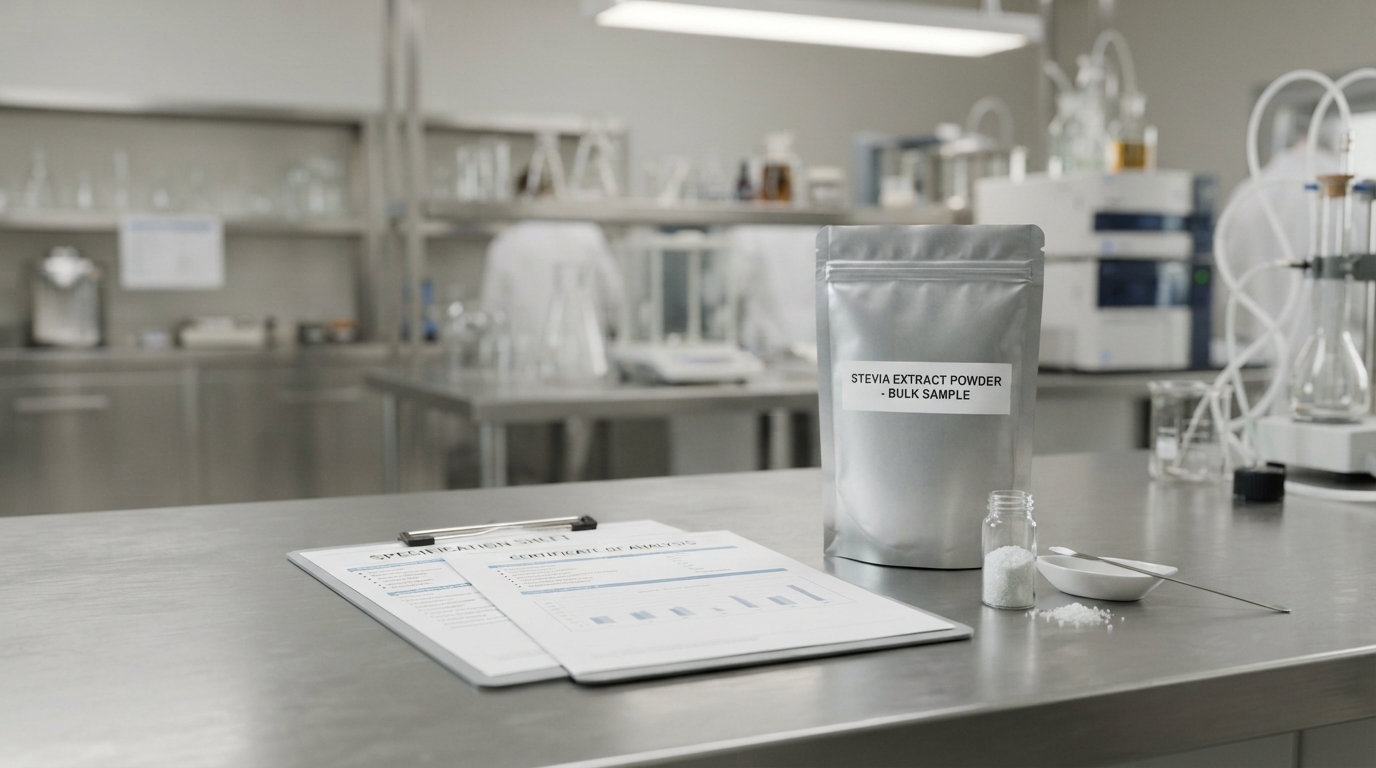
A stevia extract wholesale supplier provides bulk steviol glycoside ingredients to food, beverage, supplement, and other product manufacturers. The right supplier should be evaluated on specification accuracy, batch documentation, testing methods, application fit, and commercial terms—not price or marketing claims alone.
This guide walks through the product specifications, quality documents, application considerations, and supplier questions that matter most when buying stevia extract in commercial quantities.
What Is Bulk Stevia Extract and Why Supplier Qualification Matters
In bulk trade, stevia extract refers to concentrated steviol glycosides obtained from Stevia rebaudiana leaves. The U.S. FDA distinguishes between raw stevia leaves and steviol glycoside extracts, because they are different products with different regulatory and quality considerations. The sweetening components in the extract are the steviol glycosides, with stevioside and rebaudioside A being the most common.
A wholesale supplier should be able to state exactly which glycosides are present, at what concentration, and how those levels are verified. That information matters because stevia extract is rarely a single, uniform commodity. Products can differ in:
- total steviol glycoside content;
- rebaudioside A (Reb A) percentage;
- physical form;
- solubility;
- moisture content;
- particle size;
- shelf life and storage requirements;
- batch-to-batch consistency.
For a broader overview of stevia as a natural sweetener, see the related ingredient guide. This page focuses on what to verify before you commit to a wholesale supply relationship.
Stevia Extract Specifications to Verify Before Buying
Before comparing suppliers, make sure you understand the specification language. A small mistake in interpreting a spec can lead to the wrong ingredient arriving at your facility.
Total Steviol Glycosides vs. Rebaudioside A
Buyers often confuse total steviol glycosides with Reb A, but they are not the same measurement.
| Specification | What It Means | Why It Matters |
|---|---|---|
| Total steviol glycosides | Combined percentage of all steviol glycosides in the extract. | Gives the overall assay or standardization level of the product. |
| Rebaudioside A (Reb A) | The percentage of one specific glycoside within the total glycoside content. | Affects sweetness character and can influence bitterness or aftertaste. |
For example, a product may list 95% total steviol glycosides, but the Reb A content could be lower or higher depending on the raw material and purification process. Some buyers specifically request high Reb A profiles, while others prefer a broader glycoside profile for a different taste profile.
FDA GRAS notices describe high-purity steviol glycoside products, including products with a minimum purity of 97% consisting primarily of Reb A. These notices are product-specific, so they should not be read as a blanket approval for every stevia extract on the market. Ask your supplier which regulatory documentation applies to the exact product you are buying.
Also be careful with extract ratio terminology. A label such as 10:1 refers to the ratio of starting plant material to finished extract, not to steviol glycoside purity. Do not treat an extract ratio as an assay value.
Physical Form, Solubility, Moisture, and Stability
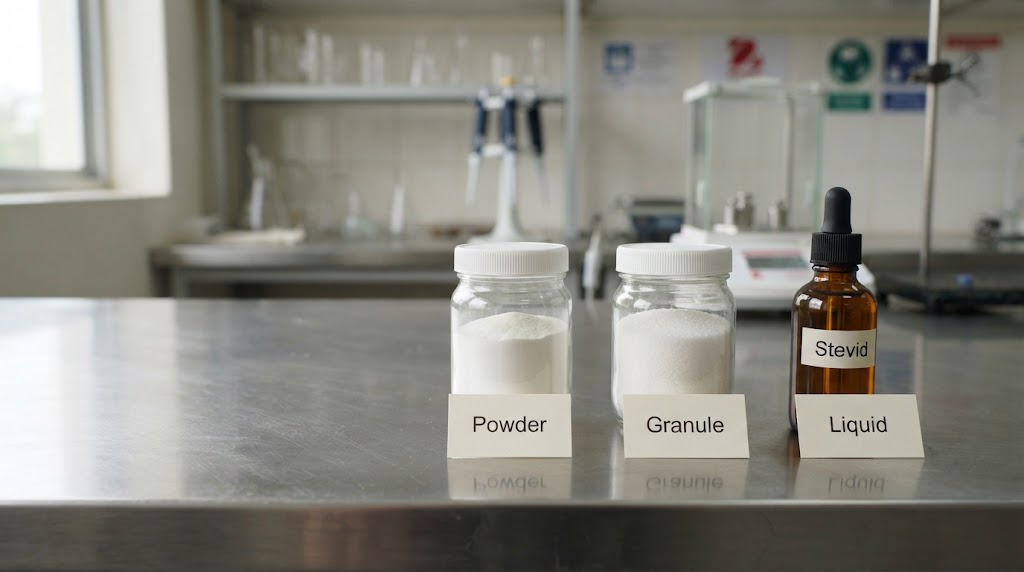
The physical characteristics of stevia extract affect how it performs in your manufacturing process.
| Specification | What to Check | Why It Matters |
|---|---|---|
| Physical form | Powder, granule, or liquid. | Powder is common, but granulation may improve flow or reduce dust. |
| Solubility | Whether it dissolves in water, cold water, or ethanol. | Critical for beverage applications. |
| Moisture content | Maximum moisture level stated on the spec. | Affects storage stability, flow, and risk of clumping. |
| Particle size | Mesh size or particle distribution. | Influences blending behavior and consistency in dry mixes. |
| Shelf life | Stated stability period under defined conditions. | Affects inventory planning and batch rotation. |
| Storage conditions | Temperature, humidity, light, and packaging requirements. | Helps you avoid quality loss after delivery. |
Request this information from the supplier in writing, and compare it against the product’s Technical Data Sheet (TDS) rather than relying on a category page summary.
CoA vs. TDS and Required Test Methods
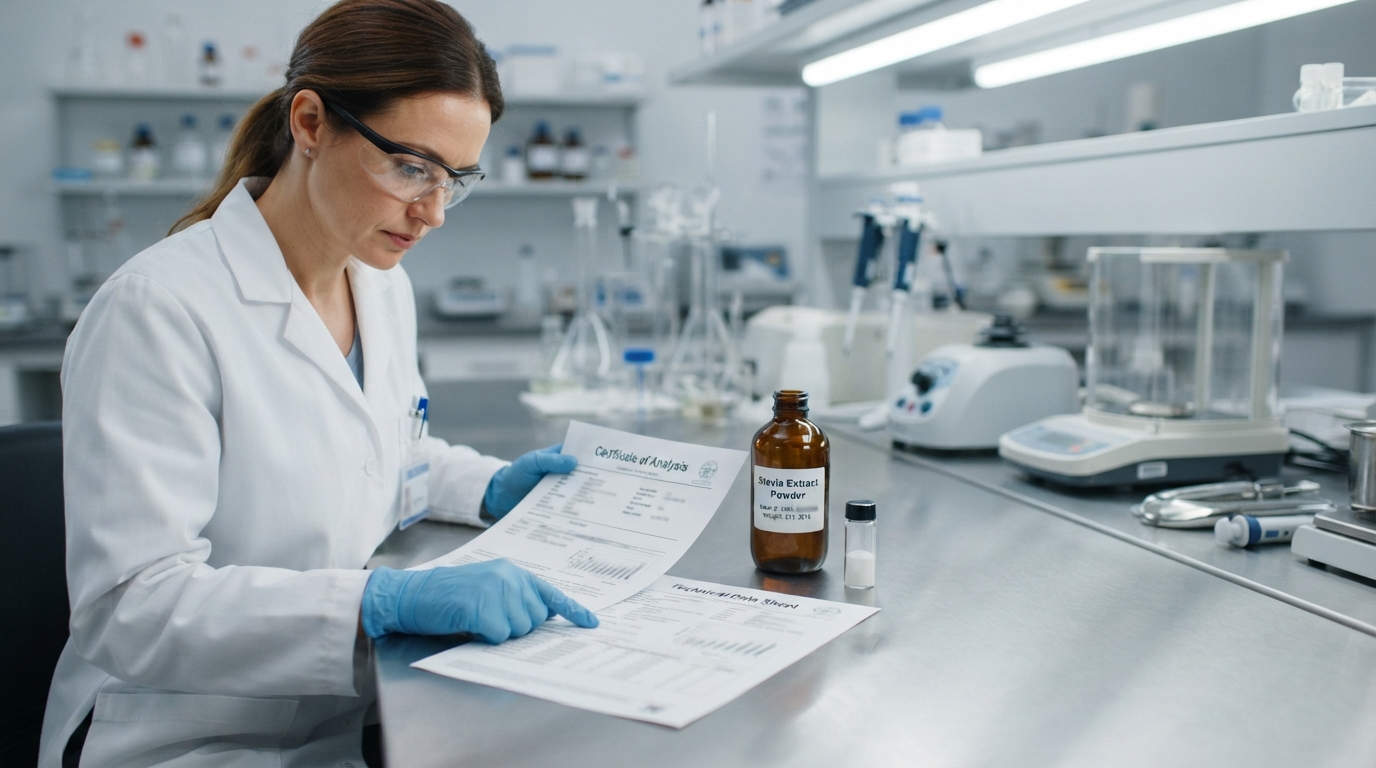
Many sourcing mistakes come from misunderstanding the difference between a Certificate of Analysis (CoA) and a Technical Data Sheet (TDS).
| Document | What It Covers | What It Does Not Cover |
|---|---|---|
| Certificate of Analysis (CoA) | Analytical results for a specific production lot or batch. | Does not guarantee every batch will be identical. |
| Technical Data Sheet (TDS) | Product-level specifications, physical description, storage, and handling guidance. | Does not prove what a particular batch actually tested at. |
A CoA should include:
- batch or lot number;
- date of analysis;
- total steviol glycoside assay;
- glycoside profile where relevant;
- appearance;
- solubility if applicable;
- moisture content;
- heavy metals;
- pesticide residues;
- microbiological testing;
- residual solvents, if solvent-based processing was used;
- analytical method used, such as HPLC.
HPLC is the method most commonly used for steviol glycoside analysis, because it can separate and quantify individual glycosides. Identity testing, heavy metal testing, and microbiological testing are also important checks. If a supplier cannot provide a current CoA for the exact batch you are considering, treat that as a red flag.
Certification claims should also be examined carefully. GMP, ISO, USDA Organic, Kosher, and Halal certifications can be relevant, but they only mean something when they are tied to a specific facility, product, or certificate. A general website statement such as “GMP certified” is not the same as a certificate that covers the product you are buying. Ask for the certificate, the issuing body, the scope, and whether the product you are ordering is included.
How to Evaluate a Stevia Extract Wholesale Supplier
A reliable supplier evaluation process does not have to be complicated. It just needs to be consistent.
- Confirm what type of supplier you are dealing with. A manufacturer, distributor, and broker can all supply stevia extract, but each has different visibility into production and testing.
- Request the product specification and the current CoA. Review both documents before discussing pricing.
- Check the glycoside profile against your formulation. Identify the total steviol glycoside content and the Reb A level you actually need.
- Confirm the physical form and solubility meet your process needs. A beverage application and a dry powder application may require different forms.
- Ask how batch consistency is controlled. Inquire about standardized raw material sourcing, production controls, and retained samples.
- Assess commercial terms. Confirm MOQ, lead time, packaging, shelf life, storage requirements, and sample policy.
- Run an application-level sample test. Do not approve a supplier based on a certificate alone. Test the material in your own product matrix.
This process helps you compare suppliers on evidence, not on website language.
Application Fit: Choosing the Right Stevia Extract for Your Formulation
The right stevia extract depends on your product, not on the highest purity number.
| Application | Priority Considerations | Typical Forms to Evaluate |
|---|---|---|
| Beverages | Solubility, taste profile, clarity in solution, sweetener stability. | Powder designed to dissolve quickly; some liquid formats may be available. |
| Powdered foods and supplements | Particle size, moisture, flow, blending uniformity. | Powder or granule with consistent particle behavior. |
| Sugar-reduction systems | Sweetness intensity, glycoside profile, aftertaste, interaction with other sweeteners. | Standardized steviol glycoside grades, possibly customized glycoside profiles. |
| Supplement and wellness formulations | Documentation, contaminant testing, regulatory compliance for the target market. | Verified powder or granule with batch-specific CoA. |
Regulatory status is also application-specific. The FDA and EFSA have both evaluated certain steviol glycoside products, but requirements and permitted uses can vary by country and by product category. For example, the FDA GRAS notification process is product-specific, and the European Food Safety Authority’s 2010 scientific opinion set an acceptable daily intake of 4 mg/kg body weight/day expressed as steviol equivalents for the glycosides evaluated at that time. These references are useful background, but they do not replace a regulatory review of your own finished product.
If your product is positioned around stevia extract and gut health or stevia extract blood sugar control, those claims need their own evidence and regulatory review. A sourcing guide cannot supply that proof.
Common Sourcing Mistakes and How to Avoid Them
The most expensive mistakes usually happen before the first order is placed.
- Confusing total steviol glycosides with Reb A. Always check which specification is being quoted.
- Treating extract ratio as an assay. A 10:1 extract ratio is not a purity percentage.
- Trusting marketing pages instead of a batch CoA. The CoA is the only document that describes what was actually shipped.
- Assuming certifications cover every product and batch. Confirm the certificate scope.
- Choosing a grade without testing it in your application. Specification sheets are necessary, but they do not replace a sample trial.
- Ignoring physical form and solubility differences. A powder that works in a beverage may not work well in a dry blend.
- Skipping batch-to-batch consistency check. A good first lot matters, but long-term consistency matters more.
Questions to Ask Before You Request a Quote or Sample
Use this checklist when you contact a wholesale supplier.
- What is the exact product name and grade?
- What is the total steviol glycoside content?
- What is the Reb A content, or the full glycoside profile?
- What is the physical form, particle size, and moisture content?
- What is the solubility profile?
- What is the stated shelf life and required storage condition?
- Can you provide a CoA for the current batch?
- Can you provide a TDS for the product?
- Which test methods were used, such as HPLC?
- What contaminant testing is included, such as heavy metals, pesticides, and microbiology?
- Do any certifications apply to this specific product or facility?
- What is the MOQ and lead time?
- What packaging and shipping options are available?
- Can a pre-shipment sample be provided for application testing?
Next Steps in Approving a Stevia Extract Supplier
Once you have the specification, CoA, sample, and commercial terms, run the sample through your own evaluation process. If the material performs well and the documentation matches the sample, you can move to the first production order.
When you contact B-Thriving, ask for the current stevia extract specification, available grades, CoA/TDS documentation, and application guidance for your specific formulation. Confirm the exact product details and commercial terms before ordering, and use the same qualification checklist you would apply to any wholesale ingredient partner.

