

The interest of companies developing weight-management and metabolic-wellness products draws towards Oleoylethanolamide. But there’s more to buying commercial OEA powder than looking at a company that offers the ingredient on the Internet.
The responsibility for the buyer is to find out who is actually producing the powder, how the identity and content of the powder is verified, what the rest of the powder is composed of and whether the powder can be produced in a consistent way on a commercial scale.
Structured Manufacturing Review eliminates the risk of a research sample, a distributor held sample product or an incomplete specification being approved as a production ready ingredient.
What Is Oleoylethanolamide?
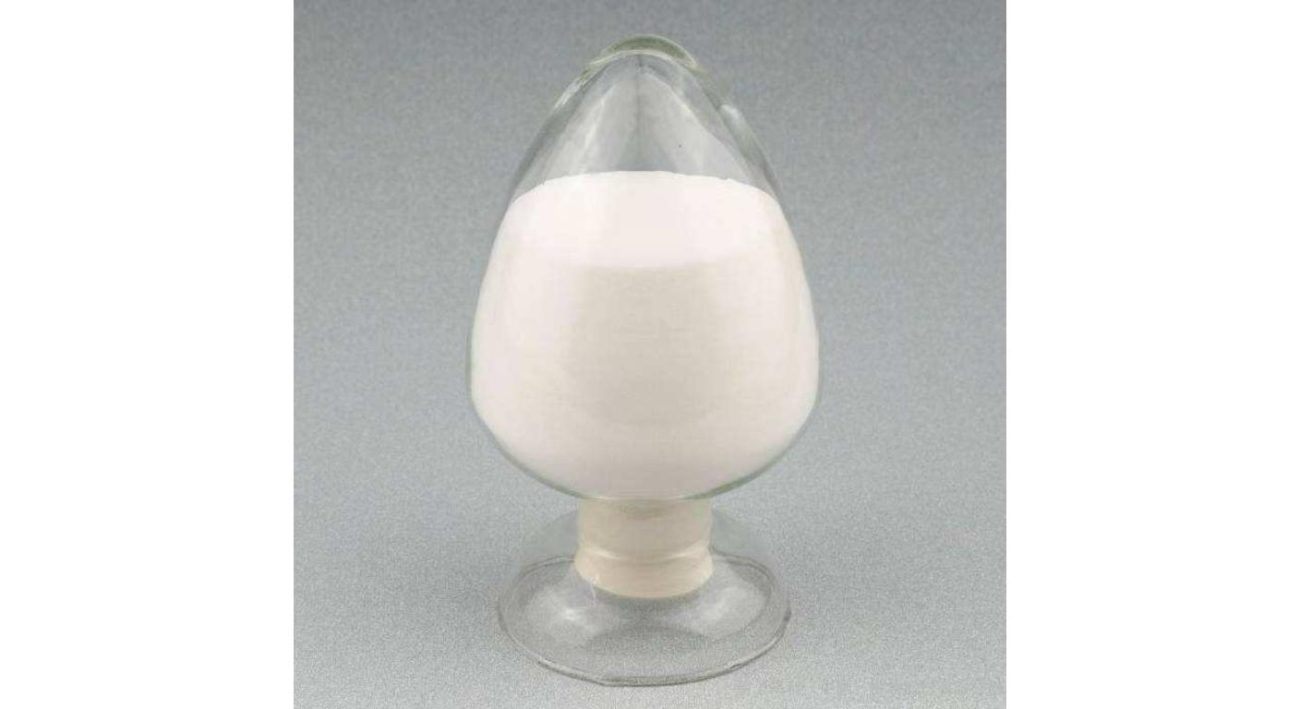
Oleoylethanolamide (OEA) is a naturally occurring Fatty-acid ethanolamide. Commercial OEA is available as a concentrated raw-material powder for selected formulated-product usage and research.
B-Thriving’s Oleoylethanolamide product is CAS No. 111-58-0, 85% OEA, HPLC tested and off white-light yellow in color. It’s commercial package listed is 25kg per drum, shelf life 2 years.
These specifications are a good starting point but an assessment from the manufacturer should link all of the values to the actual manufacturing process and commercial batch.
Verify “if the Company is the manufacturer?”
Often manufacturer, supplier, distributor and exporter are terms that are interchangeable. They are various degrees of production control.

Production should be traceable to an actual manufacturer who can describe the production steps, explain the in process controls and explain the batch manufacturing process. Even if a distributor is considered a commercial partner this should be clearly stated who is producing and releasing the material.
Inquire if production, testing, packaging and release of batches are done at the same place. When any step is outsourced, ensure that the specification is under the control of the outsourcing party, and that the quality investigations are carried out by that party.
| Verification Area | Manufacturer Evidence | Distributor Evidence |
| Production site | Facility address and production scope | Name of actual producer |
| Process control | Manufacturing flow and in-process checks | Supplier qualification records |
| Batch traceability | Production and testing records | Traceability to producer’s batch |
| Quality release | Internal QA release procedure | Producer-issued CoA |
| Deviation handling | Investigation and CAPA system | Complaint escalation procedure |
| Change control | Direct customer notification | Notification from upstream producer |
Explain the 85% OEA Specification
If the specification is an “85% OEA”, that means that the tested material contains an exact percentage of the target compound. It does not account for the other 15% which is made of other components.
The buyer should inquire about the composition of the residue, which may be related lipids, starting material residues, moisture and/or carriers or other processing components. It will impact dosage calculations, formulation behavior and supplier comparisons.
Also define if 85% is a minimum, a target or an acceptable range. The definition, in the TDS and the purchasing specification, and the actual result in the batch CoA must be the same.
Go over Manufacturing and Purification Controls
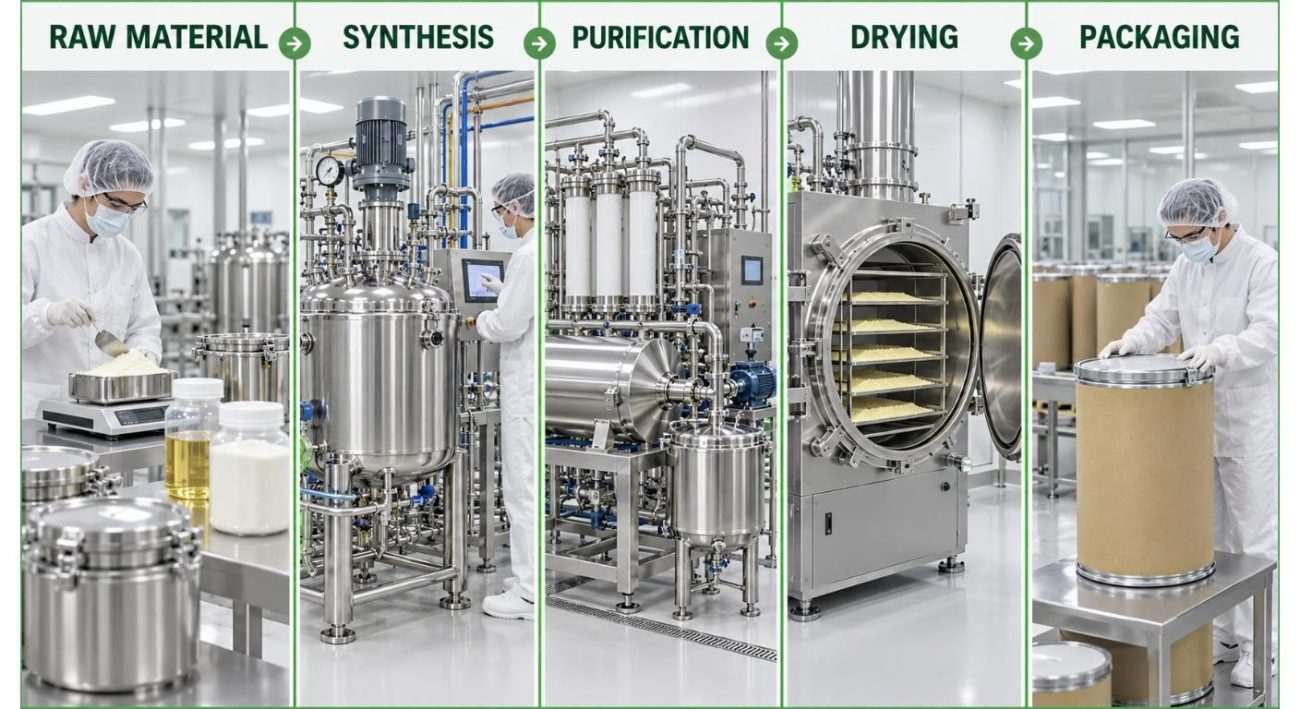
For a commercial production of OEA it is necessary to have controlled starting materials, reaction or conversion conditions, separation, purification, drying and final blending or milling. The manufacturer should make these stages clear enough for the buyer to know where the variability can come into play.
Relevant control parameters are the identity of the starting materials, completion of the reaction, removal of unreacted materials, control of related compounds, drying temperature and protection from oxidation.
You do not have to disclose confidential information to the buyer. But the manufacturer should be able to describe the critical steps that are monitored and how an OOS batch can be avoided from being released.
Verify Identity, Assay and Impurities.
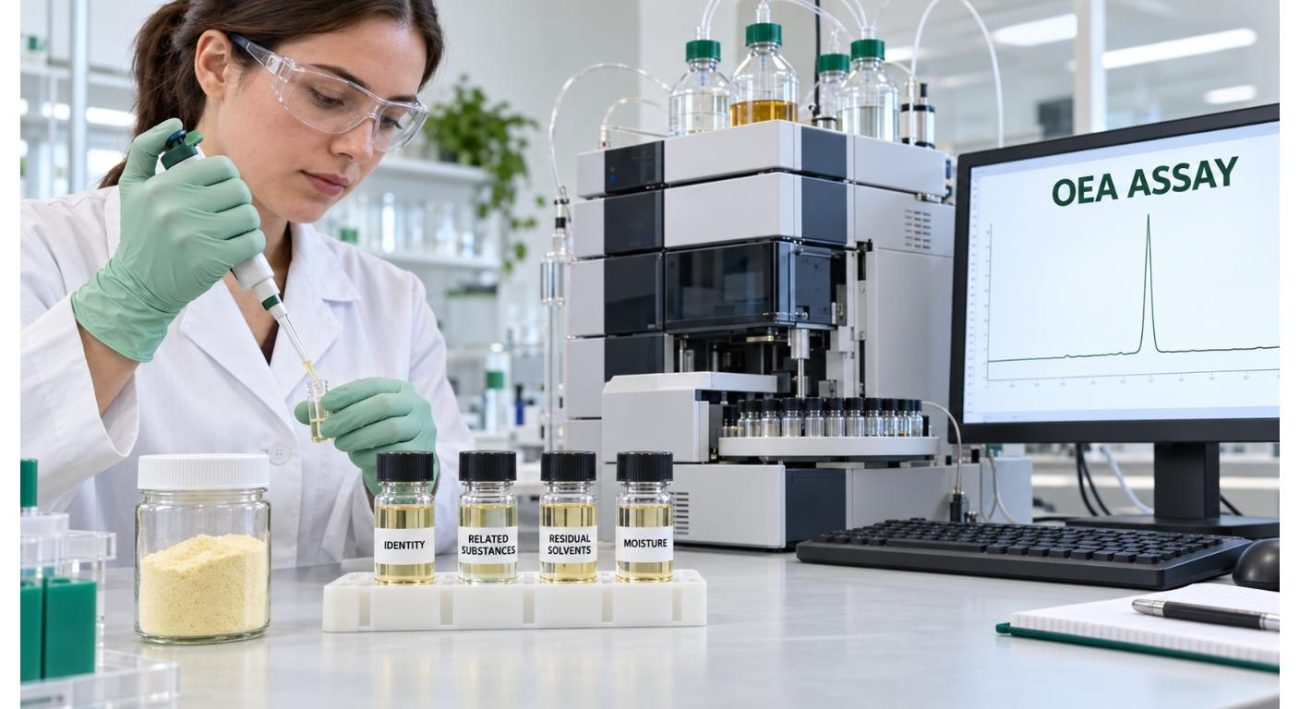
HPLC Assay is helpful in determining the amount of OEA in the product, but a percent without a method will not help. Ask the commercial specification for: Test method, Reference standard, chromatogram and acceptance limits.
Questions on identity and questions on content should be answered separately. The substance is identified by CAS number and molecular identity and a suitable identity test, and the amount of the substance is determined by HPLC assay.
Other controls can include heavy metals and limits, moisture, and residual solvents, among others. One of the assays will not mean complete purity or regulatory suitability; read B-Thriving’s guide to in-house laboratory testing.
Determine oxidation/ storage risk
As a lipid-derived compound, special care should be taken with storage and handling conditions for OEA. Sensitive materials can be impacted by heat, oxygen, light and moisture during manufacturing, storing or transporting.
Inquire about the manufacturer’s monitoring of indicators of oxidation and if stability studies have been conducted that support the proposed shelf life. Verifying the recommended temperature, packaging barrier, resealing after drum has been opened and conditions.
Packaging should be able to ensure the powder is protected during international shipping and during normal warehousing facilities. Only when used in conjunction with specific storage instructions and supporting stability data, is a two-year shelf-life statement meaningful.
Test Performance in the Intended Dosage Form (IDF)
OEA assay does not predict the behavior of the powder in capsules, tablets or blended powders. Production can be affected by particle size, bulk density, flowability and dispersibility and interactions with excipients.
Conduct a formulation trial with the proposed process and dose. On capsules, check the uniformity of the blend and the fill-weight variation. For tablets, assess compression and uniformity of the contents. In the case of powdered products, perform segregation and sensory impact testing.
If the manufacturer has a modified or carrier-like format for easier handling, request a separate specification for this format. It is not to be considered the same as the original 85% powder.
| Evaluation Item | What to Check | Acceptance Focus |
| Appearance | Color, texture and agglomeration | Matches approved sample |
| Powder flow | Movement through feeding equipment | Stable processing |
| Blend uniformity | Distribution with excipients | Consistent OEA content |
| Packaging | Seal, liner and drum condition | No moisture exposure |
| Documentation | CoA and batch-number match | Complete traceability |
| Retained sample | Storage for later comparison | Supports investigations |
Verify Batch Document and Change Control
Ask for a TDS, specification sheet, batch specific CoA and SDS if applicable. In the botanical extract TDS guide, an explanation of the difference between product level specifications and batch level test results is provided.
Review to see if the documents are consistent for product name, CAS number, content of the OEA, analytical method, appearance, storage, packaging and shelf life. The CoA batch number should match that of the shipment or sample under consideration.
Inquire about change control, too. Changes in starting materials, production site, analytical methods, limits of impurities, and major changes in production processes should be notified to customers.
Assess Scale-Up and Supply Continuity
A laboratory sample is not necessarily an indication that a manufacturer can consistently provide commercial quantities. It’s important for the Buyer to enquire for the typical batch size, available capacity, frequency of production, lead time & reserve stocks.
Determine if the sample came from a commercial batch or was separately prepared. A sample developed under different conditions may not be representative of orders to be made in the future.
Production scale should be considered along with MOQ. This B-Thriving guide on standardized ingredient minimum order quantities (MOQ) will help you understand the influence of specification, stock status and batch requirements on commercial quantities.
Use a Pilot Batch before a Full Production.
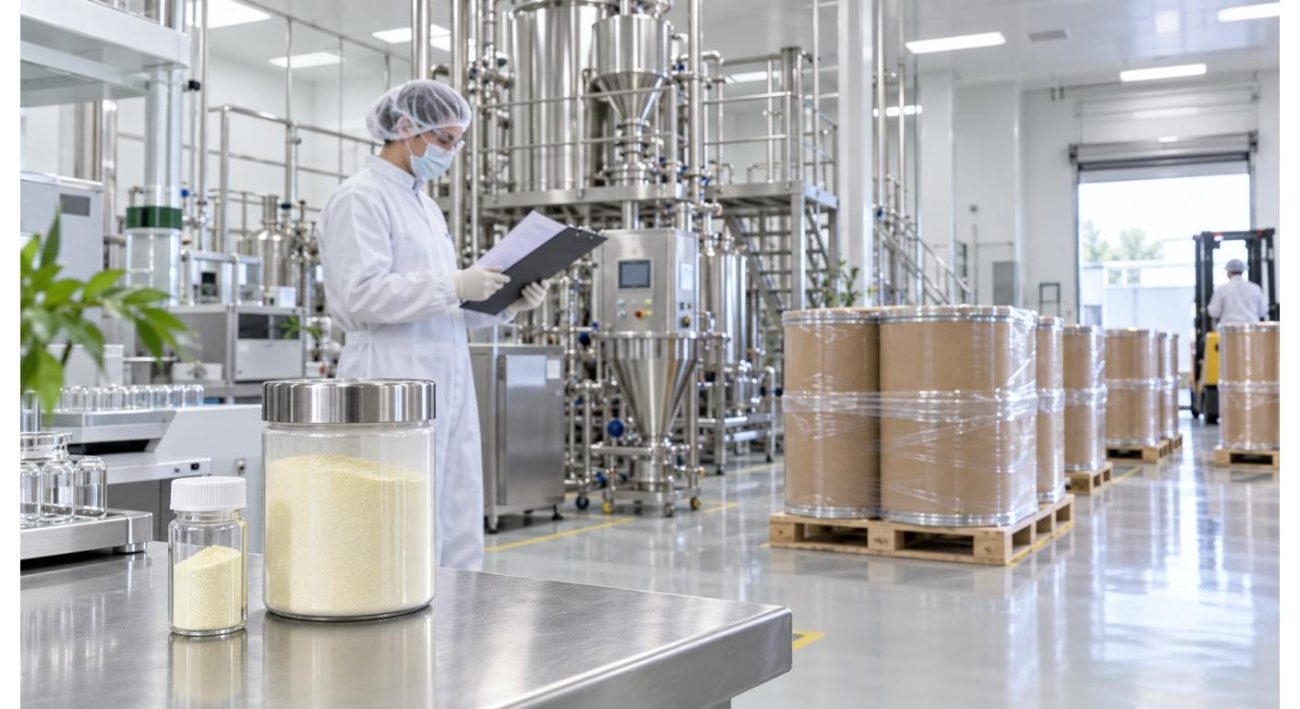
Beyond just the powder, a pilot order lets the procurement, quality and production teams try out more. They can check the integrity of packaging, accuracy of records, incoming inspection and actual manufacturing performance.
Compare the appearance, assay and impurity profile and physical behavior of the pilot batch with the approved sample. Set up written acceptance criteria prior to moving to a larger order.
Provide in the quotation OEA Content, Analytical Method, Impurity requirements, Particle size, Application, Packaging, Documentation, Order quantity/destination market.
Conclusion
A good oleoylethanolamide supplier will be able to show control from start material (crucially) through purification, testing of oleoylethanolamide, packaging, and commercial delivery.
A single 85% assay result isn’t the most important evidence. The manufacturer’s ability to explain the remaining composition and control the impurities and protect the material during storage and reproduce the agreed specification to various manufactured batches.
FAQs
Q1. What is the CAS number of Oleoylethanolamide.
The CAS No. 111-58-0 is another common name for oleoylethanolamide. This information should be verified throughout the quotation, specification, CoA and packaging by the buyer.
Q2. What is meant by 85% OEA content?
It represents the percentage of oleoylethanolamide that is declared in the material. Manufacturer should indicate or describe the rest of the composition.
Q3. Is an HPLC measurement sufficient to approve the OEA powder?
No HPLC verifies content under a stated method, other criteria buyers should consider are identity, related substances, residual solvents, and contaminants/physical properties.
Q4. Why is it important to monitor storage conditions of OEA?
OEA is a lipid derived ingredient which may be sensitive to environmental conditions. The packaging, temperature, oxygen exposure and stability evidence should be in support of the stated shelf life.
Q5. Is there a formulation that can take OEA powder without any further treatment?
Not automatically. It should be tested for flow, density, particle size and compatibility in the capsule, tablet or powder blend in which it will be used.

