

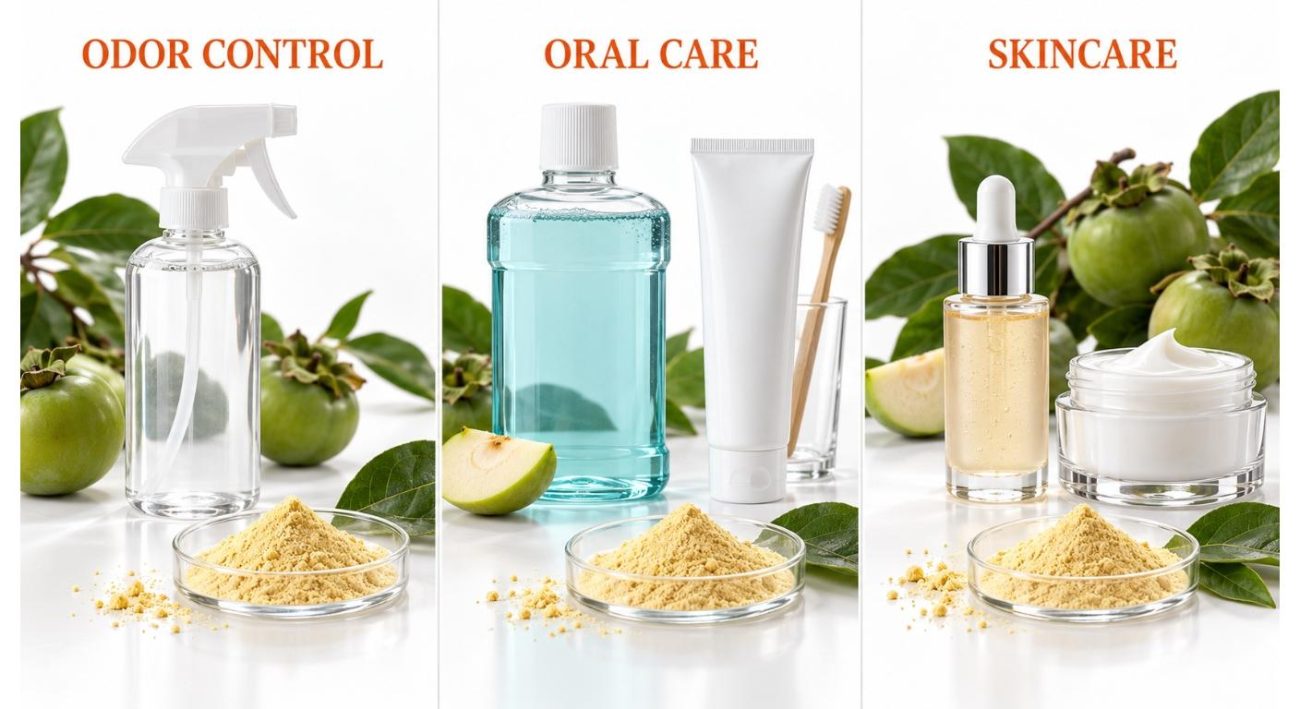
Persimmon tannin is under consideration for use in deodorizing products, oral-care formulations, cosmetics and some food and daily-chemical uses. These products may have the same ingredient name, but do not necessarily have to be made to the same specification.
An odor-control formulation may focus on the adsorption performance. The mouthwash developer will need to be particularly conscious of astringency, colour and compatibility. A skin care formulator might specialise in the pH behaviour, precipitation and sensory feel.
Thus, the first step towards a persimmon tannin supplier should be the technical function in which the tannin is going to be used – not necessarily the highest tannin percentage or cheapest price.
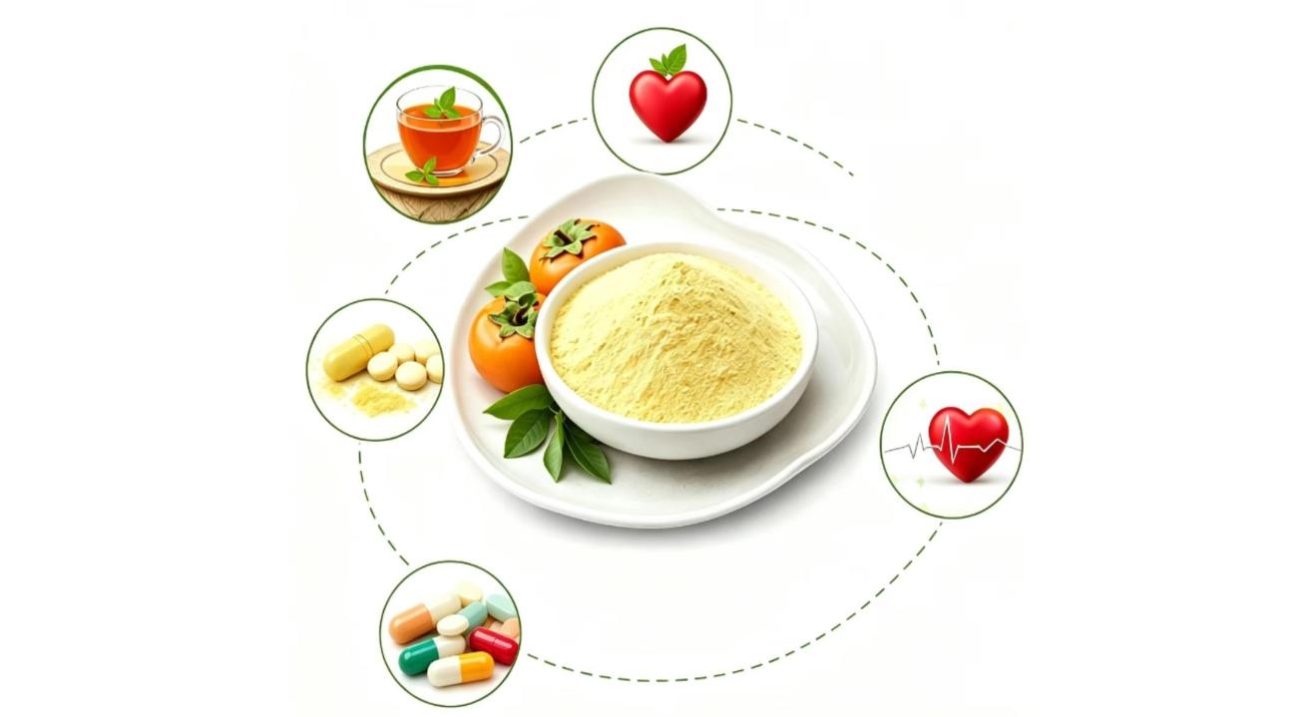
So, What is Persimmon Tannin?
Persimmon tannin is a polyphenol rich material which is isolated from persimmon fruit, sometimes from immature fruit which may have a relatively high tannin content. Commercial products are available as powder, concentrated extract or product specific to application.
Persimmon Tannin is listed as a pale-yellow fine powder that is derived from Diospyros kaki fruit and is a product of B-Thriving’s. According to the current specification, it contains 20% persimmon tannin, is tested for UV spectrometry, packaged in 25 kg drums and has a shelf life of 3 years.
This information is used to create a starting profile. It remains for the buyer to decide if the product’s tannin content can be maintained with the required formulation based on the formulation’s remaining components and physical properties.
The first step in learning about any function is to define it.
Persimmon tannin’ is not a full purchasing specification. The supplier must determine if the buyer is creating an odor-control spray, oral-care product, cosmetic or household product or another formulation.
Product format, level of use, type of solvents, pH range, processing temperature, appearance and/or undesirable sensory effects of the product should be described in the technical brief.
This will enable the supplier to suggest a suitable grade. It also does not allow for the buyer to test a general extract made for a system different from the testing required.
To know the 20% Tannin Specification
A 20% specification should state the tannin was measured on what, how the tannin result was calculated and whether the result is a minimum or a range.
Tannin or polyphenols can be estimated by UV spectrometry by a color reaction to estimate total tannin or polyphenols content. Results can vary with the test procedure, reference standard and other compounds that absorb at similar wavelengths.
Request a method summary, a reference material and a batch result. Explain the rest of the powder that consists of natural extract solids, moisture and any carrier added when the natural extract is dried.
| Application | Priority Specification | Main Formulation Concern |
| Deodorizing spray | Odor-reduction performance | Color and sediment |
| Oral-care product | Tannin level and sensory profile | Excessive astringency |
| Skincare serum | Solubility and pH compatibility | Darkening or precipitation |
| Cleansing product | Surfactant compatibility | Haze and foam changes |
| Powder product | Particle size and moisture | Caking and uneven mixing |
| Food application | Grade and sensory effect | Taste and regulatory status |
Assess the effectiveness of Deodorizing Performance with Target Odors.
Persimmon tannin can be chosen for its ability to interact with some of the compounds related to the odours. But a general deodorizing claim doesn’t indicate how the ingredient will work in a particular product.
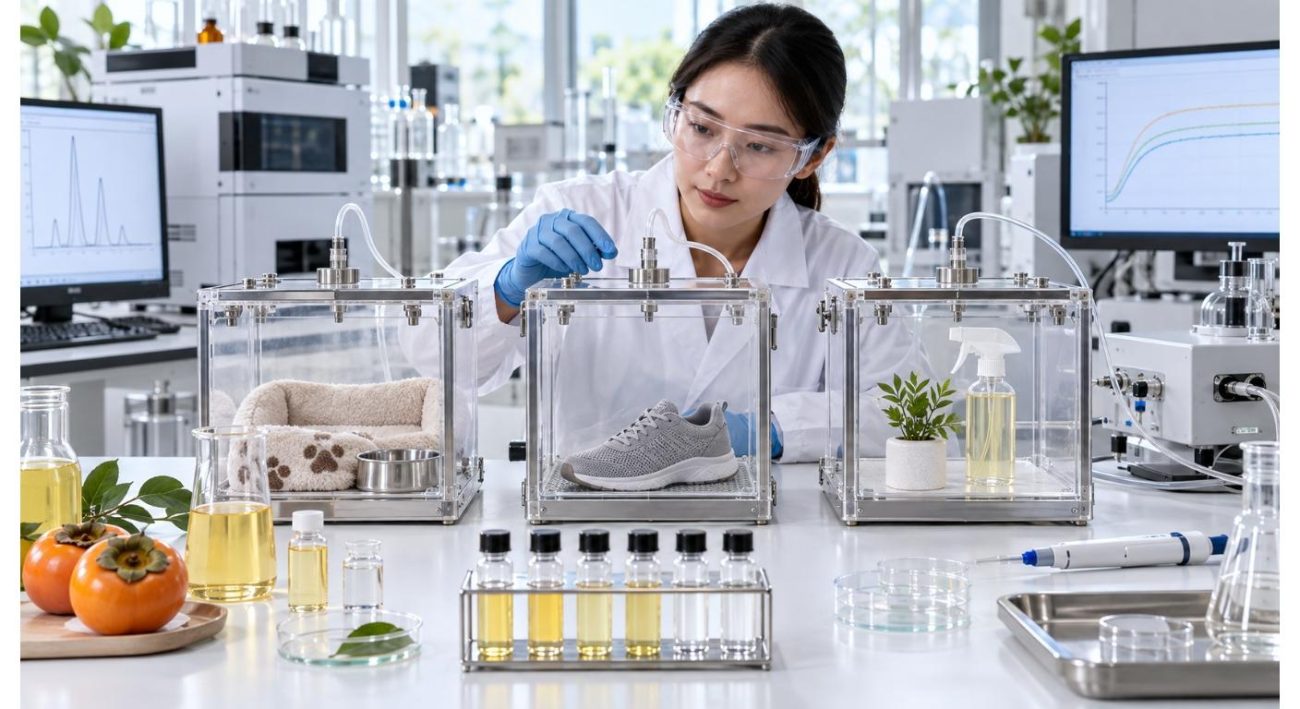
Testing should be performed using the odor system to be tested. A pet-care spray, shoe deodorizer, room product and oral-care formula all have varying amounts of ingredient exposed to different odor compounds, pH and times of contact.
Compare the amount of odor reduction at a target ingredient level to a control recipe. Also note if the tannin causes a change in color, sediments, staining or an unwanted tannin smell.
A supplier must furnish relevant data for application, if available, but performance shall be determined in the buyer’s complete formula.
Manage Astringency in Oral-Care Products
Tannins have the ability to interact with proteins and impart a dry or puckering sensation to the mouth. This can be acceptable at low levels, but can be unpleasant if it is present at too high of a concentration.
Mouthwash, toothpaste and breath-care developers should be sensory tested at the use concentration. Sweeteners and flavors can help mask the astringency, but should not be relied upon to mask too much raw-material impact.
Fluoride, mineral and surfactant compatibility as well as compatibility with flavors and preservatives should also be tested. Observe formulation during stability testing for hazing, precipitation and colour change.
Test cosmetics, daily chemicals for compatibility
For cosmetic systems, the ingredients containing polyphenols can be pH sensitive, as well as being susceptible to metal ions, oxygen and other raw materials. Even though the fresh prototype is acceptable, the formula can be dark or precipitate can form.
Try mixing different times with persimmon tannin to see which is best. Evaluate it in the real water phase, surfactant base or emulsion rather than in purified water alone.
The color and transparency limits could be critical for a clearer product. The powder may be pale and the resulting solution may not be colorless.
| Sample Check | Suggested Observation | Record as |
| Initial dispersion | Lumps or floating particles | Pass/Review |
| Solution color | Change from product baseline | Acceptable/Too dark |
| Odor control | Performance against target odor | Percentage or score |
| Astringency | Sensory intensity | Low/Medium/High |
| pH stability | Change across target range | Stable/Unstable |
| Storage stability | Sediment or discoloration | Pass/Review |
To better differentiate Persimmon Tannin and General Persimmon Extract.
The general persimmon extract cannot be considered a substitute for persimmon tannin. For a general fruit extract, the extraction ratio can be included and for a tannin product a specified tannin specification and test method should be included.
Persimmon Extract is listed separately on B-Thriving. The buyer should compare both the specifications and choose the material according to the purpose of the formulation.
It’s important that the product name, active specification, test method and application is the same throughout the quotation, sample label, TDS and CoA.
Request Application-Relevant Documents
This should include TDS, specification sheet and batch specific CoA. The botanical extract TDS guide details how these documents relate to formulation planning and batch approval, the two areas in which B-Thriving’s botanical extract TDS’s can be utilized.
Along with tannin levels, ask for moisture and microbial levels, and for levels of heavy metals and pesticide residues, if applicable. Appearance, solubility/dispersibility, packaging, storage and shelf life should also be included in the specification.
If the product to be used is intended for food, oral care or cosmetics, ensure the appropriate grade and regulatory paperwork are available for the intended destination market. Buyer’s own review of regulations can not be substituted by the supplier’s documentation.
Compare samples under conditions of the same.
One written method should be used to test the supplier samples. Maintain the same concentration of powder, solvent, pH, mixing time, temperature and period of observation.
Look at other factors besides the amount of tannin. Note down the colour and the smell and the astringency and precipitation and application performance of the solution. In some formulations, a lower assay product may be more compatible to the sensory or visual appeal.
Test samples from multiple production batches, if possible. The selected sample is not able to show the long term consistency.

Commercial Supply Terms: Read through.
Prior to approval verify minimum order quantity, lead time, normal batch size, sample availability, packaging and inventory.
For general powder sourcing needs, B-Thriving’s plant extract powder supplier guide provides an overview of the specifications, documents & commercial terms.
Tannin content, test method, appearance, physical properties, contaminant limits and requirements for packaging should be included in the final purchase specification. This will help with future deliveries to be compared with the original approved material.
Conclusion
When selecting a persimmon tannin supplier, it’s not enough to simply establish a presence of tannins. The material should provide the desired effect, but should not produce objectionable color, astringency, precipitation or stability issues.
Write the purchasing specification, based on the results of comparison and successful test, before placing a commercial order; define the application first, compare samples under the same conditions.
FAQ
Q1. What is persimmon tannin made from?
It is generally obtained from tannin-rich persimmon fruit, often immature fruit. Buyers should confirm the botanical identity, plant part and extraction process.
Q2. What does 20% persimmon tannin mean?
It indicates a declared tannin concentration measured by a stated analytical method. Confirm whether 20% is a minimum or range and review the actual batch result.
Q3. Is persimmon tannin suitable for deodorizing products?
It may be evaluated for odor-control applications, but performance depends on the odor compounds and complete formulation. Test it against the actual target odor.
Q4. Is persimmon tannin water-soluble?
Solubility or dispersibility depends on the grade, concentration, pH and formulation system. Request defined test conditions and verify the sample independently.
Q5. Can tannin affect the taste of oral-care products?
Yes. Tannins may create astringency or dryness. Sensory testing is necessary at the intended use level.

