

Two products labeled Passion Flower Extract may contain different botanical species, flavonoid profiles, and extraction residues. For supplement developers, these differences matter more than the general claim that passionflower promotes relaxation.
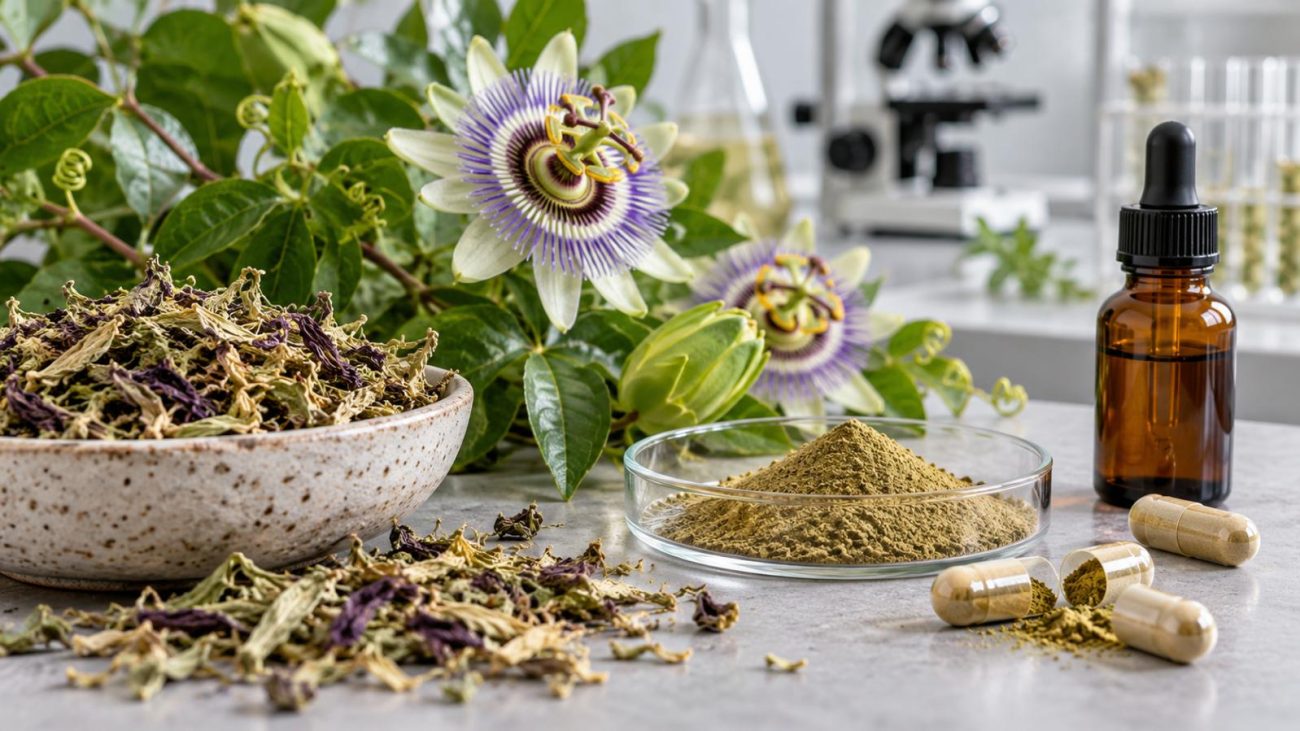
Studying Passion Flower Extract has focused on sleep and stress related symptoms. However, clinical research is limited to the botanical forms and preparations studied. Prior to including Passion Flower Extract in a sleep-support formula, the research, analytical specifications and its compatibility with the finished dosage form should be evaluated.
What is Passion Flower Extract?
Passion Flower Extract is a plant extract derived from different species of the Passiflora genus, mainly from the aerial parts of the plant (leaves, stems, flowers).
Two of the species deserve particular attention:
•Passiflora incarnata L.: which is the main species referenced in European herbal monographs and human sleep studies.
•Passiflora caerulea L.: a related species that is available as a commercial botanical extract, but is not clinically substituted for P. incarnata.
Passionflower contains flavonoids such as vitexin, isovitexin, orientin and other similar compounds. The relative proportions depend on the plant species, cultivar, harvest and the extractant.
A supplier specification should identify the plant species (not simply state “Passion Flower Extract” as the botanical source).
What Effects on Sleep does Passion Flower Extract have?
GABA Signaling and Neurological Relaxation
GABA is the main inhibitory neurotransmitter in the central nervous system and helps to regulate neuronal excitability.
A 2011 laboratory study found that a P. incarnata dry extract inhibited GABA uptake and interacted with GABA-A and GABA-B receptor binding sites.
These findings suggest possible GABA-related activity, but they do not demonstrate that all passionflower flavonoids are sedatives or that commercially available extracts produce equivalent human effects.
The distinction is important: total flavonoid concentration measures a chemical group, not clinical sleep-support potency.
What Do Human Studies Actually Show?
| Study | Findings | Limitations |
| 2011, 41 adults | Passionflower tea improved subjective sleep-quality ratings | Small sample; tea preparation |
| 2020, 110 adults | Approximately 23-minute improvement in total sleep time versus placebo | Two-week study; mixed secondary outcomes |
| 2024, 65 participants | Improvements in reported sleep time and perceived stress | Specific standardized extract; short duration |
The 2020 study used polysomnography to evaluate objective sleep parameters. Although total sleep time improved, between-group differences in sleep efficiency and wake after sleep onset were not significant.
The European Medicines Agency recognizes traditional use of P. incarnata preparations for mild mental stress and aiding sleep, while acknowledging insufficient clinical evidence for firm efficacy conclusions.
These results concern P. incarnata, not every Passion Flower Extract sold for supplement manufacturing.
Applications of Passion Flower Extract in Dietary Supplements
Capsules, Tablets, and Powder Blends
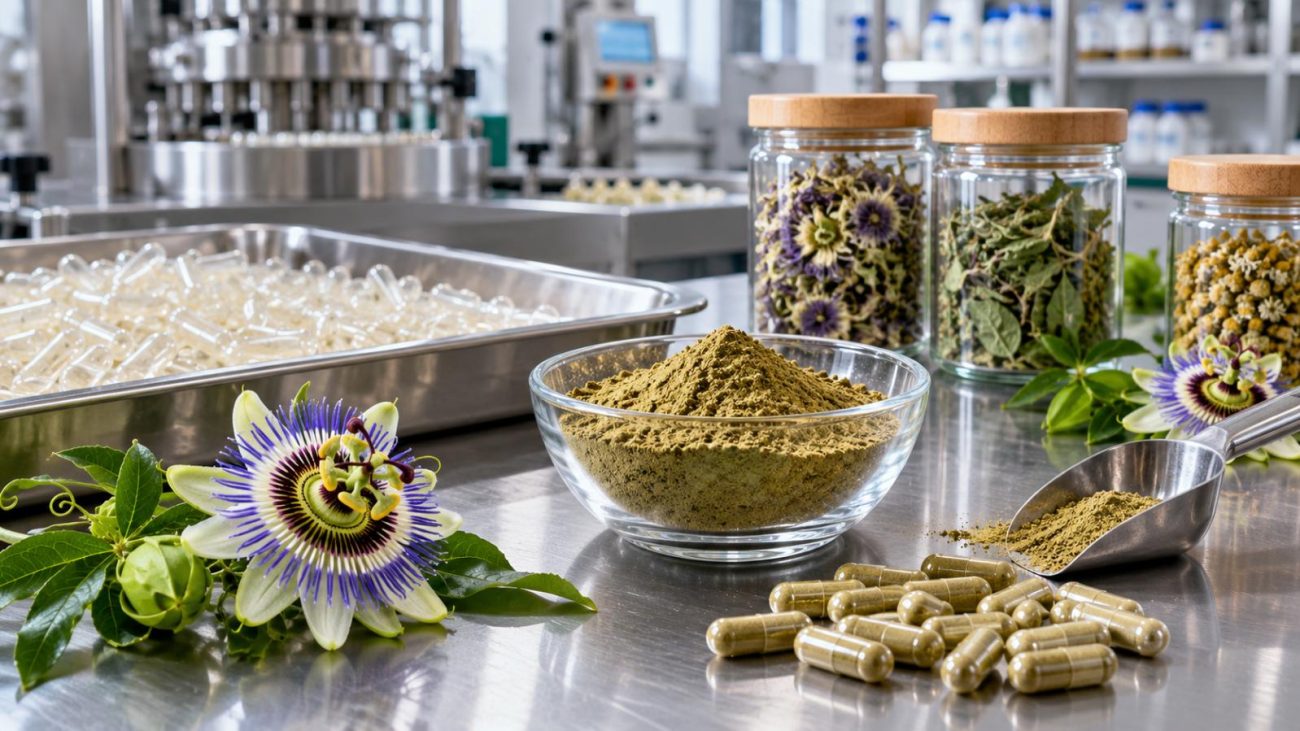
Passion Flower Extract powder can be evaluated for several oral supplement formats. Processing behavior determines whether a formulation remains consistent during manufacturing and storage.
| Dosage form | Critical properties | Validation focus |
| Hard capsules | Flowability, bulk density, particle size | Fill-weight variation, content uniformity |
| Tablets | Compressibility, moisture, excipient compatibility | Hardness, friability, disintegration |
| Powder blends | Particle distribution, hygroscopicity, flavor | Segregation, dispersibility, stability |
| Functional beverages | Solubility, pH sensitivity, flavor | Sedimentation, color changes, shelf-life stability |
Capsules may need suitable flow aids for poor-flowing botanical powders. Tablet developers should examine whether compression affects disintegration or results in inconsistent dosage units.
Fines in botanical powders do not necessarily mean water-solubility. Insoluble elements may lead to sedimentation, and botanical polyphenols may contribute bitterness and color changes.
Passion Flower Extract with Other Botanicals
Passion Flower Extract may be used in conjunction with chamomile, valerian and/or lemon balm in relaxation-style blends.
With multiple ingredients, additional considerations include:
•Are the extracts in the blends chemically and physically compatible?
•Could the effects of the sedatives in the blend overlap?
•Does the finished product meet regulatory standards for safety and efficacy?
•Will markers in the botanicals remain stable during the product’s shelf life?
Evidence for individual ingredients cannot automatically substantiate a multi-herb product.
How to Evaluate Passion Flower Extract Quality
Botanical Identity and Flavonoid Standardization
At B-Thriving, our published Passion Flower Extract specification identifies the following characteristics:
| Parameter | B-Thriving specification |
| Botanical name | Passiflora caerulea L. |
| Plant part | Aerial parts |
| Flavones | 4% |
| Analytical method | UV spectrometry |
| Appearance | Brown-yellow fine powder |
| Standard packaging | 25 kg/drum |
These are ingredient specifications, not clinical efficacy claims.
UV Spectrometry versus HPLC Testing
Typically, UV-Vis spectrophotometric measurements yield qualitative and/or semi-quantitative estimation of flavonoid content. However, a number of factors, including sample and standard preparation, type of solvent, use of a proper reference, and measurement conditions, can also influence results.
HPLC or UHPLC can achieve much better separation than UV spectrometry, and therefore can be used for more sophisticated botanical fingerprinting and marker analysis.
4% UV measured flavones do not mean the presence of 4% vitexin in the powder.
2025 analytical study on commercial P. incarnata products identified many dietary supplements containing botanical identity and composition discrepancies.
For reliable qualification of ingredients, it is suggested to combine chromatographic fingerprinting with quantitative analysis.
Prior to Formulation What Should Buyers Request?
When researching a Passion Flower Extract supplier, there are a number of areas that deserve attention. They are:
•Identity: botanical name and plant part, traceability and/or authentication method.
•Composition: analytical method, extraction detail, markers.
•Purity: Residual solvents, heavy metals, pesticides, microbes, solvents and residues.
•Processing: Bulk density, moisture, carrier and/or excipient, particle size.
•Documentation: Batch COA, specification and regulatory documents.
During the development of a process, most focus is given to the initial specification. Pilot batches of Passion Flower Extract, however, should be evaluated based on marker and/or moisture stability and content uniformity rather than initial specifications.
Discuss Your Passion Flower Extract Requirements with B-Thriving
Consider Passion Flower Extract’s botanical identity, analytical specifications, and requirements for the intended formulation, when performing your assessment.
B-Thriving contains Passiflora caerulea extract standardized to 4% flavones. Contact us for more details and documentation for your specification and quality needs.
FAQs
Q1. What is B-Thriving’s Passion Flower Extract made from?
B-Thriving’s Passion Flower Extract is derived from the aerial parts of Passiflora caerulea L. It is supplied as a brown-yellow fine powder standardized to 4% flavones.
Q2. Is B-Thriving’s Passion Flower Extract clinically proven to improve sleep?
No. Published sleep studies primarily involve Passiflora incarnata. B-Thriving supplies Passiflora caerulea extract, and clinical results from another species cannot automatically establish its sleep-support efficacy.
Q3. How might Passion Flower Extract support relaxation?
Laboratory studies of Passiflora incarnata suggest interactions with GABA-related pathways. However, these mechanisms have not been established for every Passion Flower Extract preparation, including B-Thriving’s specific product.
Q4. What is the flavonoid content of B-Thriving’s Passion Flower Extract?
B-Thriving specifies 4% flavones, measured using UV spectrometry. This value is a compositional quality parameter, not a confirmed clinical potency or sleep-support efficacy rating.
Q5. Does B-Thriving use HPLC to test Passion Flower Extract?
The specification offers UV spectrometry for flavone measurement. Buyers requiring HPLC fingerprints or individual compound analysis should confirm testing availability directly with B-Thriving.

