
A sensitive-skin serum may pass stability testing and still sting on application. Adding Chamomile Extract does not automatically solve that problem. Its chemical profile, carrier, use level, and interactions with the rest of the formula determine whether it belongs in a sensitive-skin product.
At B-Thriving, we approach Chamomile Extract as a raw material requiring characterization, not as a substitute for finished-product tolerance testing.
Why Consider Chamomile Extract for Sensitive Skin in 2026?
A botanical ingredient can’t solely depend on a natural label claim to be successful. What are the challenges for the formulator for barrier focused creams and cleansers?
•Related Chemistry: Components relating to anti-oxidant or inflammatory activity.
•Reliable Supply: Specifications that allow comparison to be made when evaluating incoming batches.
•Efficient Formulation: Color and odor acceptability, solubility, and tolerance in the final formulation.
Is Chamomile Extract worth looking into in relation to these criteria? What is the evidence for benefit that isn’t apparent from the plant name?
What Does Chamomile Extract Contain—and What Does It Do?
German chamomile (Matricaria chamomilla) contains flavonoids and volatile terpenoids. The extraction process determines which fractions appear in the ingredient delivered to a cosmetic laboratory.
| Active Constituent | Technical Relevance | Important Limitation |
| Apigenin and its glycosides | Flavonoids investigated for antioxidant and inflammation-related pathways | Assay definition and bioavailability matter |
| α-Bisabolol | Lipophilic constituent studied for skin-soothing activity | Not necessarily present at meaningful levels in every extract |
| Chamazulene | Component associated with distilled chamomile oil | Not an appropriate assumed marker for all powdered extracts |
Apigenin and Skin-Soothing Research
Apigenin is a useful analytical marker, not proof of a clinical outcome. Cell-based findings about inflammatory signaling cannot establish that a particular Chamomile Extract will reduce facial redness in a finished cream.
The dose delivered to skin, ingredient matrix, and study design all matter.
Why the Extraction Method Changes the Ingredient
Water and aqueous-ethanol systems recover different proportions of polar constituents. Steam distillation, by contrast, concentrates volatile components and can generate chamazulene from matricin.
Drying and carriers may further influence powder flow, dispersibility, and appearance.
Before formulation, clarify whether the supplier’s apigenin assay measures free apigenin or total apigenin after a defined analytical preparation. An extract ratio such as 10:1 does not establish flavonoid potency.
Chamomile Extract vs. Chamomile Essential Oil
| Decision Factor | Chamomile Extract | Chamomile Essential Oil |
| Chemical profile | Solvent- and process-dependent | Volatile, lipophilic fraction |
| Formulation concern | Solubility, carrier, sediment, color | Solubilization, oxidation, fragrance allergens |
| Quality assessment | Marker assay and compatibility | Composition profile and sensitization risk |
Neither is automatically non-irritating. A low-odor Chamomile Extract may suit some fragrance-minimized products, but its actual odor and ingredient declaration must be checked.

Where Does Chamomile Extract Fit in Sensitive Skin Formulations?
| Application | Potential Function | Development Checkpoint |
| Barrier-support cream | Complement humectants and emollients | Emulsion stability and sensory tolerance |
| Water-based serum | Botanical skin-conditioning component | Dissolution, haze, precipitation |
| Gentle cleanser | Support a mild-positioned formula | Surfactant interactions and rinse-off exposure |
| Hydrating mask | Complement skin comfort and hydration | Preservation and contact-time tolerance |
Chamomile Extract does not repair a harsh surfactant system or compensate for a poorly designed preservative package.
Its use level should be established through supplier guidance, safety assessment, and formulation testing—not copied from another product category.
What Should Formulators Test Before Scale-Up?
1. Botanical Identity and Incoming Quality
Make sure the declared Latin name is correct, verify the extracted flower part, check the carrier, extraction solvent and review the batch-specific COA. Verify the declared INCI name.
2. Physical Compatibility
Make sure haze, sediment and color drift are acceptable at the intended concentration. Observe haze, sediment, and color drift across the finished formula’s pH.
3. Storage Stability
Assess appearance, odor, viscosity, and phase separation at justifed accelerated conditions and real time storage. Botanical color can shift without an obvious change in viscosity.
4. Microbial Control
Evaluate bioburden of Chamomile Extract, and perform preservative efficacy testing (if applicable) to finished product.
5. Skin Tolerance
Evaluate the risk of sensitization and irritation using an appropriated safety strategy based on the product. Researching raw materials does not prove the efficacy of the final product.
B-Thriving Chamomile Extract: Published Specifications
Our Chamomile Extract product page identifies Matricaria chamomilla flower as the botanical source and lists the following specifications:
•Active ingredient: Apigenin 1.2%
•Analytical method: HPLC
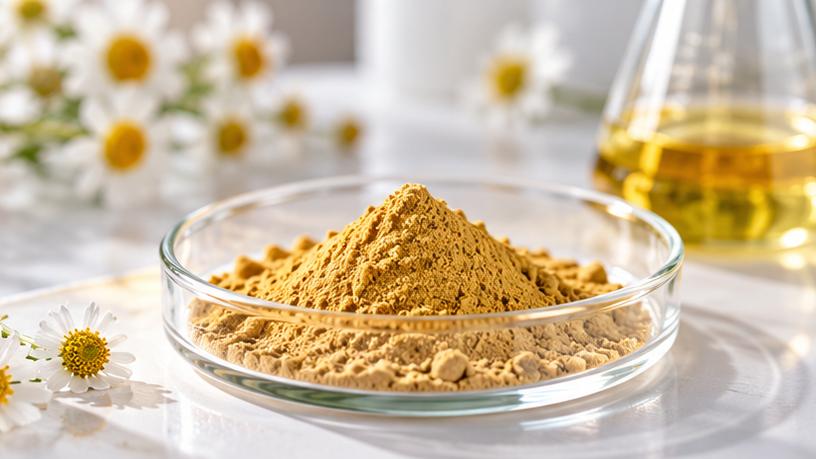
•Appearance: Yellow-brown fine powder
•Packaging: 25 kg/drum
These provide useful starting specifications, not a guarantee of finished-product skin benefits.
For sensitive-skin projects, we recommend checking the batch COA and confirming compatibility, use level, and tolerance before approving a formula.
A well-chosen Chamomile Extract should survive scrutiny at the laboratory bench as well as on the ingredient label. Explore B-Thriving Chamomile Extract and contact our team to discuss the documentation needed for your formulation.
FAQs
Q1. What is B-Thriving Chamomile Extract made from?
B-Thriving Chamomile Extract is derived from the flowers of Matricaria chamomilla. It is supplied as a yellow-brown fine powder with a specified apigenin content of 1.2%.
Q2. Is B-Thriving Chamomile Extract suitable for sensitive skin products?
B-Thriving Chamomile Extract can be evaluated for sensitive skin formulations, including creams and cleansers. Final suitability depends on concentration, formulation compatibility, and skin tolerance testing.
Q3. What active ingredient is standardized in B-Thriving Chamomile Extract?
B-Thriving specifies 1.2% apigenin, a naturally occurring flavonoid studied for antioxidant and inflammation-related activity. The published test method is HPLC.
Q4. What is the difference between B-Thriving Chamomile Extract and chamomile essential oil?
B-Thriving Chamomile Extract is a powdered botanical ingredient standardized for apigenin. Chamomile essential oil mainly contains volatile compounds. Their composition, solubility, and formulation requirements differ.
Q5. Can B-Thriving Chamomile Extract be used in facial serums?
It may be evaluated for facial serums, but its solubility, carrier composition, clarity, and stability must first be confirmed. Compatibility with a particular serum formula is not guaranteed.

