
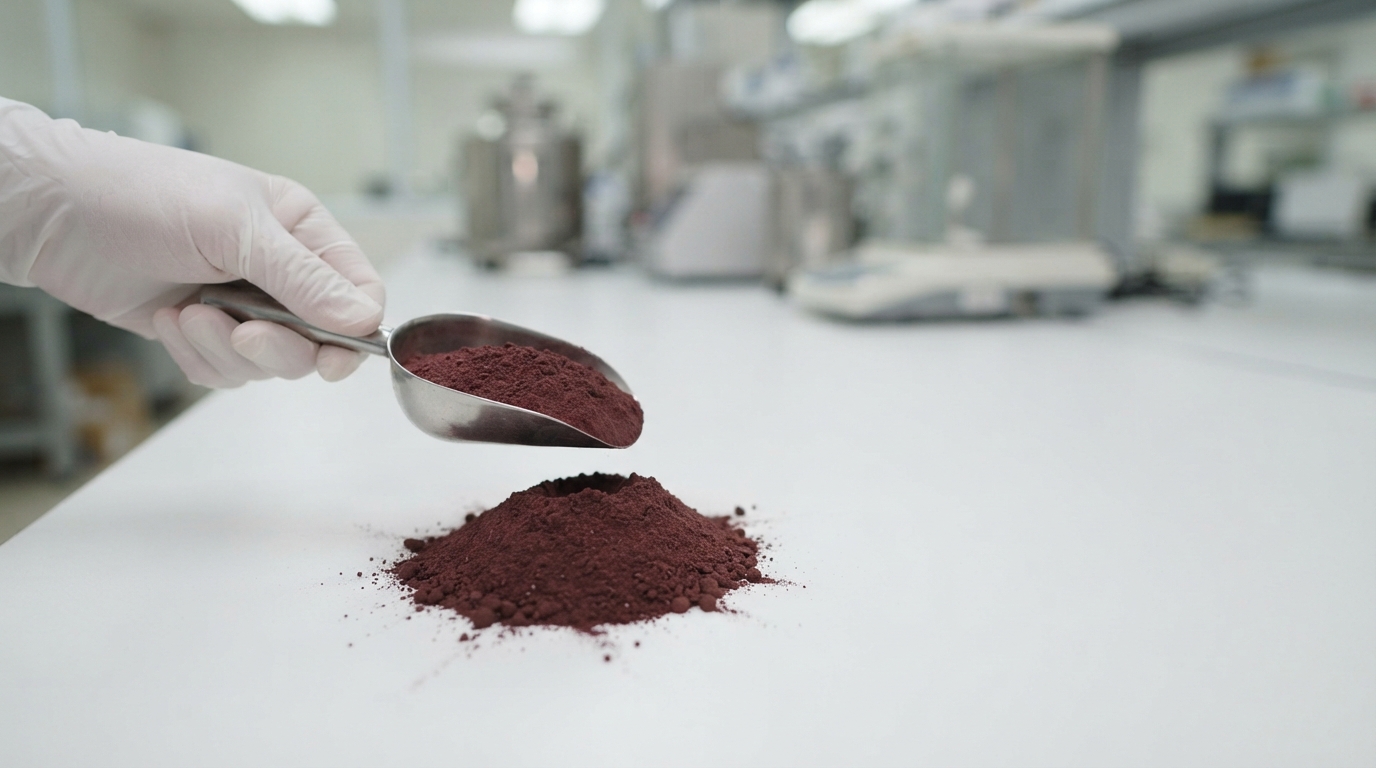
For a manufacturer, choosing a bulk PQQ powder supplier starts with one requirement: the supplier must be able to prove exactly what is in the material and what each batch contains. A purity claim on a product page is not evidence. A batch-specific Certificate of Analysis, a Technical Data Sheet, and a clear specification are the documents that matter.
This guide focuses on raw-material sourcing for manufacturing. It explains what to verify before you request a sample, compare quotations, or place an order. For the broader biological background, see the function of pqq.
PQQ Powder: Product Identity and Supplier Terminology
PQQ stands for pyrroloquinoline quinone, a redox-active quinone compound studied for its role in cellular energy metabolism. In bulk raw-material trade, the same ingredient is often listed as PQQ, pyrroloquinoline quinone, or PQQ disodium salt. Those names are not always interchangeable on a specification sheet.
| Term | What it means | Why it matters |
|---|---|---|
| PQQ | Pyrroloquinoline quinone, the compound family you are sourcing | Establishes the basic ingredient identity |
| PQQ disodium salt | A salt form of PQQ that appears frequently in bulk raw-material listings | Confirms the exact chemical form when it appears on the product and CoA |
| Bulk PQQ powder | The raw material delivered to your facility, not a finished consumer product | Determines which specifications, documentation, and tests you need |
PQQ vs. PQQ Disodium Salt: Why the Distinction Matters
Many bulk suppliers describe the same product in different ways. One may call it “PQQ powder,” while another lists “PQQ disodium salt.” The difference is not just naming preference: the exact form affects formulation behavior, solubility, and how the material should be documented.
When you evaluate a supplier, do not rely on the product-page name alone. The name on the quotation, the Certificate of Analysis, the Technical Data Sheet, and the physical label should all match. If the material is supplied as the disodium salt, that form should be stated consistently across the documents.
Verifying the CAS Number and Molecular Formula
CAS numbers and molecular formulas are useful identity checks, but only when they are tied to the actual product documentation. Different suppliers may list different identifiers, so the safest step is to ask for the exact CAS number and molecular formula shown on the current CoA or TDS and compare them with the batch you receive.
Neutral chemical records can help with this review. PubChem maintains chemical records for both pyrroloquinoline quinone and PQQ disodium salt. Use those records to confirm naming and chemical identity, not to verify a particular supplier’s batch.
Bulk PQQ Powder Specifications and Test Methods
Once the identity is clear, the next step is to review the specifications that will affect your formulation, quality program, and supply chain. The table below shows the parameters that matter most for bulk PQQ powder and what you should request from a supplier.
| Parameter | Why it matters | What to request |
|---|---|---|
| Assay | Measures the amount of target compound in the batch | Batch-specific value and the analytical method used |
| Purity | Describes composition, but only meaningful when tied to a method | Clarify whether “purity” means assay, chromatographic purity, or another measured value |
| Appearance | Helps with identity checks during receiving | Color and physical form from the TDS |
| Solubility | Important for beverages and liquid formulations | Solvent and test conditions used |
| Moisture | Affects stability and blending behavior | Moisture value in % from the CoA or TDS |
| Particle size | May affect flow and blending | Mesh or micron value if relevant to your process |
| Shelf life | Sets inventory limits and storage planning | Stated shelf life from the TDS |
| Storage conditions | Controls stability over time | Temperature, light, and moisture protection requirements |
Assay, Purity, and HPLC Testing
Assay and purity are not the same thing. An assay measures the amount of the target compound in the batch, usually as a percentage. “Purity” may refer to assay, or it may describe a separate chromatographic result. A supplier can write “99% pure” on a product page, but that claim has meaning only when a documented method supports it.
HPLC is a common analytical method for this type of material, but the supplier should state which method was used, which reference standard was used, and where the result is recorded. The assay result should always be traceable to a batch, not just to a general product description.
Appearance, Solubility, Moisture, and Particle Size
Physical properties should not be overlooked. Appearance helps receiving teams compare incoming material against the approved sample. Solubility matters if the powder will be used in a beverage or liquid application. Moisture content can affect stability and blending, and particle size may influence flow and tableting.
None of these values should be guessed from a typical product description. They should come from the supplier’s TDS or batch documentation. If a supplier cannot provide them, treat that as a gap in the qualification process.
Shelf Life, Storage, and Packaging Requirements
Ask for the stated shelf life and the required storage conditions before you commit to an order. PQQ powder should be handled according to the supplier’s instructions, usually with attention to moisture, light, and temperature. Packaging should protect the material during transit and warehouse storage, and the packaging description should be confirmed on the quotation.
CoA, TDS, and Batch Traceability

Two documents do most of the work in supplier evaluation: the Certificate of Analysis and the Technical Data Sheet. They answer different questions, and manufacturers need both.
CoA vs. TDS: What Each Document Tells You
| Document | What it covers | How it is used |
|---|---|---|
| Certificate of Analysis (CoA) | Batch-specific test results | Verifies what a particular batch contains and whether it meets specification |
| Technical Data Sheet (TDS) | Product-level physical/chemical properties | Describes handling, storage, shelf life, and general product specifications |
A CoA should change with each batch. A TDS should describe the product consistently. If a supplier provides only one of the two, ask for the missing document before moving forward.
What to Check in a PQQ Batch CoA
A useful CoA should include more than an assay percentage. Review it for the following:
- Product name and form, such as PQQ disodium salt if that is the material being supplied
- Batch number
- Manufacturing date and release date
- Assay result and the analytical method used
- Appearance
- Moisture value if applicable
- Residual solvents, heavy metals, or other contaminant results if relevant to your application
- Authorized signature or release status
If important fields are blank, ask why. A CoA that cannot be matched to a specific batch does not provide batch-level assurance.
How to Qualify a Bulk PQQ Supplier
Supplier qualification should follow a consistent process, not a product-page impression. A simple workflow is more reliable than a detailed sales conversation.
- Request the current CoA and TDS. Review them before discussing price or MOQ.
- Confirm identity. Check product name, form, CAS number, and molecular formula across both documents.
- Review the assay and method. Determine whether the result is batch-specific and which analytical method was used.
- Check batch traceability. Ask how the CoA is linked to the physical batch you will receive.
- Request a sample. Evaluate appearance, handling, and formulation behavior in your own conditions.
- Verify certificates by scope. Ask for certificate number, issuing body, product applicability, and validity.
- Compare quotations using the same product definition. Do not compare bids if the product form or specification differs.
Red Flags and Claims That Need Verification
Some supplier claims deserve extra scrutiny:
- A CAS number or molecular formula that changes between the product page, quotation, and CoA
- A CoA that does not name the actual product form or batch number
- Blank fields for method, appearance, or release status
- Certification claims such as GMP or ISO without a certificate number, scope, issuing body, or validity period
- Broad energy, cognition, or fatigue claims with no study context or regulatory basis
- A specification sheet that appears to be copied from another supplier
None of these automatically disqualify a supplier, but each one should be resolved before you order.
Commercial Terms to Clarify Before Ordering
The final qualification step is commercial. Even a technically excellent product can fail if the supply terms do not match your manufacturing needs.
Ask for clear answers on the following:
- Minimum order quantity
- Lead time from order to shipment
- Packaging format and package sizes
- Sample policy and whether samples include the current CoA
- Retained-sample policy for batch traceability
- Quotation details, including product name, batch, assay, quantity, unit price, packaging, and delivery terms
- Shipping and incoterms
- Documentation included with the shipment
A quotation should name the same product and specification you approved during qualification. If the quotation describes a different product form or a different assay, the approval process needs to start over.
Matching PQQ Powder to Your Application

The right PQQ powder specification depends on what you are manufacturing. The table below summarizes common application considerations.
| Application | Main specification concerns | Documentation or regulatory concerns |
|---|---|---|
| Dietary supplements | Assay, appearance, flow and blending behavior | Ingredient status in the target market |
| Functional foods and beverages | Solubility, moisture, taste and color impact | Food-use approval and labeling requirements |
| Sports nutrition | Assay, solubility, batch consistency | Sports-ingredient rules vary by market |
| Healthy-aging or longevity formulas | Same raw-material controls as supplements | Benefit claims must be supported and reviewed |
| Cosmetics or personal care | Solubility, purity, formulation compatibility | Cosmetic ingredient rules and safety data |
The application determines which specifications matter most. A beverage formulator will care more about solubility and regulatory status, while a supplement manufacturer may focus on blending behavior and batch consistency.
Regulatory and Quality Verification for Worldwide Buyers
PQQ status is not the same in every market. A supplier’s claim that an ingredient is approved, GRAS, or novel-food compliant should be verified for the specific ingredient form, the intended use, and the destination country.
Certifications such as GMP, ISO, USDA Organic, Halal, or Kosher should not be accepted at face value. Ask for the certificate scope, certificate number, issuing body, product applicability, and validity period. A company-level certificate does not automatically mean every product line is covered.
Benefit-related claims also need careful review. A marketing summary is not the same as the underlying study. For example, the study context behind pyrroloquinoline quinone disodium relieves fatigue is more useful than a promotional headline when you are evaluating evidence.
Work with regulatory counsel or a qualified compliance specialist for the markets you plan to serve.
Next Steps: Requesting a Sample, Specification, and Quotation
Before you contact a supplier, decide what you need to produce and which specifications matter most for that application. Then request the documents that prove the material fits: a current CoA, a TDS, packaging details, MOQ, lead time, and a sample.
If you are ready to evaluate B-Thriving’s PQQ supply, contact B-Thriving directly with your intended application, target quantity, and destination market. Ask for a current CoA, TDS, packaging details, minimum order quantity, lead time, and sample availability. That information will let you compare the material against your own qualification criteria before you commit to an order.

