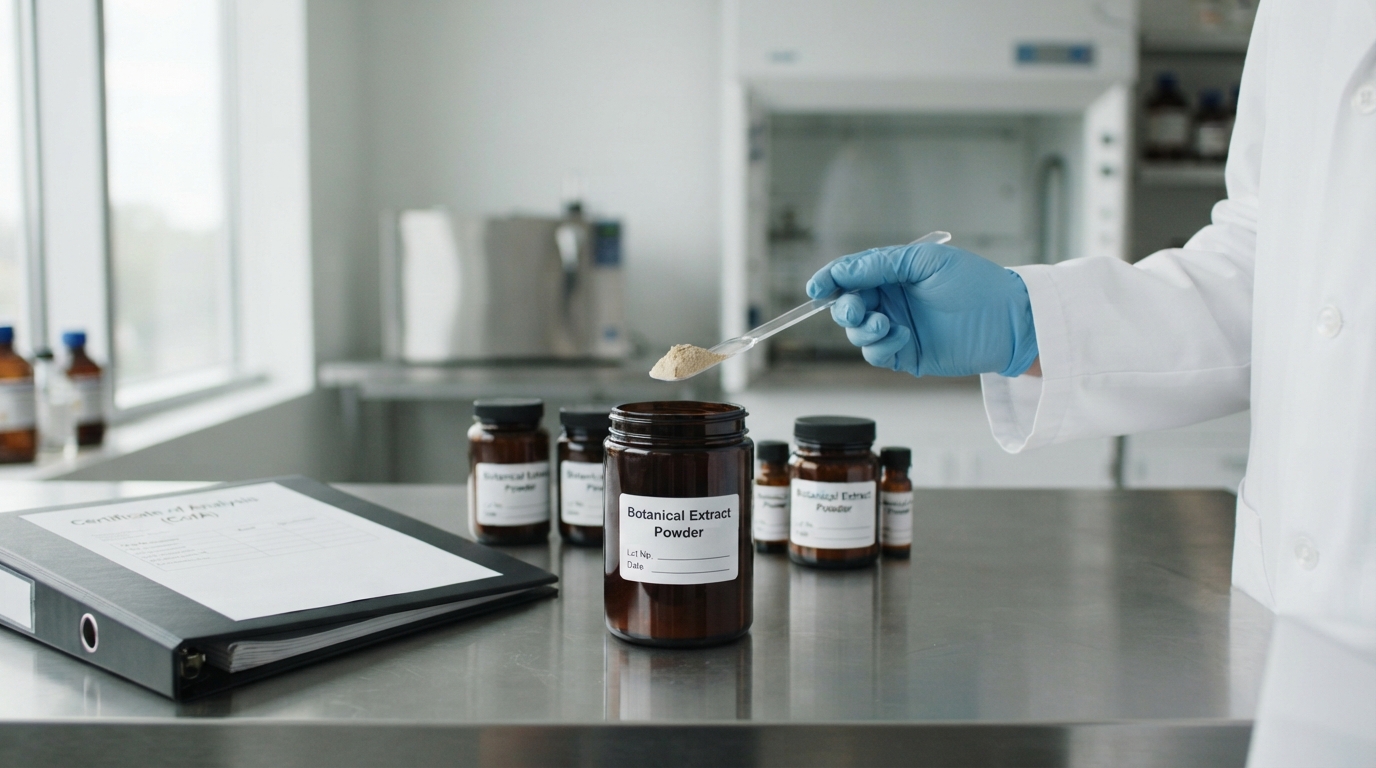
Plant extracts for beauty supplements are botanical preparations used as dietary ingredients in ingestible products positioned to support skin, hair, or nail health. When sourcing them, formulators cannot rely on a trending botanical name alone: the right choice depends on plant identity, extraction method, standardization, physical form, quality documentation, safety evidence, and supplier capability.
This guide focuses specifically on ingestible beauty supplements, not topical skincare. It gives formulators and sourcing managers a practical framework for specifying, comparing, and qualifying botanical extracts for beauty-from-within formulations.
What Are Plant Extracts for Beauty Supplements?
A plant extract is a concentrated preparation made from botanical material, usually by soaking the plant in a solvent such as water or ethanol, then separating the liquid from the plant tissue. The resulting extract may be used as a liquid or dried into a powder for capsules, tablets, and other supplement formats. The NIH Office of Dietary Supplements notes that botanical preparations can differ in strength and concentration depending on how they are made. Some products are also standardized so that batches contain a consistent amount of a measured marker chemical.
A beauty supplement, in this context, is an oral dietary supplement marketed or positioned around skin, hair, or nail support. That positioning matters: plant extracts used in topical cosmetics are not automatically suitable for oral use. Formulators must evaluate each extract for oral safety, processing fit, and the evidence required to support the finished product’s claims.
Product concepts frequently explore botanical sources such as green tea, grape seed, pomegranate, gotu kola, horsetail, bamboo, or other polyphenol- and silica-rich plants. But the ingredient name is only the beginning. The useful question is not just which plant, but which part of the plant, extracted with what solvent, standardized to which marker, and documented with what evidence.
How Plant Extracts Are Made: Source, Extraction, and Standardization
Understanding the production steps helps formulators ask better questions before committing to a supplier.
- Select the source plant and plant part. Roots, leaves, flowers, seeds, fruits, and bark can produce very different chemical profiles. A formulator should know the exact botanical species and the part used.
- Extract the material. The botanical is typically soaked or percolated with a solvent. Water, ethanol, and hydroethanolic mixtures are common. The solvent affects which constituents are pulled from the plant and how the final extract behaves.
- Concentrate, dry, or retain as liquid. The extract may be dried to a powder, concentrated into a paste or liquid, or further processed to a defined physical form. This decision affects downstream supplement manufacturing.
- Standardize where appropriate. Standardization involves measuring a marker compound and adjusting the extract so batches contain a consistent level of that compound. The NIH notes that standardization may involve identifying and measuring marker chemicals and adjusting batches to achieve consistent amounts.
- Test and document each batch. Batch-specific testing, such as HPLC or UV analysis, can confirm identity and marker content. A complete Certificate of Analysis (CoA) documents what that particular batch contains.
Extract Ratio vs Standardized Potency: What the Numbers Actually Mean
One of the most common sourcing mistakes is treating an extract ratio as if it were a potency percentage.
| Term | What it describes | Example | What it does not tell you |
|---|---|---|---|
| Extract ratio | The amount of starting botanical material relative to the resulting extract | 10:1 means 10 parts of plant material produced 1 part of extract | The concentration of any specific active or marker compound |
| Standardized potency | The measured amount of a stated marker or compound in the extract | “Standardized to 4% marker” means the extract contains 4% of that marker by an agreed test method | Whether that marker is responsible for the desired effect |
| Purity | The degree to which the material is free from other substances | 95% purity means 95% of the material is the stated compound | The strength or clinical relevance of the compound |
| Concentration | The amount of an ingredient in a dose or serving | A formula may contain 100 mg of dry extract per capsule | How much marker or active compound is actually delivered |
A 10:1 extract is not automatically “stronger” than a 4% standardized extract. A 10:1 ratio describes input and output, while standardized potency describes a measured marker. To compare two extracts, the formulator needs the marker or compound assay, the analytical method, and the dosage calculation.
Key Specifications: Potency, Purity, Particle Size, Solubility, and Stability
A complete botanical-extract specification includes more than a percentage. Formulators should evaluate several physical and chemical characteristics before approving an ingredient.
| Specification | What it affects | What to ask the supplier |
|---|---|---|
| Potency / marker content | Dosing consistency and batch comparability | Which marker is measured, by what method, and what target range? |
| Purity | Contamination risk and ingredient authenticity | What is the purity of the principal constituent or extract? |
| Particle size / mesh | Powder flow, blending, and capsule fill | What mesh size or particle-size distribution is typical? |
| Moisture content | Microbial stability, flow, and shelf life | What moisture limit is controlled? |
| Solubility / dispersibility | Performance in liquids, powders, or gummies | How does the extract behave in the intended vehicle? |
| Shelf life and stability | Finished-product stability and storage requirements | What stability data and retest date are available? |
| Packaging and storage | Protection from moisture, light, oxygen, and heat | What packaging is used, and what storage conditions are required? |
These specifications should be confirmed from the supplier’s Technical Data Sheet (TDS) and, for a specific lot, from the batch-specific CoA.
Potency, Purity, and Concentration: Keeping Units Straight
It is easy to confuse product labels, but the units affect formulation decisions.
- Potency (%) refers to the measured marker content under a stated analytical method.
- Purity (%) refers to how much of the material is the stated compound, not necessarily how effective it is.
- Concentration (mg) refers to the amount of the extract or compound used in a finished dose.
- Extract ratio (e.g., 10:1) describes the concentration of starting plant material relative to the extract.
When comparing two suppliers, ask for the same unit and the same test method. A “4% marker” from one supplier may not mean the same as “4% marker” from another if the analytical methods differ.
Physical Form, Solubility, and Stability: Matching the Extract to the Finished Product
The same botanical extract may not work in every supplement format.
- Capsules and tablets usually favor dry extracts with consistent particle size and controlled moisture.
- Powders and sachets require careful attention to solubility, taste, and bulk density.
- Gummies require heat stability, flavor compatibility, and physical stability in a high-sugar or low-sugar matrix.
- Liquid supplements require solubility or dispersibility and may need masking of taste and color.
Stability testing should be conducted in a representative finished-product formula. A powder extract that is stable in a capsule may degrade or become unpalatable in a gummy. The physical form, packaging, and storage conditions all influence shelf life.
Quality Documentation: CoA vs TDS, and Analytical Testing
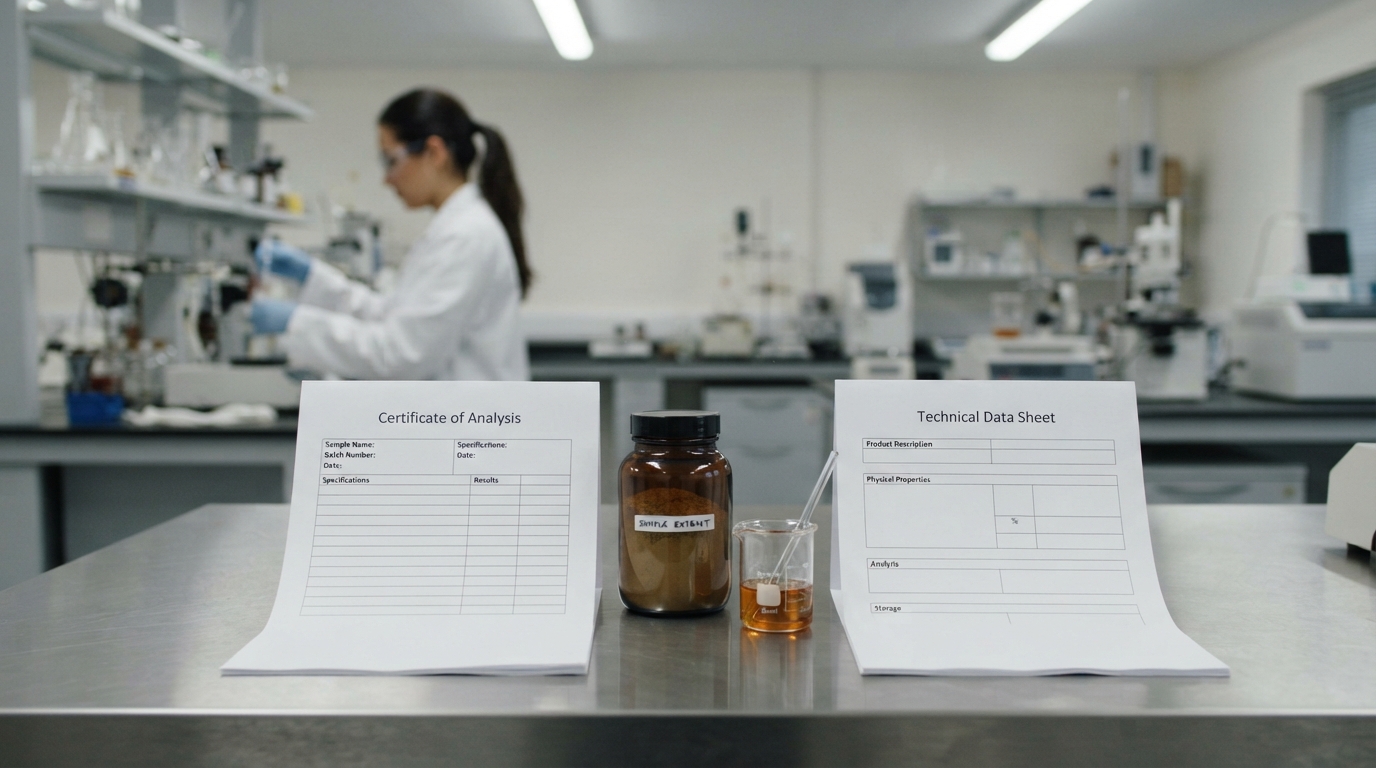
Two documents are often confused: the Certificate of Analysis (CoA) and the Technical Data Sheet (TDS). Both are important, but they answer different questions.
| Document | Purpose | What it typically contains |
|---|---|---|
| CoA | Verifies the results for a specific batch | Batch number, identity, assay results, purity, contaminant testing, dates, and the analytical methods used |
| TDS | Describes the product’s typical physical, chemical, and handling properties | Appearance, form, solubility, moisture, particle size, packaging, storage, and shelf-life guidance |
A CoA is batch-specific. It should not be treated as a permanent product constant. If the supplier provides a CoA, check that the batch number matches the material being evaluated.
Analytical testing is central to both documents. HPLC and UV spectrophotometry are common tools, but the method must be appropriate for the compound being measured. The CoA or TDS should name the method clearly enough for a formulator or quality team to assess it.
What a Complete CoA Should Include
Use this checklist when reviewing a botanical-extract CoA:
- Botanical identity, including Latin binomial when available
- Plant part used
- Batch number
- Manufacturing and retest dates
- Assay result, including the method used
- Marker or active-compound content where applicable
- Purity or content of the main constituent
- Heavy-metals results
- Pesticide-residue results
- Microbial limits
- Packaging, storage conditions, and shelf-life statement
If the CoA is missing any of these, ask the supplier why.
Certification Claims: GMP, ISO, and Organic
Certifications such as GMP, ISO, and USDA Organic can be useful signals, but they must be scoped correctly.
- A GMP certification usually applies to a specific facility and manufacturing process, not automatically to every product a supplier sells.
- ISO standards are system-based and may cover quality, environmental, or food-safety management systems.
- USDA Organic certification applies to specific ingredients or products, and the certificate should identify the product and certifier.
Ask to see the certificate, check the scope, and confirm it covers the supplier’s facility and the product you are buying. A general marketing claim such as “GMP-certified” is not enough on its own.
Choosing the Right Plant Extract for Your Finished Supplement Format
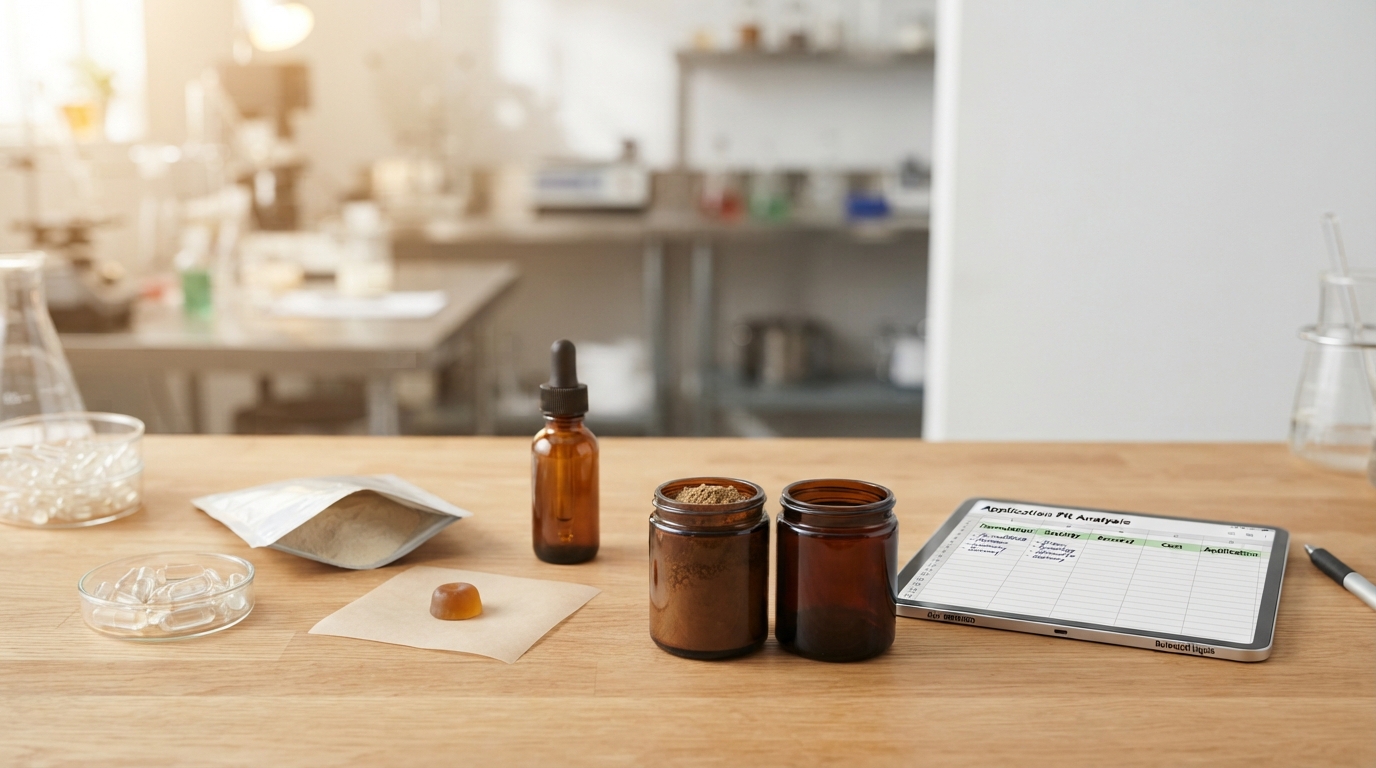
The finished product format should drive part of the specification. Here is a practical mapping:
| Finished format | Important extract characteristics | Common form |
|---|---|---|
| Capsules / tablets | Good flow, controlled moisture, compatible fill weight | Dry extract powder |
| Powders / sachets | Solubility, taste, dispersibility, consistent bulk density | Dry extract powder or fine granule |
| Gummies | Heat stability, flavor compatibility, low interaction with gelling systems | Dry extract or specialized coated/resinated form |
| Liquid supplements | Solubility or dispersibility, taste masking, clarity, stability | Liquid extract or highly soluble dry extract |
A formulator should test the extract in the actual finished-product base, not assume it will behave the same across formats.
Sourcing and Supplier Evaluation: Questions Every Formulator Should Ask
Once the specification is clear, evaluate the supplier against that specification.
- Confirm the botanical identity and plant part. Ask for the Latin binomial, cultivar if relevant, and the exact plant part used.
- Request the extraction details. Ask which solvent was used and how the extract was concentrated or dried.
- Require the product TDS and batch-specific CoA. Review them before approving a sample.
- Check the standardization method. If the product is standardized, confirm the marker, target range, analytical method, and batch-adjustment process.
- Evaluate the physical specifications. Particle size, moisture, solubility, and stability data should fit the finished-product format.
- Ask about batch consistency and change control. How does the supplier prevent variation between batches?
- Confirm commercial terms. MOQ, lead time, traceability, packaging, and documentation should match your supply plan.
- Verify certification scope. Do not accept a vague certification claim; ask for certificate numbers and scope.
Red Flags in Botanical-Extract Supplier Data
Be suspicious when a supplier’s documentation contains:
- Missing Latin binomial or plant part
- An extract ratio presented as if it were potency
- Implausible specifications that look identical across very different botanicals
- No analytical method listed for the assay
- Certificate claims without a certificate number, scope, or product name
- No batch-specific CoA
- Confusion between %, mg, and extract ratios
- A refusal to share the TDS or CoA before purchase
None of these are proof of bad faith, but they are reasons to ask deeper questions before placing an order.
Safety, Regulatory, and Claim Limitations for Beauty Supplements
“Natural” does not automatically mean safe. A botanical that is used safely in food may not be appropriate at concentrated extract levels in a supplement. Formulators should review the relevant safety and regulatory requirements for each target market.
The European Food Safety Authority (EFSA) has published guidance on the safety assessment of botanicals and botanical preparations used in food supplements. The FDA’s Botanical Safety Consortium also works on safety-assessment methods for botanical ingredients. Regulatory requirements are not uniform worldwide, so the label, ingredient status, allowed claims, and permissible dosage should be checked for each country where the product will be sold.
Beauty-related claims also need substantiation. A claim that a supplement “improves skin elasticity” or “supports hair growth” carries expectations about evidence, wording, and labeling. A formulator should work with regulatory counsel to ensure the finished product’s claims match the available evidence and local rules.
Sourcing Checklist and Next Steps
Build your sourcing brief around the following steps:
- Define the finished product format and target market.
- Write a tentative extract specification, including plant part, extraction solvent, standardization, physical form, and required documentation.
- Request a TDS and a batch-specific CoA from potential suppliers.
- Review the analytical method, marker content, contaminant results, and stability data.
- Request a reference sample and test it in the finished-product base.
- Confirm batch consistency, MOQ, lead time, packaging, and storage requirements.
- Verify all certification claims against the certificate scope.
- Complete a regulatory and claim review for the target market.
For formulators exploring adjacent supplement categories, the same sourcing discipline applies to other ingredient verticals such as women’s health supplement ingredients.
When you are ready to source plant extracts for a beauty supplement, B-Thriving is positioned as a plant-extract supplier and describes tailored plant-extract solutions. Because product availability and specifications change, confirm current botanical availability, documentation, and formulation support directly with the B-Thriving team before finalizing your product brief.

