
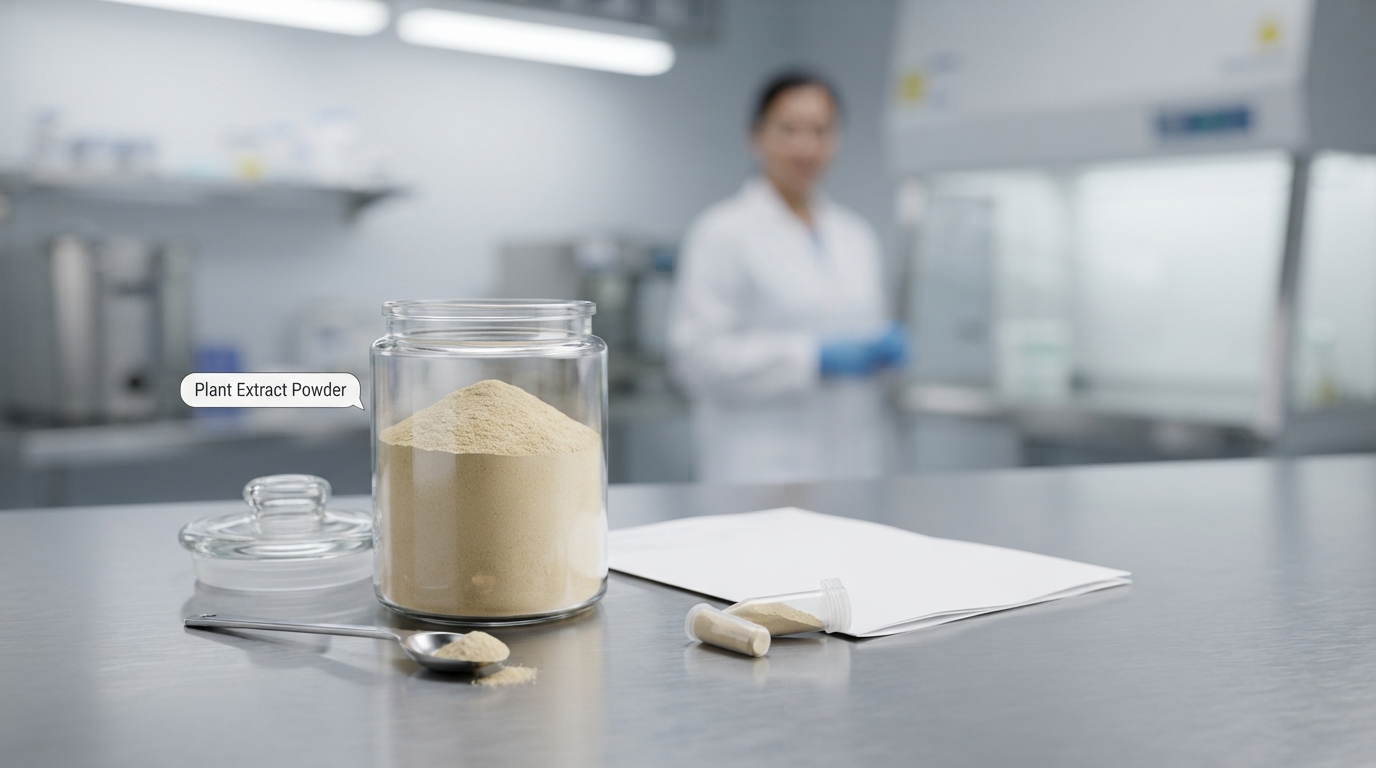
A plant extract powder supplier is a B2B ingredient vendor that supplies powdered botanical and herbal extracts to agreed specifications. This page covers B-Thriving’s powder-form extract range and the specification, documentation, and sourcing details buyers should review before purchasing.
B-Thriving, identified on its website as Xi’an B-Thriving I/E Co., Ltd., is a plant-extract and natural-ingredient supplier based in Xi’an, China. Many buyers looking for this type of powder are sourcing ingredients for dietary supplement manufacturing; for the broader supplement sourcing context, see botanical extract supplier for dietary supplements.
What Is a Plant Extract Powder?
A plant extract powder is the dried, powdered result of extracting plant material, not simply ground plant material. During extraction, plant material is treated with water, a solvent, or another process designed to concentrate selected constituents; the resulting extract is then dried and milled into a powder.
According to the USP botanical extracts chapter, botanical extracts can be prepared from plant material and further processed to increase or decrease constituents. The NIH Office of Dietary Supplements similarly notes that botanical preparations and extracts can differ in strength and constituent concentration. That is why buyers need specifications, not just a category name.
| Form | What it is | What buyers should know |
|---|---|---|
| Raw plant powder | Dried plant material ground to a powder | Used where a whole-plant form is acceptable; no extraction step. |
| Plant extract powder | Concentrated extract dried to a powder | May be standardized by marker, ratio, or further purified; specifications vary. |
| Liquid extract | Extract suspended in water, alcohol, or another liquid | Used in liquid formulations; different handling and formulation profile. |
Types of Powder-Form Plant Extracts B-Thriving Carries
On its website, B-Thriving groups its ingredients into categories including Standard Herb Extract, Herb Extract Monomer, Fungal Extract, and Natural Plant Pigment. These categories are useful starting points, but they are not the same as a product specification. Buyers should confirm the physical form, assay, and documentation for each ingredient they plan to use.
Standardized Herbal Extracts and Ratio Extracts
Standardized herbal extracts are made with a defined marker in mind. The extract is controlled to a stated target or range, such as a percentage of a characteristic active compound, measured by a specified analytical method.
Ratio extracts are described by the relationship between the starting plant material and the final extract. For example, a 10:1 extract means a defined amount of plant material was processed to produce one part of extract. That ratio describes the concentration process, not the percentage of a specific marker.
| Extract type | What it tells you | What to confirm |
|---|---|---|
| Standardized extract | A marker or constituent is controlled to a target or range | Marker identity, assay, analytical method, acceptable range |
| Ratio extract | Amount of starting plant material relative to extract | Ratio definition, plant part, marker data if relevant |
Herbal Extract Monomers
Herbal extract monomers are products focused on a single compound or a highly enriched constituent rather than a broad herbal profile. These products are often described by purity percentage rather than extract ratio. Because the compound identity and purity level determine whether the material works in a given application, buyers should confirm the exact monomer, purity, analytical method, and intended use.
Fungal Extract Powders
Mushroom or fungal extracts are not botanically plant extracts, but they sit alongside botanical powders on B-Thriving’s website because the same buyers often source both. B-Thriving lists Fungal Extract as a separate category. As with any extract, the species, extraction method, standardization, and documentation should be confirmed before purchase.
Key Specifications for Plant Extract Powders
The exact values for a plant extract powder depend on the product, the batch, and the supplier’s specification. Use the table below as a checklist when reviewing a product datasheet or requesting information.
| Specification | What it tells you | Why it matters |
|---|---|---|
| Source plant and plant part | Exact botanical identity | Prevents species confusion or substitution |
| Extract type | Standardized, ratio, monomer, etc. | Changes how the specification should be interpreted |
| Active marker / constituents | Compound(s) being controlled | Basis for assay and application fit |
| Assay / potency (%) | Amount of the marker present | Needed for dosing consistency |
| Purity (%) | Compound content in monomer-type products | Important for isolated compounds |
| Extract ratio | Plant-to-extract relationship | Describes processing concentration, not marker percentage |
| Solubility | Behavior in water or other liquids | Affects beverage and liquid formulation |
| Particle size / mesh | Powder granularity | Affects blending, flow, and processing |
| Moisture content | Water remaining in the powder | Influences stability and shelf life |
| Shelf life | Expected stability period | Needed for inventory planning |
| Packaging and storage | Protection from moisture, light, and temperature | Supports quality through the supply chain |
If a supplier gives you a percentage, ask whether it refers to assay of a marker, purity of a compound, or something else. Do not treat an extract ratio such as 10:1 as a potency percentage. A higher number is not automatically better; the right specification depends on what your formulation needs.
CoA, TDS, and Testing Documentation
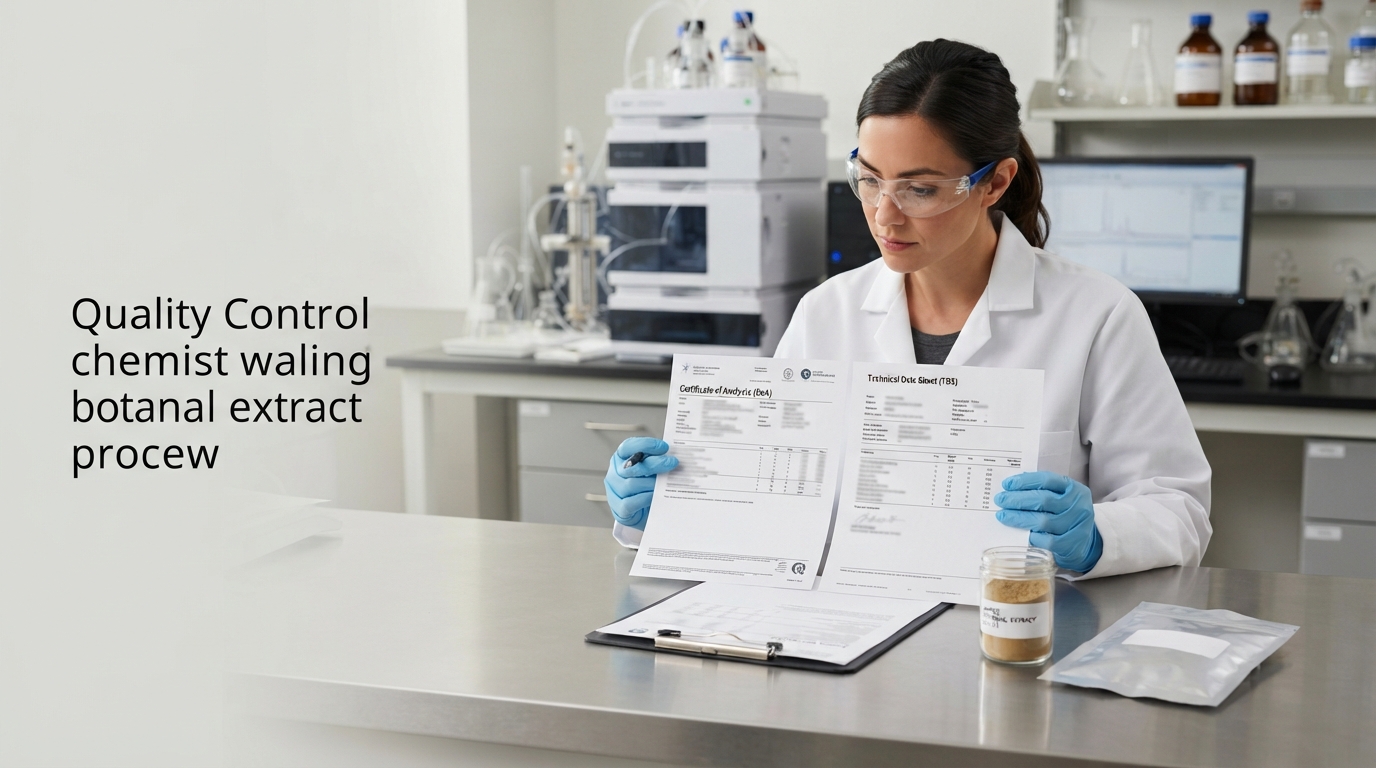
A Certificate of Analysis (CoA) is a batch-specific quality document. It reports test results for one manufactured batch, including identity, assay, and contamination checks where applicable. A Technical Data Sheet (TDS) is a product-level document describing the product’s physical and chemical characteristics, storage conditions, and handling guidance.
| Document | What it is | What to check |
|---|---|---|
| CoA | Batch-specific | Batch/lot number, release date, identity, assay, contamination results, test method |
| TDS | Product-level | Appearance, solubility, particle size, moisture, shelf life, storage, packaging |
In short, the CoA answers: “Does this batch meet the agreed specification?” The TDS answers: “What is this product and how should it be handled?”
High-performance liquid chromatography (HPLC) and ultraviolet-visible (UV) spectroscopy are common analytical techniques used to identify and quantify active constituents. The suitable method depends on the compound and the laboratory’s validated procedure. If you are sourcing a standardized extract, ask which method was used and whether the assay applies to the marker you care about.
Certification claims—such as GMP, ISO, organic, Halal, or Kosher—should be checked against documentation that names the relevant product or batch. A general statement about a supplier’s quality system is not the same as a certificate with a clear scope. If the certificate does not appear on the CoA or TDS, ask how it applies to what you are buying.
Applications of Plant Extract Powders
Plant extract powders are used across several industries, but suitability is product-specific. A powder that works well in a supplement capsule may not be appropriate in a beverage if it is not water-soluble or has an undesirable taste or color.
| Application | Typical concerns | What to request |
|---|---|---|
| Dietary supplements | Assay consistency, batch documentation, regulatory status | CoA, TDS, stability data, applicable regulatory documentation |
| Functional foods and beverages | Solubility, taste, color, stability | Solubility data, sensory information, application guidance |
| Cosmetics and skincare | Grade, safety, ingredient compatibility | Ingredient specification, safety documentation |
| More regulated applications | Compliance with market-specific requirements | Full product qualification documentation; verify per product and jurisdiction |
For the broader topic of sourcing botanical extracts for dietary supplement manufacturing, see botanical extract supplier for dietary supplements.
Regulatory requirements vary by country and by ingredient. For the U.S. market, for example, FDA guidance on new dietary ingredients notes that plant material, extract type, and processing can affect regulatory analysis. Other jurisdictions have their own frameworks, so the target market should be part of the specification discussion.
How to Evaluate a Plant Extract Powder Supplier
Use a supplier evaluation process that checks both documentation and commercial terms:
- Confirm the botanical identity: Latin species and plant part.
- Request a current TDS and a batch-specific CoA.
- Ask which marker is being assayed and which analytical method is used.
- Check batch-to-batch consistency by comparing CoAs from more than one batch.
- Confirm packaging, storage conditions, and shelf life.
- Ask about MOQ, lead time, sample availability, and quotation terms.
- Review red flags: vague specifications, identical values on unrelated products, confusion between assay and extract ratio, or certification badges without product scope.
If a supplier cannot explain which species, plant part, and marker are being used, the risk of adulteration or substitution increases. Clear documentation is part of the product, not an afterthought.
How to Request Samples and Quotations from B-Thriving
A specific inquiry gets a more useful response than a general request. Use the contact details on the B-Thriving website to send a concise list of what you need.
- List the botanicals or herbal extracts you are evaluating.
- State the plant part and extract type, if known.
- Include the assay or ratio you need, and note the intended application.
- Ask for the current TDS and a sample batch CoA.
- Ask about sample policy, MOQ, lead time, packaging, and pricing.
Do not assume a product is available in powder form or at a particular assay just because it appears in a category. Product-level confirmation is part of the sourcing process.
Start with a short inquiry that gives B-Thriving enough detail to return a useful quotation: target botanicals, plant parts, extract type, desired assay or ratio, and intended application. The response will show whether B-Thriving can supply a powder-form extract that matches your project.

