

A nootropic ingredients supplier provides the bulk raw materials used by formulators and brands to develop products intended to support cognitive functions such as focus, memory, alertness, and mental energy. This guide explains how to evaluate a supplier for brain-performance formulations, from active-compound specifications and quality documentation to application fit and batch consistency. It is a focused part of the broader cognitive health ingredients supplier landscape.
What Is a Nootropic Ingredients Supplier?
A nootropic ingredients supplier sells ingredients to product developers, supplement brands, contract manufacturers, and distributors. The supplier’s range may include botanical extracts, amino acids, mushroom extracts, vitamins and cofactors, or isolated compounds. What matters for this buying decision is that you are sourcing raw materials, not finished consumer products.
That distinction matters because the supplement supply chain has different types of companies:
- Raw-ingredient suppliers sell bulk ingredients with specifications, samples, and batch documentation.
- Contract manufacturers and white-label companies produce finished supplements, often using ingredients sourced from other suppliers.
- Research-chemical vendors sell compounds for laboratory use, not necessarily for food, beverage, or dietary-supplement applications.
This guide covers the first category. If you need a finished product, a white-label or contract manufacturing partner may be more useful. If you need a lawful dietary ingredient for human consumption, you need a supplier that can provide proper identity, specification, and batch-level quality documentation.
Research-chemical suppliers are not equivalent to nutraceutical ingredient suppliers. The regulatory, safety, and quality expectations are materially different.
Core Ingredient Categories for Brain-Performance Formulations
Nootropic-oriented formulations can draw from several ingredient categories. Knowing the category helps you ask the right sourcing questions.
Botanical Extracts
Botanical extracts are derived from plant source material. When evaluating a botanical extract, clarify:
- the exact plant species and plant part used;
- the extraction method;
- the active compound or marker compound measured;
- whether the extract is standardized to a defined compound.
A standardized botanical extract is held to a consistent concentration of a specified compound. A non-standardized extract may vary more from batch to batch. Neither is automatically better, but they require different expectations and specifications.
Amino Acids and Related Compounds
Amino acids are common in formulations aimed at cognitive performance, relaxation, or mood balance. L-theanine is one example of an amino-acid-type ingredient used in brain-performance products. Its benefits, mechanisms, and applications are covered in detail in the separate article on understanding l theanine benefits mechanisms and applications. For sourcing purposes, the main questions are identity, form, assay, and batch documentation.
Mushroom Extracts
Certain mushroom extracts appear in cognitive-support formulations, but they deserve extra scrutiny. Buyers should verify:
- the exact species;
- whether the product is derived from fruiting body, mycelium, or a blend;
- the extraction method;
- the marker compounds measured;
- whether identity testing is performed.
Mushroom products have been documented as a category where mislabeling and adulteration can occur. Species-level identity testing is not optional when the ingredient is intended for a labeled product.
Vitamins, Cofactors, and Isolated Compounds
Some cognitive-performance ingredients are not botanicals or amino acids. They may be vitamins, cofactors, or isolated nutritional compounds with a defined chemical structure. For these ingredients, the specification is usually based on the compound itself rather than a plant extract.
PQQ is one example of a cofactor-type ingredient used in formulations related to energy metabolism. That relationship is explained in the separate article on pqq and energy metabolism. When sourcing this type of ingredient, confirm the exact compound name, the assay method, and whether the specification is expressed as purity, potency, or concentration.
Nootropic Ingredient Specifications: What to Compare
The most common sourcing mistake is comparing supplier specifications that look similar but mean different things. These terms are often used interchangeably, but they are not the same:
| Specification Term | What It Means | Sourcing Question |
|---|---|---|
| Assay / potency | The measured amount of the active compound or marker compound, usually expressed as a percentage. | What compound is measured, and which analytical method was used? |
| Purity | The degree to which the material is free from unrelated compounds. | What purity data is provided, and how was it determined? |
| Extract ratio | The ratio of starting plant material to finished extract, such as 10:1. | Is the ratio stated alongside the active-compound assay? |
| Concentration | The amount of a compound per unit, sometimes expressed in milligrams. | Is the concentration based on the raw material or the finished extract? |
An extract ratio is not a potency percentage. A 10:1 extract may contain a lower or higher concentration of the active compound than a 4:1 extract, depending on the source material and process.
Physical specifications also matter:
- Form: powder, granule, or liquid;
- Particle size: affects flow, blending, and dissolution;
- Solubility: critical for beverages and liquid applications;
- Moisture content: affects stability and microbial risk;
- Shelf life and storage conditions: affect procurement planning.
Ask the supplier to state the test method for each specification. Two suppliers can report the same percentage using different methods, and those results may not be directly comparable.
Quality Documentation: CoA, TDS, and Batch Testing
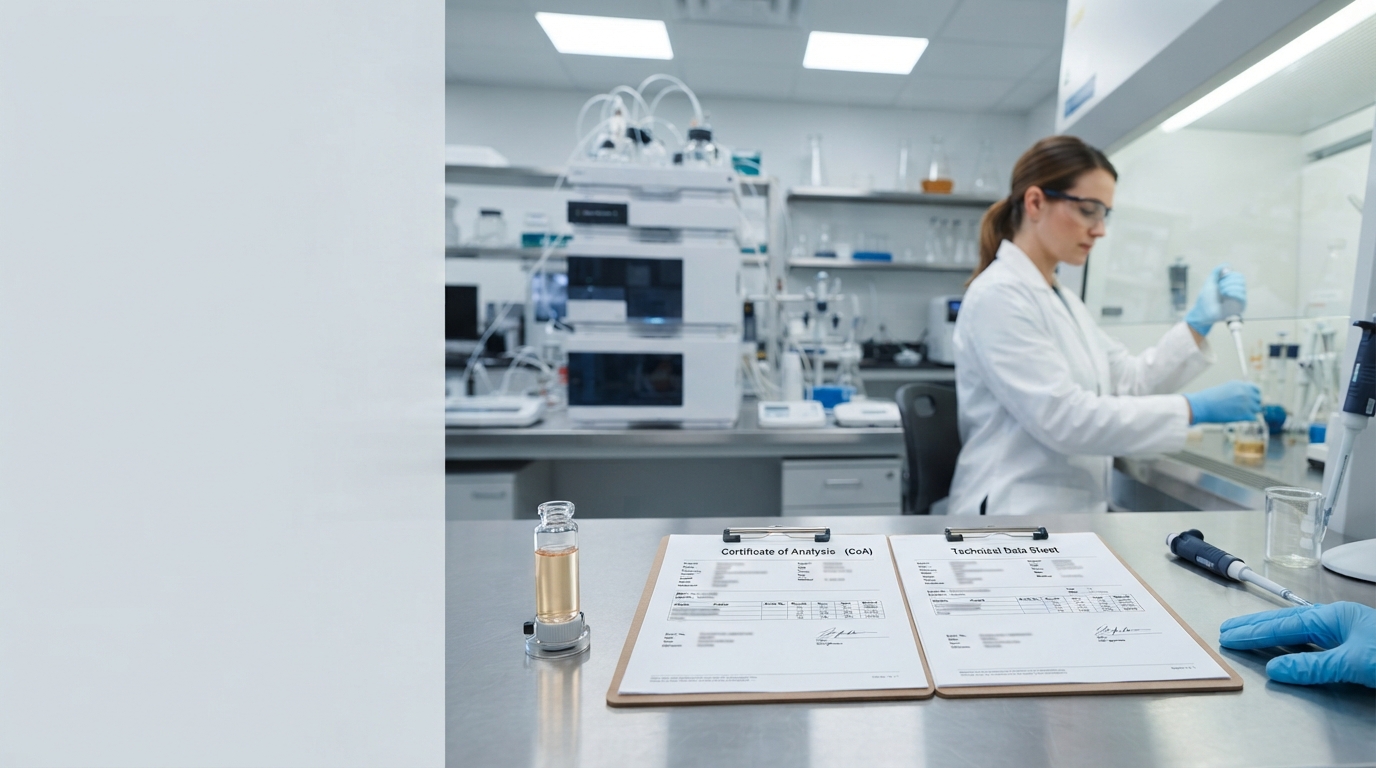
The documents a supplier provides matter as much as the ingredient itself. Two documents are commonly confused:
| Document | What It Covers | What to Check |
|---|---|---|
| Certificate of Analysis (CoA) | Batch-specific quality data: identity, assay, purity, contaminant results, batch number, testing date, and methods used. | Does the CoA refer to the exact batch you are purchasing? Are the methods identified? |
| Technical Data Sheet (TDS) | Product-level description: appearance, physical form, particle size, solubility, moisture, packaging, storage, and shelf life. | Does the TDS match the current product specification? Is it updated when the product changes? |
A CoA verifies what was found in a specific batch. A TDS describes the expected characteristics of the product. They are not interchangeable.
Ask which analytical method was used for the active compound. HPLC is common for many botanical and isolated compounds; UV spectrophotometry may be used for certain analytes. The method should be appropriate for the compound and clearly identified on the document.
Certification claims also need scrutiny. GMP, ISO, USDA Organic, Halal, Kosher, and HACCP certifications are valuable when they apply to the correct site, product, or batch. A general logo on a website is not evidence that a specific ingredient meets that standard. Ask for a copy of the certificate and confirm the scope, validity date, and applicable products.
Batch traceability is equally important. A supplier should be able to trace the material you receive to a defined batch and its release records. That traceability becomes essential if you need to investigate a quality issue or respond to a customer inquiry.
Matching Ingredients to Your Application
The same ingredient can behave differently depending on its form, standardization, and processing. Application fit should therefore be part of the supplier review.
| Application | Key Considerations | Questions to Ask the Supplier |
|---|---|---|
| Capsules and tablets | Powder flow, particle size, compressibility, excipient compatibility. | Is the particle size suitable for direct compression or encapsulation? Are density and flow data available? |
| Powder products | Solubility, taste, moisture behavior, bulk density. | Does the ingredient dissolve or disperse as needed? Is taste-masking required? |
| Functional beverages | Solubility, pH stability, heat stability, clarity or suspension, taste. | Has the ingredient been tested in beverage conditions? Does it remain stable at the target pH or processing temperature? |
| Sports nutrition | Batch testing, prohibited-substance control, regulatory status, label claims. | What batch-level testing supports product integrity? Does the ingredient meet the regulatory requirements of the target market? |
Ask the supplier for application-specific data when you need it. A supplier that understands your product format will know why solubility, stability, and processing behavior matter.
How to Qualify a Nootropic Ingredients Supplier

A simple qualification process reduces the risk of choosing a supplier based on a polished sales page. Use these steps:
- Define the formulation goal. Identify the finished product format, target market, and regulatory path before you contact suppliers.
- Define the ingredient specification. Write down the active compound, form, target potency or purity, physical properties, and required documentation.
- Request a sample, TDS, and batch-specific CoA. The sample should match the specification you requested.
- Verify the test method. Confirm which laboratory method was used, whether testing is in-house or third-party, and whether the method is appropriate for the compound.
- Review certification documents. Check the scope, validity, and product applicability of any claimed certification.
- Compare batch history. Ask for batch-to-batch assay data, not just one favorable CoA.
- Confirm packaging, storage, and shelf life. These affect incoming inspection, warehousing, and production planning.
- Confirm commercial terms. MOQ, lead time, incoterms, sample policy, payment terms, and documentation support should be clear before ordering.
- Establish a quality agreement. Define incoming release criteria and what happens if a batch fails to meet specification.
This process does not need to be bureaucratic. It should be practical enough to use with every serious candidate.
Common Sourcing Risks and How to Avoid Them
Sourcing nootropic-related ingredients carries risks that are easy to overlook during a first review.
| Risk | Why It Happens | How to Reduce It |
|---|---|---|
| Adulteration or mislabeling | Some ingredients are substituted with cheaper or undeclared materials. | Require identity testing and batch-specific CoAs. The CDC has documented unexpected substances in products marketed as nootropic-containing products, which is why identity testing matters in this category. See the CDC investigation. |
| Potency inconsistency | Different suppliers may use different extraction or testing methods. | Ask for the analytical method and compare batches over time, not just one certificate. |
| Unit confusion | Extract ratio, potency %, purity %, and mg concentration are mixed up. | Define specifications using one clear measurement basis and confirm the units with the supplier. |
| Contamination | Heavy metals, microbes, residual solvents, or pesticides may be present. | Review the CoA for the applicable contaminant panels and confirm which methods were used. |
| Regulatory variability | A substance may be legal in one country but restricted in another. | Check the ingredient’s status in your target market and verify label-claim requirements with a regulatory professional. The FDA’s Dietary Supplement Labeling Guide is one starting point for U.S. supplement labeling. |
| Certification overstatement | A company-level claim may not apply to the specific ingredient or batch. | Ask for the actual certificate and confirm the covered products and site. |
| Overstated ingredient claims | Nootropics are not a single uniform category of substances. | Evaluate each ingredient on its own evidence and specification. A PubMed-indexed review notes that nootropics include different types of substances with different dosage and safety considerations. |
These risks do not mean sourcing is impossible. They mean the buyer must verify claims instead of accepting them at face value.
Starting Your Sourcing Conversation with B-Thriving
Before contacting any supplier, prepare a one-page specification summary. Include the target ingredient, form, application, target market, and the documents you will request. Then ask for:
- current availability;
- technical data sheet;
- batch-specific certificate of analysis;
- samples;
- minimum order quantity;
- lead time;
- packaging and storage conditions;
- shelf life.
Those questions apply whether you are sourcing a botanical extract, amino acid, mushroom extract, or isolated compound. The same checklist works with any supplier, because the goal is the same: confirm that the ingredient matches your formulation, documentation, and supply requirements.
B-Thriving’s official website provides current product and contact information. Use the same sourcing checklist when you evaluate its materials that you would use with any other supplier, and ask for the documentation that supports your specific application.

