
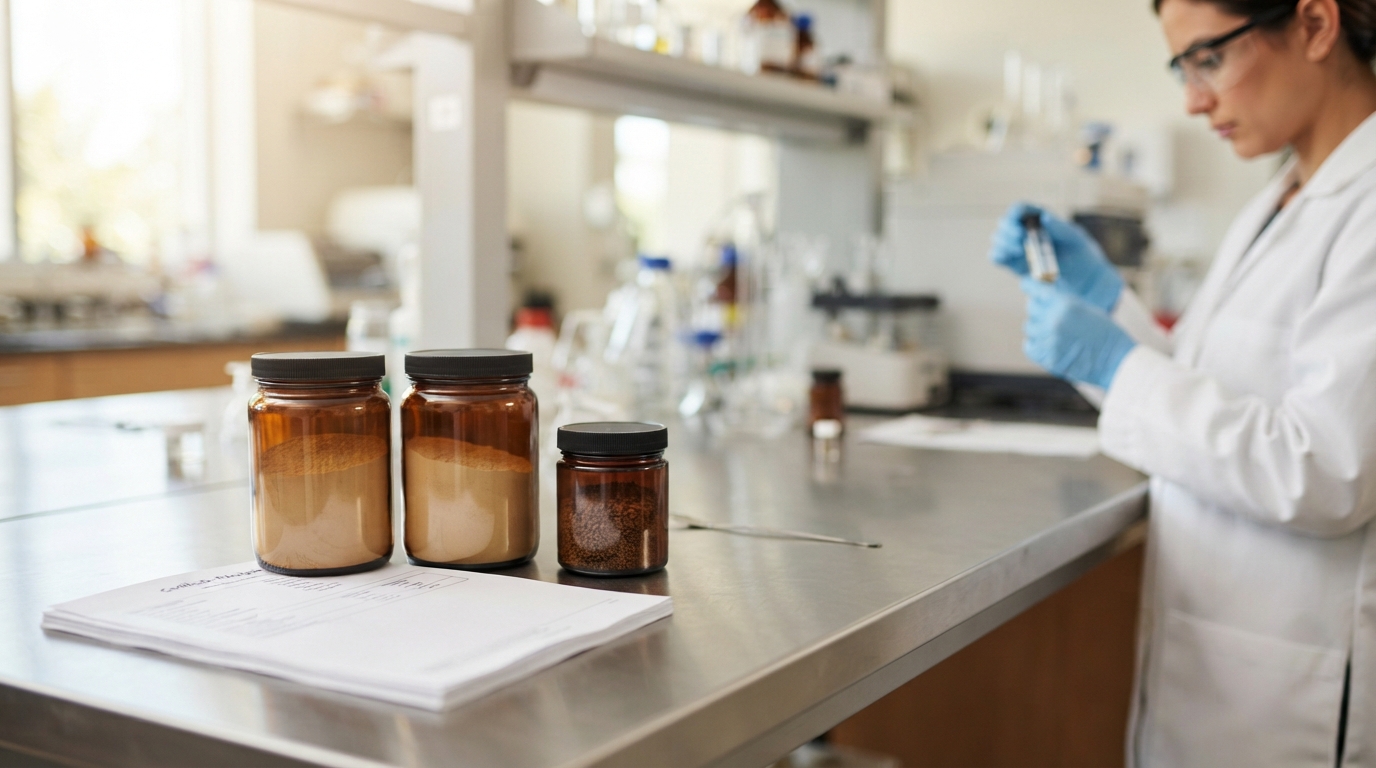
A natural ingredient supplier for pet supplements is a B2B company that provides botanical, fungal, or other naturally derived ingredients to pet-supplement formulators, brand owners, and contract manufacturers — along with the identity, specification, testing, and traceability documentation needed to source responsibly. This guide explains how to evaluate and compare those suppliers before you request a sample or commit to a purchase.
Natural ingredients can come from many categories, including botanical extract supplier for dietary supplements operations, mushroom extract producers, and suppliers of amino acids, vitamins, or enzymes. But not every supplier positioned for human nutrition is automatically equipped for pet products. Understanding what to check — from species suitability to batch documentation — makes the difference between a smooth sourcing process and a costly compliance problem.
What Is a Natural Ingredient Supplier for Pet Supplements?
A natural ingredient supplier for pet supplements sells bulk ingredients to companies that formulate finished products such as chews, powders, capsules, liquids, or soft gels for dogs, cats, and other animals. The supplier’s job is not just to deliver a material, but to provide:
- Clear ingredient identity, including botanical or species name and the part of the plant used.
- Transparent processing information, such as extraction method and physical form.
- Batch-specific documentation for every delivery.
- Consistent quality across production runs.
- Practical support for questions about specifications, packaging, storage, and shelf life.
A natural ingredient supplier is not necessarily a contract manufacturer, private-label producer, or finished-product brand. Some companies offer those services, but they are separate capabilities that require their own verification.
What Natural Ingredient Categories Are Relevant to Pet Supplements?
Several natural ingredient types appear regularly in pet supplement formulations. The right category depends on the intended use of the finished product, the target species, and the regulatory requirements of the destination market.
Botanical Extracts
Botanical extracts are among the most common natural ingredients in pet supplements. When evaluating a botanical extract, confirm the exact botanical name, the plant part used, the extraction method, and the marker compound that defines the specification. Two products may share a common name but differ significantly in source, processing, or concentration.
Mushroom Extracts
Mushroom extracts have become more common in pet nutrition. As with botanicals, species identity matters. The extract type — such as fruiting body versus mycelium, or hot-water versus solvent extraction — can affect the final composition. Buyers should ask for the same level of specification and testing documentation they would expect from any botanical supplier.
Other Natural Nutritionals
Amino acids, vitamins, enzymes, and other nutritional ingredients may also be sourced from natural suppliers. These ingredients require the same scrutiny as botanical and mushroom extracts. The form, purity, and stability of each ingredient should be documented clearly.
Why Species and Target-Market Suitability Matter
A natural ingredient that is safe and effective for humans is not automatically safe or suitable for dogs, cats, or other animals. Species differ in metabolism, digestive physiology, and sensitivity to certain compounds. Likewise, an ingredient approved for human dietary supplements may not have the regulatory status needed for pet food, pet treats, or animal feed in a given country.
In the United States, ingredient standards for pet food and animal feed are established through frameworks that include AAFCO model regulations and oversight by the FDA Center for Veterinary Medicine. AAFCO explains that ingredient standards exist because violations have the potential to create serious pet-food safety problems. For that reason, buyers should never rely on “human grade,” “natural,” or “food grade” language as proof that an ingredient is acceptable for a pet product.
The same caution applies internationally. Each destination market may have its own rules for animal feed ingredients, supplement products, and labeling claims. Confirm the regulatory status of the ingredient for the specific species and market before sourcing, not after.
How to Evaluate Ingredient Specifications
A specification sheet tells you what a supplier expects the ingredient to be. The first step is confirming the identity of the material. Then look closely at the processing details and physical characteristics.
Key specification points to review:
- Botanical or species name.
- Plant part or source material.
- Extraction or production method.
- Standardization level or marker compound.
- Physical form, such as powder, liquid, or granule.
- Solubility, particle size, and moisture content where relevant.
- Packaging, storage conditions, and shelf life.
The goal is to confirm that the ingredient meets your formulation requirements, not just that it sounds natural or plant-based.
Potency %, Extract Ratio, Purity, and Concentration
Specification terminology is frequently misunderstood, and the differences matter.
| Term | What It Means | Example |
|---|---|---|
| Extract ratio | The amount of raw material used to produce one part of extract. | A 10:1 extract means 10 parts of starting material produced 1 part of extract. |
| Potency % | The percentage of a marker compound or active constituent in the extract. | A product standardized to contain 2% of a specified marker compound. |
| Purity % | The percentage of a single compound in a high-purity or isolated ingredient. | A monomer extract at 95% purity. |
| Concentration | The amount of a substance in a finished product or serving. | 50 mg of extract per chew. |
An extract ratio describes concentration from raw material, not potency. Potency percentage refers to the assayed level of a marker compound. Purity percentage applies when a specific compound has been isolated. These terms cannot be used interchangeably.
Physical specifications such as moisture content, particle size, and solubility are separate from potency and purity. A product can meet its assay specification while failing a moisture or solubility requirement that matters for your formulation.
Standardized vs. Full-Spectrum vs. Single-Compound Ingredients
Three broad ingredient forms appear across natural ingredient categories:
- Standardized extracts contain a declared level of a marker compound. This provides consistency across batches when the extraction process and testing method are reliable.
- Full-spectrum extracts contain a broader profile of constituents from the source material. They are not defined by a single marker level.
- Single-compound or high-purity ingredients are isolated constituents, such as a purified monomer extract.
The right choice depends on formulation goals, available evidence, and the documentation a supplier can provide. A standardized extract is useful when consistency is the priority. A full-spectrum extract may be appropriate when the full constituent profile is intended. A single-compound ingredient is appropriate when a specific molecule is the target.
Which Quality Documents Should a Supplier Provide?
Before approving any ingredient, request the supplier’s documentation package. At minimum, this includes a Certificate of Analysis, a Technical Data Sheet, and a Safety Data Sheet. You may also need a specification sheet, an allergen statement, an origin statement, and compliance documents for the destination market.
CoA vs. TDS vs. SDS
| Document | What It Does | When You Need It |
|---|---|---|
| Certificate of Analysis (CoA) | Reports batch-specific test results for identity, assay, and contaminants. | Every batch you purchase. |
| Technical Data Sheet (TDS) | Describes the product’s physical and chemical specifications, storage conditions, and shelf life. | When evaluating whether the ingredient meets your formulation needs. |
| Safety Data Sheet (SDS) | Provides hazard, handling, storage, and transport information. | For safe handling and shipping evaluation. |
A CoA is batch-specific. It verifies what was found in a particular production run. A TDS is a general product document. The two should be compared together: the TDS defines the expected specification, and the CoA demonstrates whether a specific batch meets it.
Certifications and Compliance Claims
Certifications can be useful, but only when they are specific. A valid certificate should identify the product, site, or batch it covers, the issuing body, the scope of the certification, and its validity period.
Be cautious with general statements such as “GMP compliant” or “ISO certified.” These phrases are meaningful only when tied to a verifiable certificate with a clear scope. A certification does not replace batch-specific CoA testing, and it does not automatically establish that an ingredient is suitable for pet use.
Red flags to watch for:
- Certification claims with no issuing body or certificate number.
- General “natural” or “high quality” language without supporting documentation.
- CoA documents that do not reference a specific batch number.
- Specifications that change between documents without explanation.
What Testing Should a Supplier Be Able to Show?

A natural ingredient supplier for pet supplements should be able to provide testing appropriate to the material and its risk profile. The following tests are commonly expected:
| Test | What It Checks |
|---|---|
| Identity | Confirms the ingredient is the species or compound it claims to be. |
| Assay | Measures the level of a marker compound or active constituent. |
| Heavy metals | Screens for lead, arsenic, cadmium, mercury, and similar contaminants. |
| Pesticide residues | Screens for agricultural chemical residues. |
| Microbiology | Checks for bacteria, yeast, mold, and pathogens. |
| Residual solvents | Relevant when solvents are used in extraction. |
| Mycotoxins | Relevant for certain botanical and fungal materials. |
The analytical method matters. HPLC and UV testing are both used in the industry, but they are not interchangeable. The method should be appropriate for the marker compound and the ingredient matrix. Ask the supplier which method was used and whether the CoA reflects the method.
How to Compare Suppliers and Reduce Sourcing Risk

Comparing natural ingredient suppliers means evaluating technical documentation, sample quality, and commercial terms side by side. A polished website is not evidence of batch consistency.
Supplier Comparison Checklist
- Ingredient identity is fully disclosed.
- Specification matches your formulation requirements.
- CoA, TDS, and SDS are available and consistent.
- Testing coverage matches the ingredient’s risk profile.
- Batch numbers are traceable from source to shipment.
- Sample qualification is possible before commercial orders.
- MOQ, lead time, packaging, and shelf life fit your planning.
Questions to Ask Before Requesting a Sample or Quote
- What is the exact botanical or species name, and what part of the plant is used?
- What extraction or production method is used?
- How is the ingredient standardized, and what marker compound defines the assay?
- Can you provide a batch-specific Certificate of Analysis?
- What contaminant testing is performed on each batch?
- What is the shelf life, and what storage conditions are required?
- What is the minimum order quantity and typical lead time?
- Can samples be matched to the same specification as commercial batches?
The best suppliers answer these questions directly and provide documents that support their claims.
Common Sourcing Mistakes and Red Flags
- Assuming “natural” or “human grade” means the ingredient is safe for pets.
- Confusing extract ratio with potency percentage when comparing quotes.
- Accepting a CoA that is not tied to a specific batch.
- Trusting certification language without checking the actual certificate scope.
- Skipping sample qualification and palatability testing.
- Failing to check batch-to-batch consistency before committing.
These mistakes are common because they happen during a fast sourcing process. A short qualification step at the beginning can prevent much larger formulation and compliance problems later.
Next Steps for Sourcing Pet-Supplement Ingredients
Use the sourcing checklist above to shortlist suppliers, request documentation, and evaluate samples against the species and market requirements of your finished product. Compare CoA results against the TDS specification, verify that the assay method matches the marker compound, and confirm that each new batch is traceable to its source.
If you are exploring plant-extract and natural-ingredient sourcing more broadly, botanical extract supplier for dietary supplements provides useful context on what to expect from a supplier. For questions about a specific ingredient, specification, or application, request a sample and a batch-specific CoA from the supplier before you make a final decision.

