
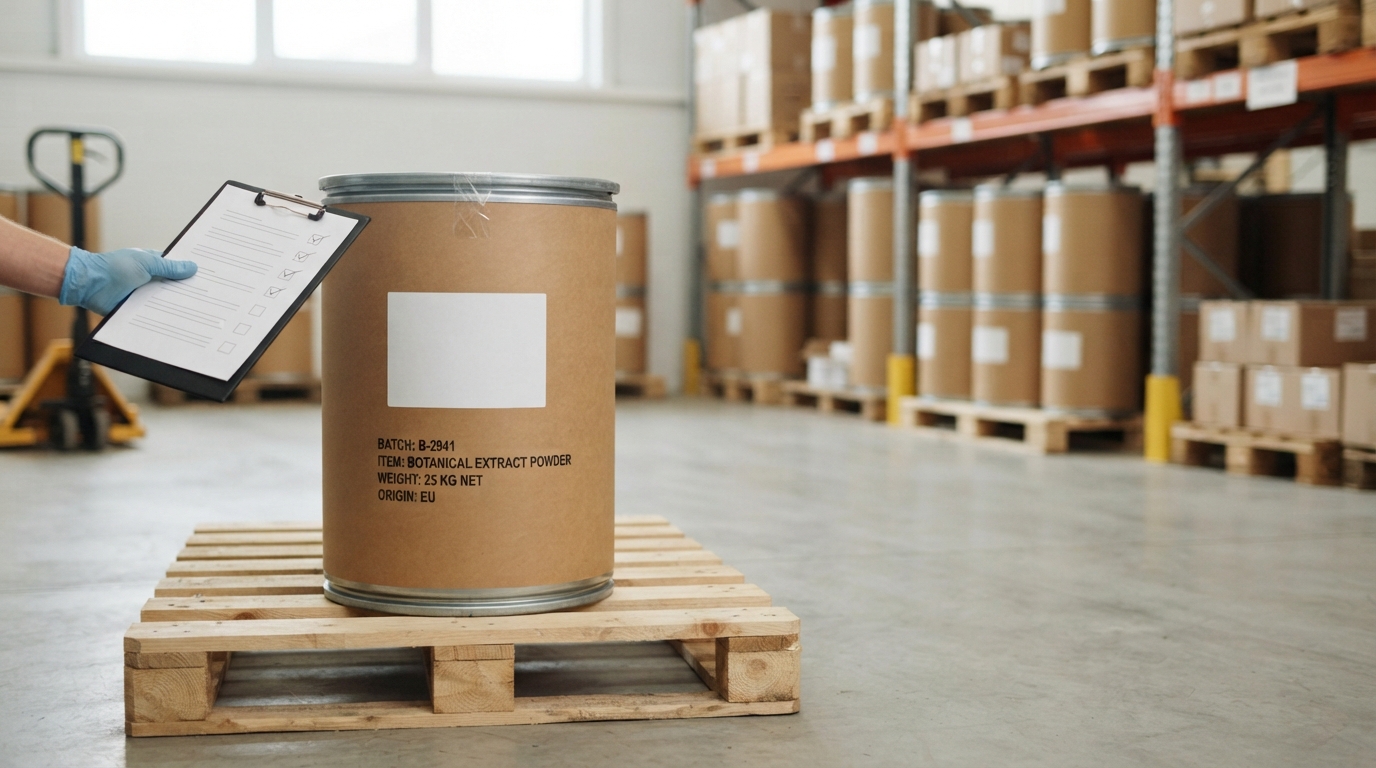
There is no universal MOQ for standardized botanical extracts. The minimum order quantity depends on the botanical itself, the marker compound and potency level you specify, whether the material is stocked or made to order, and whether you are buying a sample, a pilot batch, or a commercial quantity.
A standardized extract is a botanical ingredient processed to guarantee a specific level of a marker compound. For example, Bacopa monnieri extract standardized to 10% bacosides has been tested to contain that minimum concentration in each batch. That specification, not just the botanical name, drives the supplier’s production planning — and therefore the MOQ.
MOQ is one of several practical questions in a botanical-extract sourcing decision. It interacts with lead time, payment terms, and the choice between bulk ingredients and private-label finished products. This article focuses on the quantity question: what determines it, how to compare quotes, and what to ask before you commit.
What Does “Minimum Order Quantity” Mean for Botanical Extract Buyers?
A minimum order quantity is the smallest order quantity, or minimum order value, that a supplier is willing to accept for a given product. Defining it upfront saves both sides from quoting and ordering work that does not make commercial sense.
Two distinctions matter when you receive a quote:
- Weight-based vs. value-based MOQ. Many extract suppliers set MOQ in kilograms. Others set a minimum order value, which means you can combine several extracts into one order as long as the total exceeds that threshold.
- Per-SKU vs. per-batch vs. total-order MOQ. A supplier may require a minimum quantity for each extract, or simply a minimum batch size per production run. Ask which one applies.
Suppliers set MOQs for practical reasons: raw-material commitments, production economics, testing costs, packaging minimums, and the work involved in preparing and documenting a batch. A small order may still be possible, but the unit price is usually higher because the supplier must recover the same setup and testing costs from fewer kilograms.
Why Is There No Standard MOQ for Standardized Extracts?
The complexity of the standardized specification is the main reason different suppliers quote different MOQs. A widely available botanical may be stocked and sold in small quantities. A less common botanical, or one with a tightly controlled marker range, may have to be produced specifically for your order — and that raises the practical minimum.
| Variable | How It Affects MOQ |
|---|---|
| Botanical and plant part | Scarce or seasonal raw materials often require larger production runs to justify sourcing and processing. |
| Marker compound and target potency | A standard potency may be stock material; a nonstandard potency may require a dedicated production run with additional testing. |
| Extract ratio vs. potency | A 10:1 extract ratio describes how much raw plant material was used; 10% potency describes the measured marker content. They are not equivalent, and confusing them leads to comparing quotes that are not actually comparable. |
| Stock vs. made-to-order | Stocked extracts can be split into smaller orders. Made-to-order material usually carries a higher MOQ because the supplier commits to a full production batch. |
| Custom potency or private label | Customized specifications require extra development, validation, and testing, which is usually priced into a larger minimum order. |
| Packaging format | Bulk drums, sealed bags, and smaller unit packs each have different minimum filling quantities. |
| Testing and documentation | Every batch must be tested, often by HPLC or UV methods, and documented with a CoA. That testing cost is distributed across the batch, so smaller batches mean higher per-unit cost. |
| Destination and shipping | International freight on very small quantities can exceed the value of the extract itself, making a tiny MOQ impractical for both buyer and supplier. |
One rule is worth keeping in mind: the more specific the specification, the more likely the material is made to order — and the higher the MOQ can become.
Sample, Pilot, or Commercial Order: How Much Do You Actually Need?
Before comparing MOQ numbers, decide which order stage you are in.
| Order Stage | What It Confirms | Typical Quantity (example only) | MOQ Relationship |
|---|---|---|---|
| Sample | Basic identity, appearance, and often a quick assay check | Often 10–100 g; sometimes free, sometimes charged | Usually outside the commercial MOQ, but confirm the sample matches the commercial specification |
| Pilot batch | Formulation behavior, stability, scale-up, and packaging fit | 1–5 kg, depending on the extract and supplier | May be offered at a higher unit price; sometimes credited against the first commercial order |
| Commercial order | Regular production supply with full documentation | Supplier-specific — for example, some suppliers quote 25 kg for standardized extracts | The true MOQ; confirm whether it applies per SKU, per batch, or per order |
Sample policies vary. Some suppliers provide free R&D samples; others charge. Confirm in writing that the sample represents the same specification — same botanical part, marker compound, assay method, and potency — as the material you intend to buy commercially. A sample of a different grade tells you very little about the production material.
How to Compare Standardized Extract MOQ Quotes

A lower MOQ is not automatically a better deal if the unit price, specification, documentation, or lead time is worse than a competing offer. Compare these factors:
- Unit price at the quoted MOQ. A low MOQ with a high per-kilogram price can cost more per gram than a higher MOQ with a better unit price.
- Specification match. Confirm botanical name, plant part, marker compound, target potency, assay method, and physical form. If two quotes differ on any of these, they are not comparable.
- Packaging and shelf life. Verify the pack size, packaging format, and storage conditions. A larger pack may be cheaper per kilogram but unusable if the shelf life is too short for your timeline.
- CoA and TDS availability. Ask for a preprint CoA with the quote and the final CoA with the shipment. The TDS should confirm the product form, solubility, moisture, and handling requirements.
- Lead time and freight. A low MOQ is meaningless if the supplier cannot deliver in time for your production schedule.
- Payment terms. Deposit percentages and payment timing affect your working-capital cost.
- Repeat-order consistency. Ask how the supplier maintains batch-to-batch consistency and whether future lots will match the approved specification.
Red flags to watch for:
- MOQ quoted on a different specification than you requested.
- No clarity on whether the MOQ applies per SKU, per batch, or per total order.
- CoA and TDS not available before the order.
- A low MOQ offered only for a different potency or a different physical form than you need.
What Documents Should Come with a Standardized Extract Order?
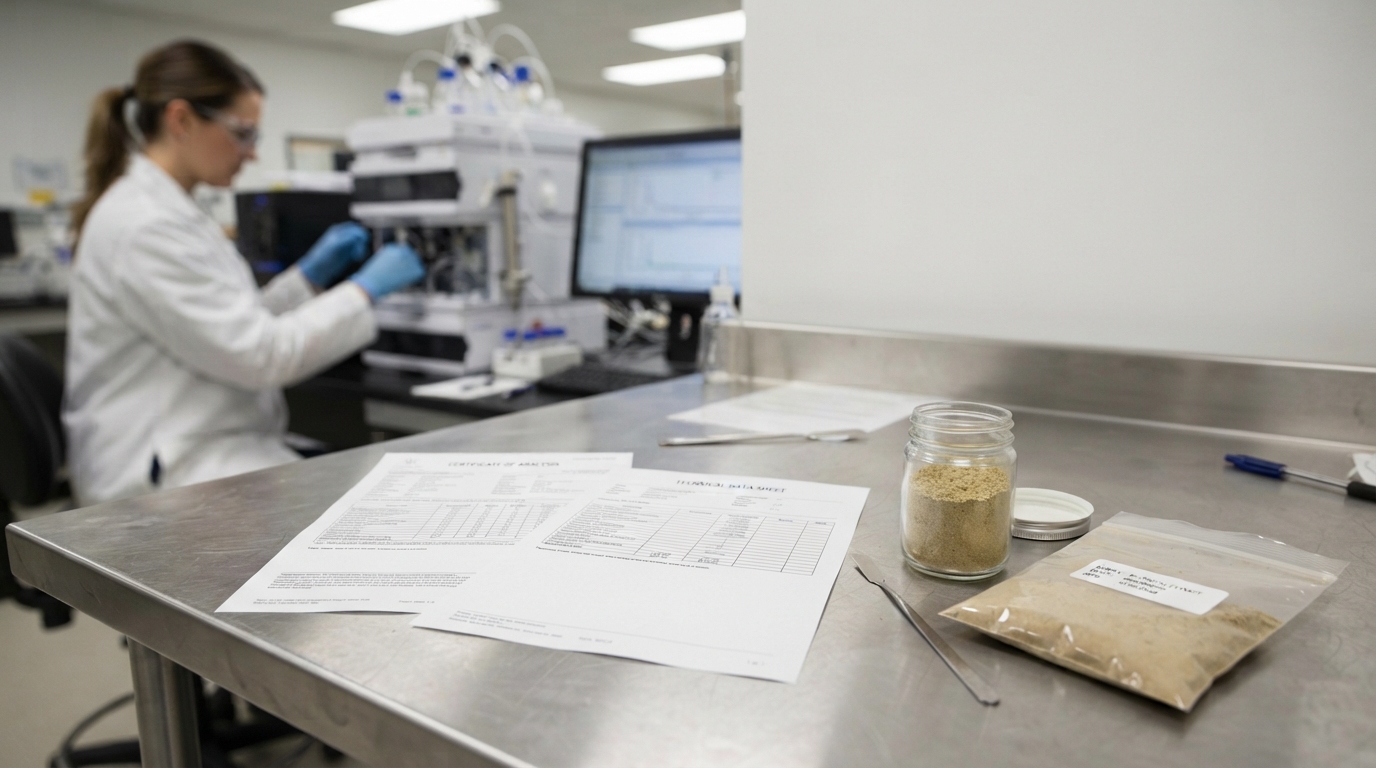
Two documents matter most: the Certificate of Analysis (CoA) and the Technical Data Sheet (TDS).
- CoA — batch-specific verification. The CoA confirms the identity of the botanical, the concentration of the marker compound, purity and moisture results, contaminant testing, and the analytical method used (typically HPLC or UV/Vis) for the exact batch you are buying. It is tied to a specific lot number.
- TDS — product-level specification. The TDS describes the product’s general specifications: physical form, particle size, solubility, moisture content, shelf life, storage conditions, and packaging. It remains valid until the product formulation changes.
Ask for a preprint CoA with your quotation and the final CoA with the shipment. That prevents surprises when the commercial order arrives.
Questions to Include in Your RFQ for Standardized Extracts
The fastest way to receive comparable MOQ quotes is to send a complete RFQ. Include these ten items:
- Botanical name and plant part (e.g., Bacopa monnieri aerial parts).
- Marker compound and target potency (e.g., bacosides 10%).
- Assay method and acceptable range (e.g., HPLC).
- Physical form and particle size (e.g., powder, 80 mesh).
- Sample quantity, and whether samples are charged or credited.
- Commercial MOQ per SKU, including whether it applies per batch, per order, or per packaging unit.
- Whether the material is stocked or made to order.
- Packaging format, shelf life, and storage conditions.
- Availability of the preprint CoA and final CoA/TDS.
- Lead time and payment terms — both affect how quickly you can use the quantity you commit to. See what is the typical lead time for ordering plant extracts from china and what are the payment terms for purchasing plant extracts from china.
If you need a finished branded product rather than a bulk extract, the MOQ logic changes completely. Finished-product projects follow formulation, filling, and packaging batch sizes, not raw-extract production economics. That is a different conversation — see our private label botanical extract supplier overview.
Frequently Asked Questions
Can I negotiate the MOQ?
In many cases, yes. Suppliers are often more flexible on stocked materials, multi-SKU orders, or first-order commitments. Negotiation is easiest when you provide a complete specification and a realistic order forecast. Always confirm the final MOQ in writing.
Does a lower MOQ always mean a higher price?
Usually, yes. The supplier spreads raw-material purchasing, production setup, testing, and packaging costs over fewer kilograms, so the unit price rises. A slightly higher MOQ can produce a meaningfully lower per-kilogram price.
Is MOQ the same for bulk extracts and private-label finished products?
No. Bulk extract MOQ follows the cost structure of raw-material production and testing. Private-label finished products follow formulation and packaging batch sizes. If your goal is a branded supplement, ask for finished-product MOQs separately, since finished-product MOQs follow a different logic.
What is the difference between an extract ratio and standardized potency?
An extract ratio such as 10:1 describes how much raw botanical material was used to produce the extract. It does not tell you the level of any specific compound. Standardized potency — for example, 10% bacosides — is a measured marker concentration confirmed by an analytical method like HPLC. When comparing quotes, compare potency percentages, not ratios.
When you have a concrete specification in mind, the next step is straightforward: request the supplier’s current MOQ, sample policy, preprint CoA, and TDS before committing to an order. A complete specification and the right questions will quickly show you which suppliers are quoting real options — and which are only quoting a number.

