
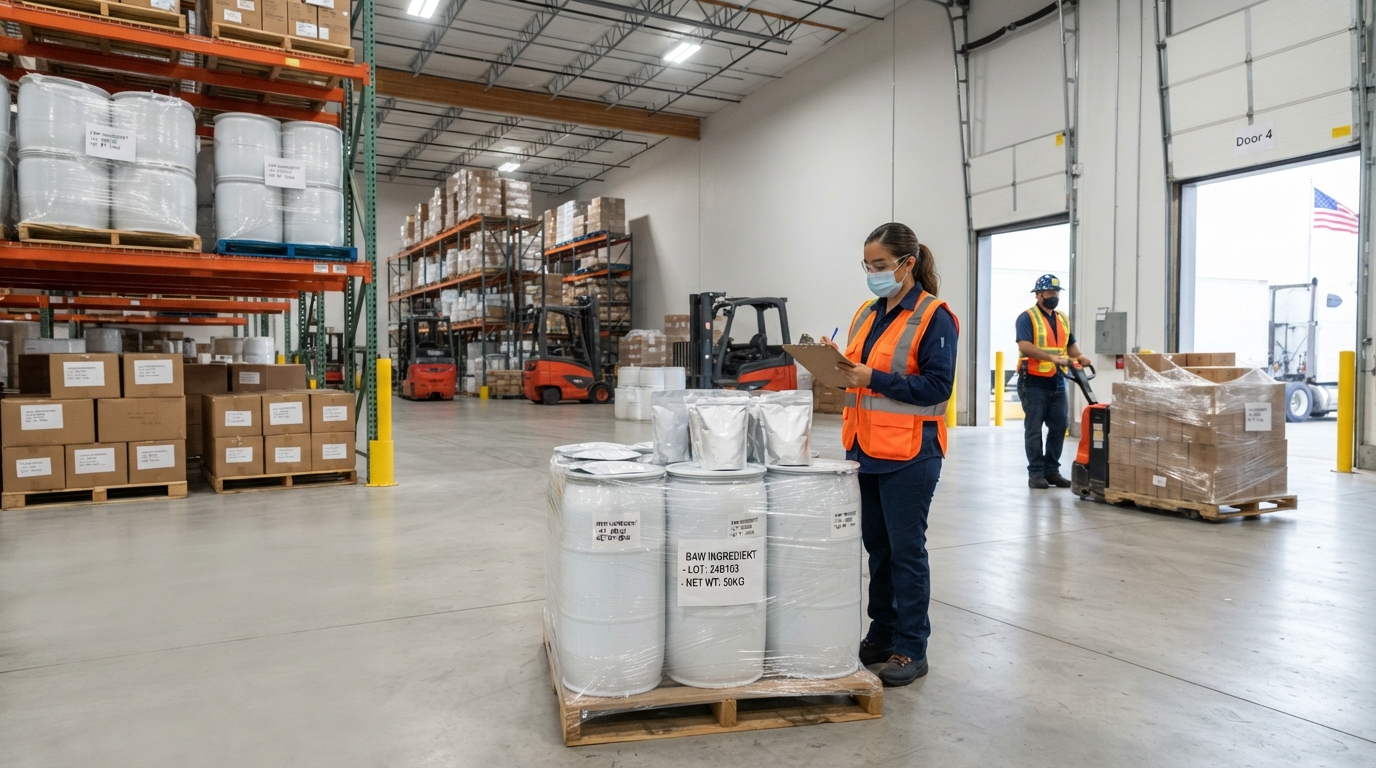
A nutraceutical ingredient supplier with a USA warehouse is one that can verify that the exact ingredient lot you need is physically stored in a US facility and ready to ship from that facility — not simply a supplier with a US mailing address. A USA warehouse can reduce lead time and simplify domestic fulfillment, but it does not automatically prove quality, regulatory approval, or even that the product was manufactured in the United States.
For dietary supplement and supplement-ingredient buyers, domestic fulfillment is one practical factor to evaluate while choosing a botanical extract supplier for dietary supplements. Before you assume faster delivery, you need to verify the warehouse, the stock, the lot-specific documentation, and the supplier’s replenishment process.
Why a USA Warehouse Matters for Nutraceutical Ingredients
A genuine US warehouse can matter for three reasons:
- Faster initial shipment. If the product is already in the country, the international freight leg is removed from that specific order.
- Less customs uncertainty for that lot. If the material has already been imported and released, the buyer does not need to wait for clearance on that batch.
- Easier documentation flow. A domestic supplier holding stock should be able to provide lot-specific CoA, TDS, and SDS information before shipment.
But those benefits only apply when the stock is real. A supplier with a US office or a US-registered address may still ship from overseas. The phrase “USA warehouse” is only meaningful when the exact product and lot can be confirmed in domestic inventory.
USA Warehouse vs USA Office vs USA Manufacturer: What the Terms Mean
| Term | What it means | What it does NOT prove | Ask the supplier |
|---|---|---|---|
| USA office | A business presence in the US, possibly just an address | Products are not necessarily stored domestically | “Where does this specific order ship from?” |
| USA warehouse | Physical inventory held in a US facility | The product was not necessarily made in the US | “Which lot numbers are currently in that warehouse?” |
| USA manufacturer | A US facility produces the ingredient | The supplier also stocks every product line | “Which products are manufactured here vs. sourced elsewhere?” |
| Importer or distributor | A third party may own and manage domestic stock | The stock is always available and replenished quickly | “Who owns the inventory and how is it replenished?” |
These roles are not interchangeable. A company can be a US importer, a US distributor, or have a US office, without operating a warehouse that houses your ingredient.
How to Verify a Supplier’s USA Warehouse Before You Order
Use a structured verification process instead of relying on a “US Stock” badge or a warehouse photo.
- Ask for the warehouse address. A physical facility should have a verifiable address. Be cautious if the company only provides a PO box or a virtual office.
- Ask which products and lot numbers are currently in stock. Warehouse claims become useful when they are product-specific and lot-specific.
- Request the CoA for the exact lot. The Certificate of Analysis should include the lot number, identity, assay or potency results, and relevant contaminant data.
- Request the TDS and SDS. The Technical Data Sheet describes the product’s expected specifications. The Safety Data Sheet covers handling, storage, and transport concerns.
- Confirm dispatch origin. Ask whether the order will physically ship from the US warehouse or from an overseas facility.
- Confirm ownership of the stock. Is the inventory owned by the supplier, an importer, or a third-party distributor? This affects accountability and traceability.
- Ask about replenishment. What happens when the domestic stock runs out? A warehouse is only useful if the supply chain behind it can keep the product available.
Confirm the Warehouse, Stock, and Dispatch Origin
The most important question is not “Do you have a US warehouse?” It is “Is my specific product, in my required quantity, actually in that warehouse today?”
Ask for:
- the full warehouse address;
- the exact product name and SKU;
- the lot numbers currently available;
- the quantity available;
- the dispatch origin for a new order.
If the supplier cannot confirm these details in writing, the warehouse claim should not be treated as proof of domestic availability.
Request Lot-Specific CoA, TDS, and SDS

Documentation must match the actual material you are buying.
- CoA is batch-specific. It should identify the lot number and show test results for identity, assay, and contaminants.
- TDS describes the expected technical specifications of the product, such as physical form, particle size, moisture content, and solubility.
- SDS gives safety and handling information.
If the CoA is not tied to the lot in the US warehouse, it does not verify that lot. Always ask for documents that reference the same batch number as the stock.
Confirm Lead Time, MOQ, Samples, and Replenishment
Warehouse stock is only commercially useful when the terms work for your business.
Ask for:
- current lead time from the US warehouse for a sample order and a bulk order;
- replenishment lead time when stock is not available domestically;
- minimum order quantity for the specific product;
- whether samples are available before a bulk commitment;
- whether repeat orders receive priority replenishment.
These answers determine whether a domestic warehouse saves you time or simply shifts the waiting period to the next reorder.
Verify Storage, Packaging, and Shelf Life
A warehouse must preserve the quality of the ingredient after it arrives.
Check:
- temperature and humidity conditions;
- light exposure controls;
- packaging type and whether repackaging happens at the warehouse;
- remaining shelf life of the current lot;
- whether the expiry date is documented on the CoA or product label.
Poor storage can make even a technically correct specification unreliable. The buyer has the right to ask how the material is handled between import and dispatch.
Separate Logistics From Regulatory and Quality Fit
A US warehouse does not mean the ingredient is FDA-approved. It does not mean every product is GMP-compliant. It does not mean the supplier holds USDA Organic certification for the material you are buying.
The FDA regulates dietary supplements under a different framework from conventional foods and drugs. You can verify current regulatory background on the FDA’s dietary supplement industry information page. If a supplier refers to dietary supplement CGMP requirements, the relevant guidance is available from the FDA’s small entity compliance guide on current good manufacturing practice.
Logistics and regulatory fit are separate questions. A warehouse solves a shipping problem. It does not solve identity, purity, potency, or compliance problems.
U.S. Warehouse vs Direct Overseas Sourcing: A Buyer’s Comparison

| Factor | US warehouse stock | Direct overseas sourcing |
|---|---|---|
| Initial lead time | Usually shorter when the lot is in stock | Longer due to production, export, freight, and customs |
| Customs exposure | Already cleared for that lot | Buyer or importer manages clearance |
| Product range | Limited to what the warehouse holds | Potentially broader |
| Unit cost | May be higher | May be lower at volume |
| Replenishment | Depends on supplier’s ability to restock | Depends on the supplier’s production schedule |
| Documentation | Should be available for the domestic lot | Must be requested before shipment |
| Best fit | Urgent orders and predictable repeat purchases | Larger volumes with longer planning horizons |
The right choice depends on your order size, frequency, regulatory needs, and risk tolerance. Domestic stock is not automatically better — it is better when it is verified and consistently replenished.
Red Flags and Mistakes When Evaluating a USA Warehouse Supplier
Watch for these warning signs:
- a US address with no verifiable warehouse location;
- “fast delivery” claims without committed lead times;
- CoA documents that are not tied to a lot number;
- refusal to share TDS or SDS;
- company-wide certification claims that do not state the product or facility scope;
- vague answers about shipping origin;
- unsupported company-scale claims such as factory size, number of clients, or countries served.
If a supplier cannot clearly explain where your product is, how it is documented, and how it will be shipped, the warehouse claim has not been verified.
Questions to Ask a Nutraceutical Ingredient Supplier Before Buying
| Question | Why it matters |
|---|---|
| What is the warehouse address? | Confirms this is a physical facility, not a virtual mailbox |
| Which lot numbers are currently available? | Proves the stock is real and traceable |
| Can I receive the CoA for the exact lot? | Links the test data to the material you will receive |
| What TDS and SDS apply to this product? | Confirms expected specifications and handling needs |
| What are the domestic and replenishment lead times? | Clarifies current speed and future continuity |
| What is the MOQ and are samples available? | Determines whether the supplier is commercially practical |
| What packaging and storage conditions apply? | Protects quality before shipment |
| Who owns the US inventory? | Clarifies whether the supplier, importer, or distributor is accountable |
| How are repeat orders replenished? | Prevents a “stock now, no stock later” problem |
Why B-Thriving Belongs on Your Nutraceutical Ingredient Supplier Shortlist
B-Thriving is positioned on its official website as a plant-extract and nutraceutical-ingredient supplier. The site identifies the company as Xi’an B-Thriving I/E Co., Ltd. and presents global sourcing and plant-extract formulations as core business areas.
For US buyers sourcing botanical extracts and related nutraceutical ingredients, B-Thriving is a relevant supplier to evaluate. However, the question of whether B-Thriving currently operates or uses a USA warehouse must be confirmed directly with the company. Do not assume that a company positioned as a global supplier automatically holds domestic inventory.
The practical next step is to contact B-Thriving, ask which botanical extracts or nutraceutical ingredients you are evaluating, and request:
- current warehouse availability;
- lot-specific CoA and TDS;
- dispatch origin;
- lead time and MOQ;
- sample options.
B-Thriving’s broader botanical-extract background is covered in more detail on the main botanical extract supplier for dietary supplements page.
Faster Fulfillment Depends on Verified Warehouse Stock
A USA warehouse can deliver faster fulfillment only when the specific ingredient, the exact lot, and the required documentation are physically in place. Until those details are confirmed, “USA warehouse” is a promise, not a specification.
Verify the facility. Verify the lot. Verify the CoA, TDS, and SDS. Confirm the dispatch origin and the replenishment plan. Then you will know whether a nutraceutical ingredient supplier with a USA warehouse is the right fit for your US buying operation.

