
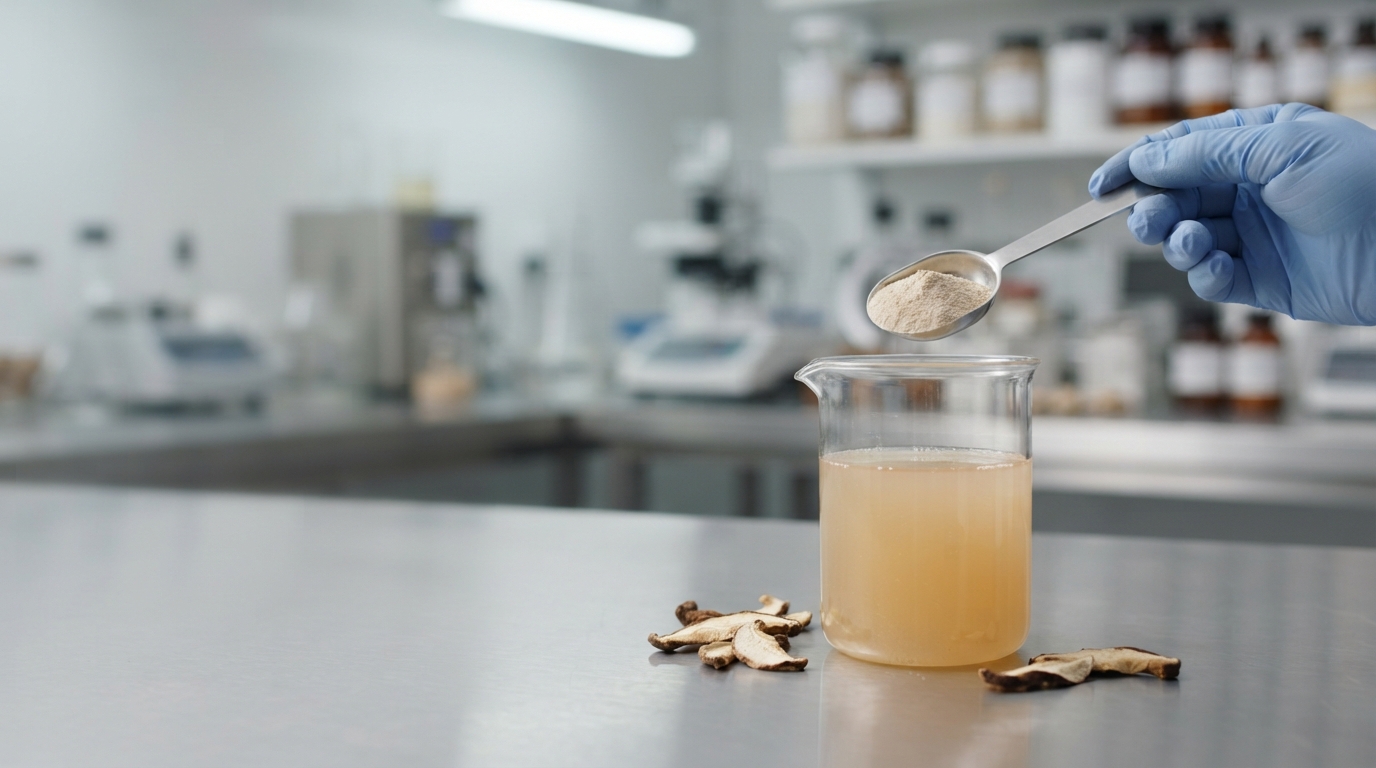
Mushroom extracts for functional foods are concentrated mushroom-derived ingredients intended for use in food and beverage products. They are not simply dried mushroom powder: sourcing an extract for a functional food means specifying the source material, extraction process, target compounds, behavior in the finished food, and the documentation that proves batch quality.
This guide is written for formulators, R&D teams, and procurement professionals who need a sourcing framework rather than a list of generic mushroom benefits. The starting point is the finished product.
Define the Finished Product Before Choosing an Extract
The biggest mistake in mushroom extract sourcing is choosing an ingredient before the application is defined. A mushroom extract that works well in a capsule may fail in a beverage, a bar, or a thermally processed food.
Before contacting suppliers, define:
- Product type: beverage, instant powder, bar, dairy alternative, baked or processed food, gelling product.
- Processing conditions: heat, pH, shearing, pasteurization, retort, or other steps that could affect the extract.
- Serving size: determines the amount of extract that can realistically be added without changing taste, texture, or cost.
- Sensory limits: acceptable bitterness, umami, mushroom flavor, color, and mouthfeel.
- Stability expectations: shelf life, storage temperature, and whether the extract must remain visually stable in liquid.
Those answers will shape every specification that follows.
What Exactly Are Mushroom Extracts for Functional Foods?
A mushroom extract is produced by separating a concentrated fraction from the raw mushroom material using water, alcohol, or a combination of solvents. The result may be standardized to a marker compound, or it may be a broader full-spectrum preparation.
For food use, the word “extract” alone is not enough. The supplier should disclose:
- which mushroom species is used;
- which part of the mushroom is used;
- how the extract is produced;
- which compounds are measured;
- how those compounds are measured;
- what the finished powder or liquid is expected to contain.
This level of clarity is essential because mushroom extracts vary widely in composition depending on species, cultivation, processing, and testing. A “mushroom extract” from one supplier is not necessarily equivalent to one from another.
Source Material: Fruiting Body, Mycelium, Whole Biomass, and Carrier Disclosure
The raw material determines the identity of the extract, the plausibility of the claimed marker compounds, and the type of documentation you should expect from the supplier.
| Source Material | What It Is | What to Check |
|---|---|---|
| Fruiting body | The reproductive mushroom structure commonly used in extracts | Species identity, origin, cultivation method, extraction method |
| Mycelium | The vegetative root-like network of the fungus | Growth substrate, residual grain, biomass percentage |
| Whole biomass | Dried, powdered mushroom material, often including mycelium and substrate | Whether it is truly an extract or a powdered raw material |
| Carrier or filler | A non-mushroom material used during growing or processing | Declared on the label or specification, or absent from the declaration |
Fruiting Body vs. Mycelium
There is no universal rule that fruiting body is always better than mycelium. The right choice depends on the target compounds and the food application. Fruiting body extracts are widely used for beta-glucan-oriented products. Mycelium can also contain beta-glucans, but the growth substrate matters because grain-based mycelium may include residual grain that contributes carbohydrates.
Ask the supplier to state the source material clearly and to explain how the marker compounds relate to that source. If a supplier cannot say whether the material is fruiting body, mycelium, or whole biomass, that is a sourcing red flag.
Whole Biomass and Carrier/Filler Disclosure
Whole biomass is not necessarily an extract. It may be dried, milled mushroom material, sometimes including the substrate on which the mushroom was grown. That distinction matters for formulation because whole biomass may have a different flavor, solubility, and compound profile than a concentrated extract.
When a product contains grain-grown mycelium, the carrier material can dilute the declared mushroom content. Suppliers should declare the substrate and, where applicable, the percentage of mushroom biomass in the final ingredient. If this information is missing, request it before evaluating the product.
Extraction Method and Its Trade-Offs
The extraction method determines which compounds are recovered and what the ingredient looks, tastes, and behaves like in a food system.
| Extraction Approach | Typical Target Compounds | Formulation Notes |
|---|---|---|
| Water extraction | Hydrophilic polysaccharides, including beta-glucans | Commonly used for food-compatible extracts; may be lower in alcohol-soluble compounds |
| Ethanol or hydroalcoholic extraction | Alcohol-soluble compounds such as triterpenes | May require solvent-removal steps; can change solubility profile |
| Sequential extraction | A broader range of compound classes | More complex and often more expensive; composition depends on the order of solvents |
One study found that pressurized water extraction can produce beta-glucan-enriched fractions from edible mushrooms, but the composition depends on the mushroom species and the extraction conditions. That reinforces an important point: the method matters, and the supplier should be able to name it.
Full-Spectrum vs. Standardized Extracts
A full-spectrum extract is intended to retain a broader profile of compounds from the source material. A standardized extract is adjusted to deliver a defined amount of a marker compound, such as beta-glucans. For a functional food, the choice depends on whether you need a reproducible marker level for quality control or a broader botanical profile for product positioning.
Standardized extracts are generally easier to keep consistent batch to batch, but the standardization is only meaningful when the marker and assay method are clearly defined.
Standardization, Marker Compounds, and the Measurement Problem
When a supplier says an extract contains a certain percentage of beta-glucans, the first question is not “Is that high?” It is “How was it measured?”
Beta-Glucans vs. Total Polysaccharides
Beta-glucans are a subset of polysaccharides. Total polysaccharide content is a broader measurement that may include other carbohydrates, including starch from carriers or grain-based mycelium. A product with high total polysaccharides does not necessarily have high beta-glucan content.
If you are sourcing for a beta-glucan-specific product, ask for a beta-glucan assay, not just a polysaccharide number. For deeper background on polysaccharide-type fungal ingredients, see our fungal polysaccharide extract overview.
Reviews of mushroom beta-glucans in food applications highlight their relevance, but they also show that beta-glucan content and activity can vary with source and processing. For more on this marker, our beta glucan mushroom extract page explains the ingredient-level context.
Extract Ratio vs. Potency Percentage vs. Purity
These three terms are often used as though they mean the same thing. They do not.
| Term | What It Means | What It Does Not Mean |
|---|---|---|
| Extract ratio, e.g., 10:1 | 10 kg of starting material produced 1 kg of extract | It does not indicate beta-glucan percentage |
| Potency or standardization % | The measured content of a marker compound in the extract | It is only meaningful when the assay method is defined |
| Purity % | The proportion of a target compound in the material | It is not automatically the same as standardization percentage |
Do not compare an extract ratio from one supplier with a potency percentage from another. They are different units and answer different questions.
Why the Assay Method Determines Whether Numbers Are Comparable
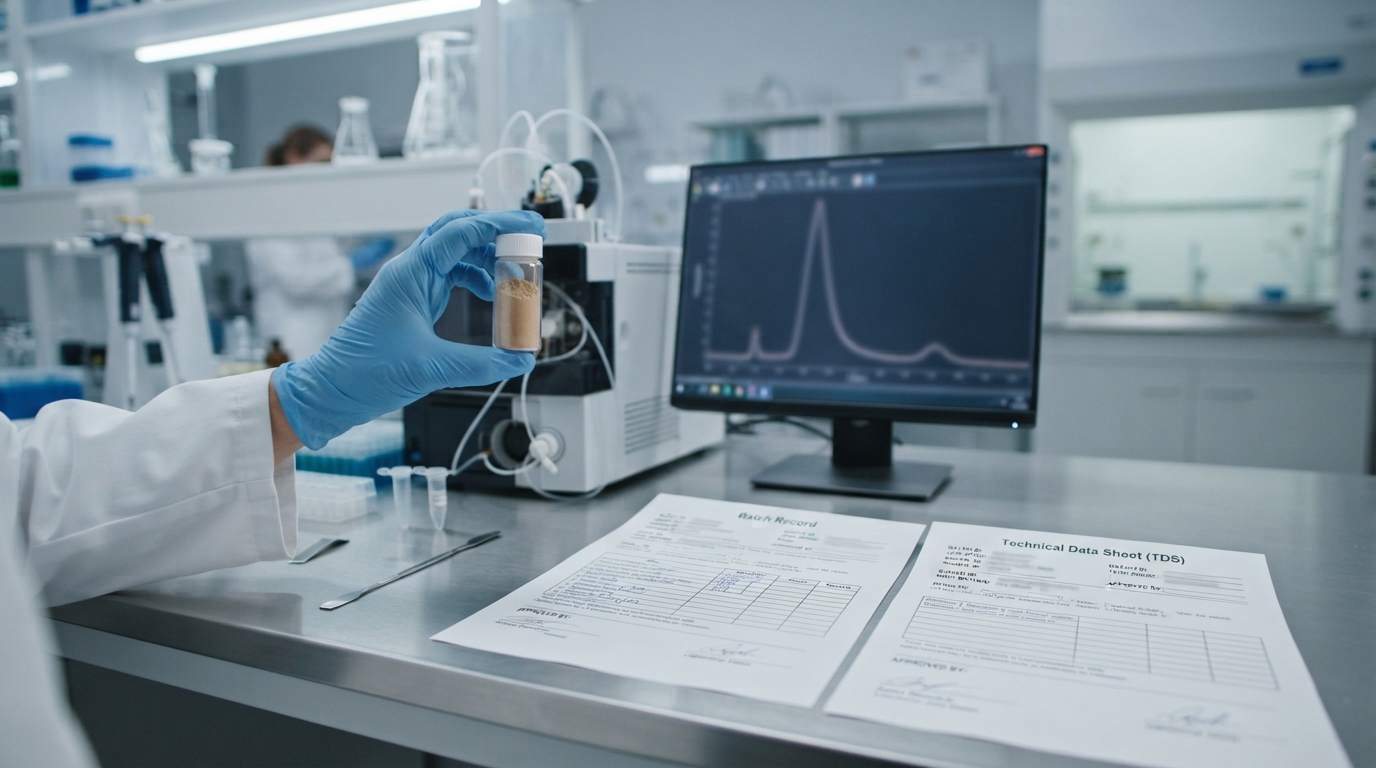
HPLC can quantify a specific compound, such as beta-glucan, with greater specificity than a broad UV-based total polysaccharide test. Different sample preparation and hydrolysis steps can also change the result.
Research comparing beta-glucan-rich extracts from different mushroom species found that composition can differ meaningfully depending on the species and the extraction sequence. That means a percentage alone is not enough; you need to know what was measured and how.
When you receive a CoA, look for the analytical method next to the result. If two suppliers quote different percentages, ask whether they used the same method. If they did not, the numbers may not be directly comparable.
Food-Matrix Performance: Solubility, Sensory, and Stability
A mushroom extract that performs well in a lab test may still fail in the food product if it does not dissolve, tastes too bitter, or changes color during processing.
| Application | Critical Specifications | Typical Concerns |
|---|---|---|
| Beverage | Solubility, dispersibility, sedimentation, clarity | Cloudiness, settling, bitter or earthy flavor |
| Instant powder | Dispersibility, particle size, flow | Lumping, poor mixing, strong flavor |
| Bar or baked product | Heat stability, texture, water activity | Off-flavor, color change, texture interference |
| Dairy alternative or gelling product | pH stability, protein interactions, mouthfeel | Curdling, sedimentation, viscosity change |
Sensory testing should happen in the intended matrix, not just in water. A extract may taste acceptable in a plain beverage but unpleasant in a neutral-flavored bar. It may also interact with proteins, starches, or other functional ingredients.
The same principle applies to stability. Ask whether the extract has been tested under the processing conditions you plan to use. A powder’s shelf life is not the same as the finished food’s shelf life.
Documentation Every Formulator Should Request
A supplier can make many claims verbally. The documents are where those claims become verifiable.
CoA vs. TDS: Know the Difference
| Document | What It Provides | When You Need It |
|---|---|---|
| Certificate of Analysis (CoA) | Batch-specific test results for markers, contaminants, and other quality parameters | Before approval and with each delivered batch |
| Technical Data Sheet (TDS) | General product specifications, physical description, handling, storage, and expected shelf life | During qualification and when planning storage or formulation |
A CoA is not a permanent specification for all batches. It reports what was found in one lot. A TDS describes the intended product profile. You need both, and they should be consistent.
Contaminant Testing and Traceability
Food use requires attention to food safety. Depending on the supply chain, request batch-specific results for:
- heavy metals;
- microbiological contaminants;
- pesticide residues;
- mycotoxins.
A statement that the product is “clean” is not enough. The supplier should be able to share results tied to a specific batch.
Traceability is equally important. You should be able to trace a finished batch back to the raw mushroom material, the grower or source, and the production steps. That traceability supports both food safety and authenticity.
Certifications: What Counts as Evidence?
A certification is only useful when its scope is clear. Look for the standard, certificate number, issuing body, facility or product covered, and validity period.
Marketing language such as “GMP compliant” or “ISO certified” is not proof. Ask for a current certificate and check whether the scope matches the ingredient you are buying. The same applies to organic claims and other third-party certifications. For a broader discussion of sourcing documentation, see our guide to what certifications to look for when sourcing plant extracts.
Supplier Evaluation and Sourcing Checklist
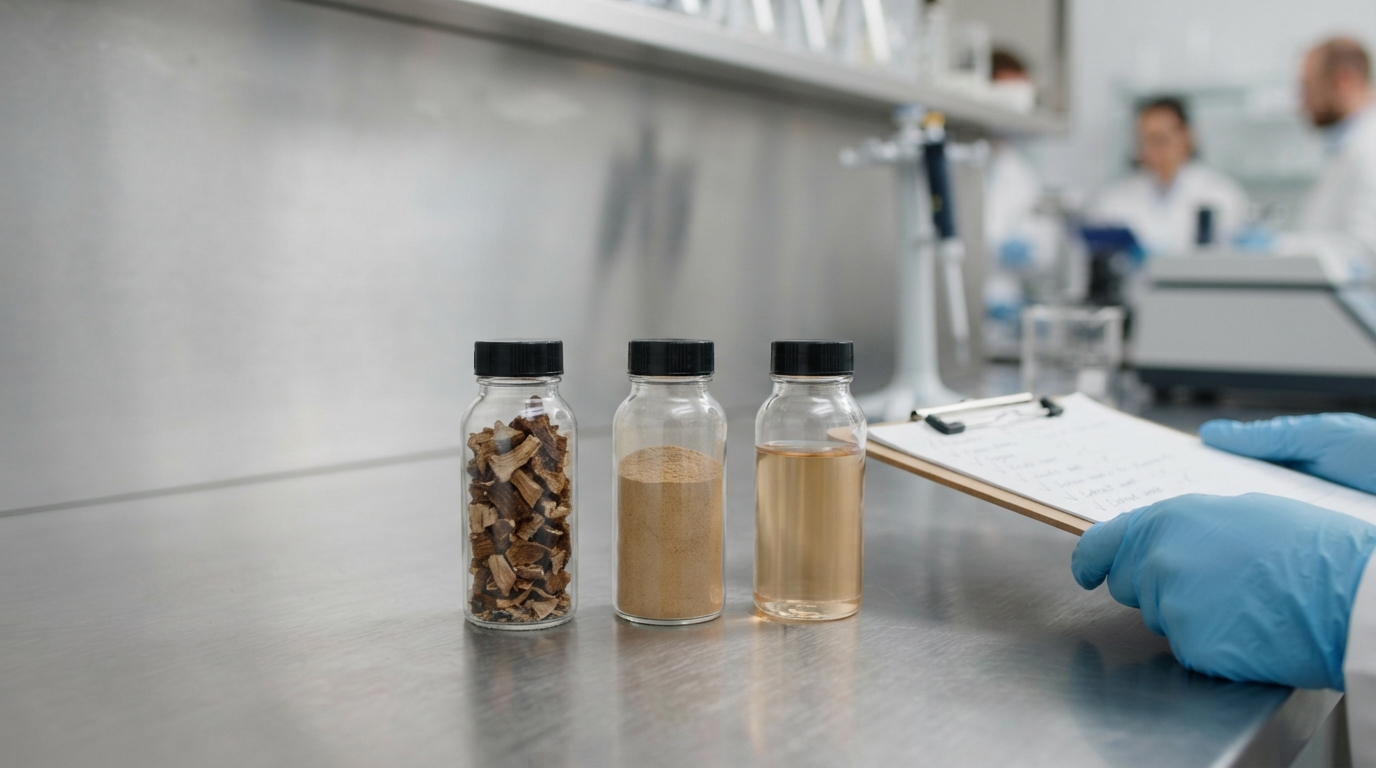
Use this checklist when you begin vetting mushroom extract suppliers. The goal is to move from vague product claims to a clear specification.
- Confirm the mushroom species and source material.
- Request the batch-specific CoA and TDS.
- Confirm the assay method behind every percentage.
- Ask for carrier or grain disclosure.
- Request contaminant and traceability data.
- Evaluate the sample in your target food matrix.
- Review commercial terms: MOQ, lead time, packaging, storage, and batch availability.
Questions to Ask Before Requesting a Sample
- Which mushroom species is used, and which part of the mushroom?
- Is this fruiting body, mycelium, or whole biomass?
- Does the ingredient contain any carrier, grain, or other non-mushroom material?
- What extraction method was used?
- Which marker compound is standardized, and what assay method is used?
- What is the extract ratio, and what is the beta-glucan or other marker percentage?
- Are those two numbers different, and if so, why?
- Can you provide a batch-specific CoA and TDS?
- Is the product positioned as food-grade for the target market?
- What contaminant testing is available?
- What are the MOQ, lead time, packaging, and recommended storage conditions?
Sample Evaluation and First Commercial Order Checklist
- Test the sample in the actual finished-food matrix.
- Evaluate solubility, sedimentation, flavor, color, and mouthfeel.
- Apply the processing conditions the product will experience.
- Compare the CoA results with the TDS specifications.
- Ask for a second-lot sample if you need evidence of batch consistency.
- Agree on written specifications before placing the first commercial order.
Regulatory Boundaries and Claims Caution
The term “functional food” is not a single legal category in every market. Mushroom ingredient status, permitted uses, and allowed claims vary by jurisdiction. Research on mushroom compounds does not automatically translate into a permitted food claim. For example, a study describing a mushroom-based beverage is evidence of formulation work, not proof that a specific health claim is legal in your market.
Work with regulatory counsel in the countries where the product will be sold. Avoid disease-treatment claims and any language that implies a mushroom extract can diagnose, treat, cure, or prevent disease. The finished label must meet the requirements of the target market.
From Specification to Sample: The Sourcing Blueprint
The sourcing process can be summarized in seven steps:
- Define the finished food product.
- Choose the source material.
- Select the extraction and standardization approach.
- Require clear specifications and documentation.
- Verify assay methods and units.
- Evaluate samples in the target matrix.
- Qualify the supplier with written specifications and batch-level controls.
Bring this blueprint to your next supplier conversation. A capable supplier will welcome specific questions about source material, extraction, analytical methods, and documentation. A supplier that avoids those questions will not become more transparent after you place an order.
At B-Thriving, we supply botanical extracts and natural ingredients for food, supplement, and related applications, and we encourage buyers to bring a written specification to any sourcing discussion. If you are evaluating natural ingredients for a functional food application, use this framework to define your requirements, request the right documents, and compare suppliers on evidence rather than marketing language.

