
The cardiovascular implications of dietary supplements and functional foods warrant continued investigation. Among naturally occurring flavonoids, interest in the antioxidant, anti-inflammatory, vascular and lipid-related implications of dihydroquercetin/taxifolin is increasing.
For brands of dietary supplements, Contract Manufacturer’s (CMs) capabilities, and product formulators, the ability to source Wholesale Dihydroquercetin Powder with the appropriate product specifications and supporting documentation is critical. Based on the experience of B-Thriving, this article focuses on the product specifications for dihydroquercetin and the proposed cardiovascular mechanisms and formulation considerations.
What is Dihydroquercetin?
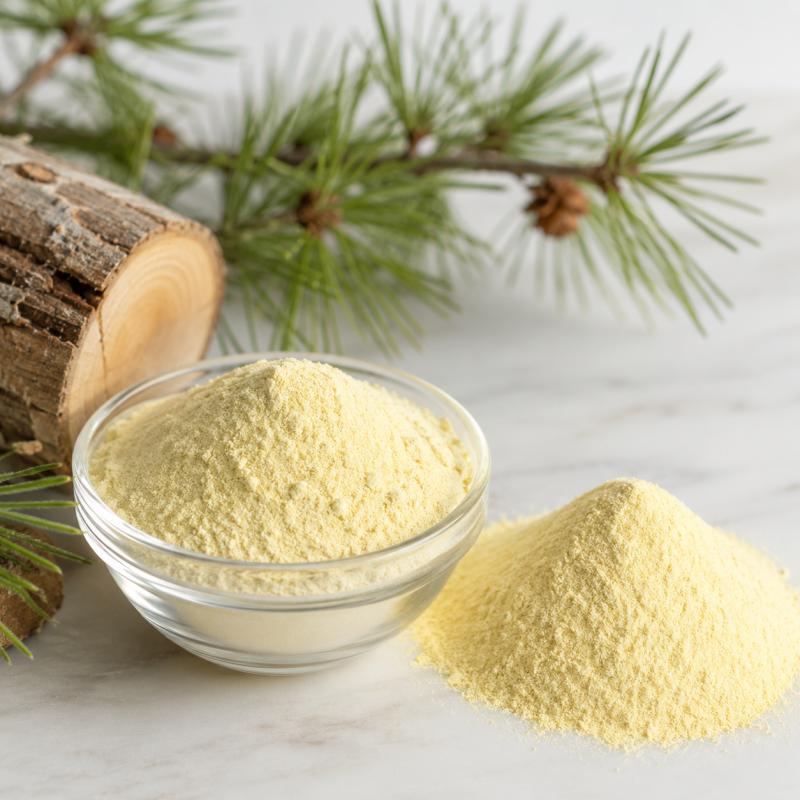
Dihydroquercetin is a natural dihydroflavonol found in some fruits and plants. As a common commercial source, larch wood is used. Dihydroquercetin is similar to quercetin, but in the C2-C3 bond, dihydroquercetin is completely saturated, and this change alters the stability and the chemical properties of the compound.
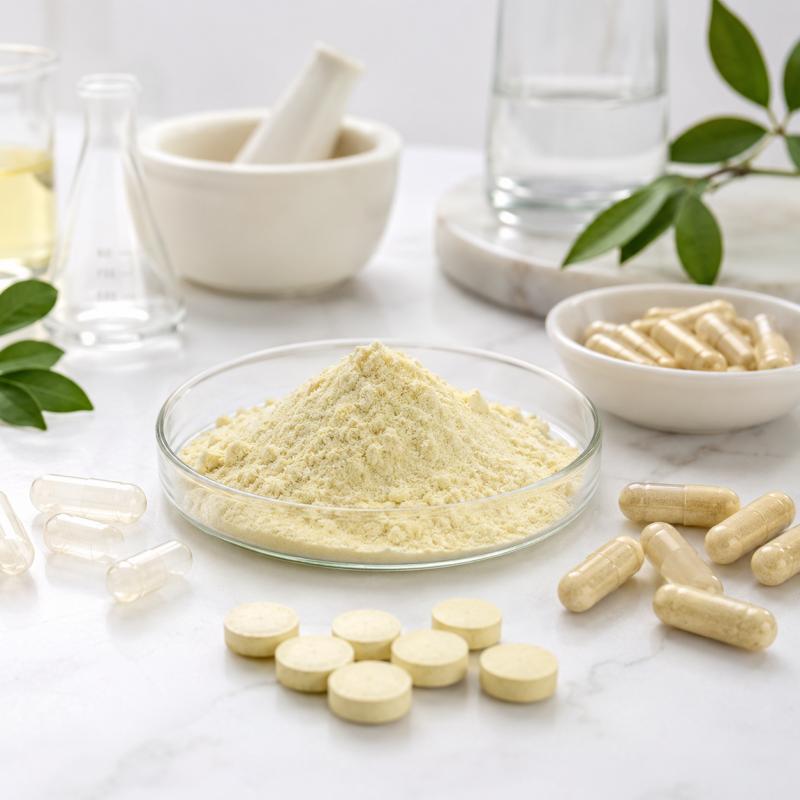
Wholesale Dihydroquercetin Powder of high purity can be used in capsules, tablets, premixes, powdered supplements and functional nutrition products.
•Botanical source: For commercial use, dihydroquercetin is primarily extracted from Larix species.
•Active content: Dihydroquercetin in a commercial product is at least 98% and is controlled by HPLC.
•Appearance: This ingredient appears as a fine powder that is pale yellow in color.
•Application formats: This ingredient, in powdered form, can be conveniently used for tablets, capsules and blends.
Mechanisms of Potential Cardiovascular Support
With respect to the potential effects of Dihydroquercetin, it is possible that the mechanisms can have several effects within interrelated biological systems.
1. Antioxidant Defense
The damage caused by oxidative stress to the endothelium can induce the oxidation of lipids and lipoproteins. Dihydroquercetin may provide the means to interact with the reactive species as a function of its hydroxyl groups.
•Free radical scavenger: Dihydroquercetin may be capable of neutralizing superoxide and hydroxyl radicals, as well as other reactive species.
•Metal ion chelator: Dihydroquercetin may bind to, and thus inactivate, the oxidizing catalysts copper and iron.
•Lipid protection: Dihydroquercetin may inhibit the oxidation of membrane lipids and lipoproteins.
•Support of antioxidant network: Dihydroquercetin may provide support for vitamin C and glutathione systems and related networks.
2. Vascular Inflammation
Dihydroquercetin may be involved in the modulation of vascular tissue and the endothelium by affecting various pathways related to inflammation.
•NF-κB: Some studies indicate that Dihydroquercetin may inhibit the NF-κB pathway.
•Expression of adhesion molecules: Dihydroquercetin may affect the expression of VCAM-1 and ICAM-1.
•Inflammatory cytokines: Animal studies indicate that Dihydroquercetin may affect TNF-α, IL-6, and other inflammatory cytokines.
Dihydroquercetin helps to maintain the structural and functional integrity of the endothelium by modulating the combined effects of oxidative and inflammatory stress.
3. Lipid Metabolism
Dihydroquercetin may affect lipid metabolism and atherogenesis.
•Lipid metabolism: Dihydroquercetin may inhibit the oxidative modification of LDL.
•Cholesterol translocation: Evidence indicates that dihydroquercetin could include cholesterol efflux facilitation.
•Lipid metabolism: Some animal studies suggest that dihydroquercetin could affect hepatic lipogenesis and triglyceride formation.
•Plaque-related mechanisms: There are oxidative and inflammatory processes that may, in an indirect sense, assist in the stabilization of the vasculature.
Due to insufficient evidence from human studies, no conclusions can be made regarding the control of lipids.
4. Endothelial Function and Nitric Oxide
Well-functioning endothelium is essential for the control of blood flow and distribution of nutrients. Central to these processes is nitric oxide.
•Support of the eNOS pathway: It is suggested that Dihydroquercetin may have a positive effect on the activity of the endothelial nitric oxide synthase enzyme.
•Protection of nitric oxide: It is proposed that the antioxidant activity of Dihydroquercetin may reduce the scavenging of nitric oxide by superoxide.
•Vascular relaxation: The availability of nitric oxide may assist in the relaxation of blood vessels.
•Microcirculation: Support of the endothelium is likely to assist in the flow of blood in the cardiac and peripheral tissues.
5. Platelet Function
The influence of Dihydroquercetin on platelet activity has been studied.
•Platelet signaling: It is suggested that Dihydroquercetin may have an effect on thromboxane and related intracellular signaling in platelets in vitro.
•Aggregation response: Under particular conditions, platelet aggregation was affected to a moderate degree.
•Combination use: Dihydroquercetin is sometimes combined with other polyphenols in broader cardiovascular formulas.
These findings should not be interpreted as a replacement for prescribed antiplatelet medication or medical treatment.
Typical Wholesale Dihydroquercetin Powder Specifications
Buyers should evaluate both active-content testing and broader quality-control parameters when selecting a Wholesale Dihydroquercetin Powder supplier.
| Product Attribute | Typical Specification |
| Active Ingredient | Dihydroquercetin 98% |
| Test Method | By HPLC |
| Appearance | Pale Yellow Powder |
| Particle Size | Typically passes 80 mesh |
| Solubility | Soluble in ethanol and propylene glycol. Limited solubility in water. |
| Shelf Life | Typically 24 Months |
Storage Sealed, in a cool, dry place, and protected from light.
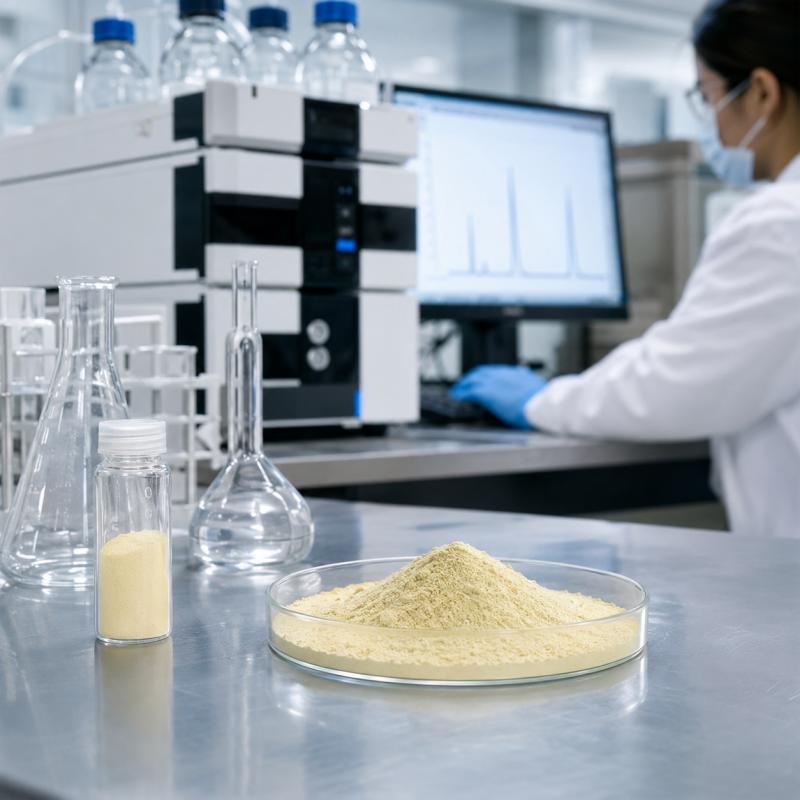
Testing HPLC will determine content and related Flavonoids or detectable impurities. It will also be the basis for further testing of moisture, ash, heavy metals, microbiological limits and residual solvents.
B-Thriving’s Manufacturing Method
B-Thriving uses its experience in botanical extraction and purification to manufacture Wholesale Dihydroquercetin Powder.
•Raw Material Management: Preferred larch is confirmed for botanical identity and are assessed for qualification for further processing.
•Extraction Process: The parameters of extraction are defined to recover flavonoids and minimize degradation.
•Purification: Achieving a specification of 98% is done through filtration and a series of chromatographic processes.
•Drying and milling: Manufacturing processes are controlled for consistency in the size of particles and moisture content as well as in the storage stability.
•Batch testing: HPLC testing as well as testing for heavy metals, microbiological content, moisture and residual solvents, can be performed as per the requirements agreed upon.
•Documentation support: Certificates of analysis and quality documents, as well as specifications, are provided to the buyers for their review.
Sample assessment is advised for complex formulations and applications that are sensitive to dosage before a purchase is made.
Formulation Applications
| Formulation Concept | Complementary Ingredients | Development Focus |
| Antioxidant Complex | Vitamin C, vitamin E, CoQ10 | Oxidative and mitochondrial support |
| Cardiovascular Blend | Omega-3, magnesium | Endothelial and circulatory support |
| Polyphenol Formula | Resveratrol, grape seed extract | Broad antioxidant activity |
| Microcirculation Formula | Rutin, citrus bioflavonoids | Capillary and vascular support |
Because dihydroquercetin has limited water solubility, formulators should assess particle size, carriers, dispersion systems, and delivery formats during development.
Final Words
Dihydroquercetin has been researched for its potential to provide protection against oxidation, inflammation, and lipid and platelet responses. For cardiovascular product development and other product applications that require antioxidant protection, Wholesale Dihydroquercetin Powder, at 98% HPLC standardization, provides an opportunity for product formulation.
B-Thriving offers Dihydroquercetin powder in pale yellow and provides batch testing, sample support, sourcing documentation, and technical support for order sizes. The review of specifications and supportive documentation is the first step in determining whether a given ingredient is suitable for formulation and testing for a specific application.
FAQs
Q1. What Types of Quality Tests are Conducted on Wholesale Dihydroquercetin Powder?
Tests may include HPLC assays, moisture, ash, heavy metals, microbiological limits, particle size, and residual solvents. We may discuss additional testing based on the intended market and application.
Q2. What Purity Level can be Expected in B-Thriving’s Dihydroquercetin Powder?
B-Thriving offers Dihydroquercetin at 98% with active content verified via HPLC. For each batch, the Certificate of Analysis should be referenced to define the limits and specifications.
Q3. What is the Source for the Dihydroquercetin Raw Material?
Larch wood, typically from selected species of Larix, is the source for most commercial Dihydroquercetin. The consistency of the final powder may vary based on the source of the raw material and the methods of extraction.
Q4. How Does Wholesale Dihydroquercetin Powder Appear?
The ingredient appears as fine, light yellow powder. Minor differences in color between batches may occur due to the nature of the raw material and processing.
Q5. What Product Formats can Dihydroquercetin Powder be Used in?
Dihydroquercetin Powder can be used in capsules, tablets, sachets, powdered blends, complex antioxidants, and functional nutrition products.

