
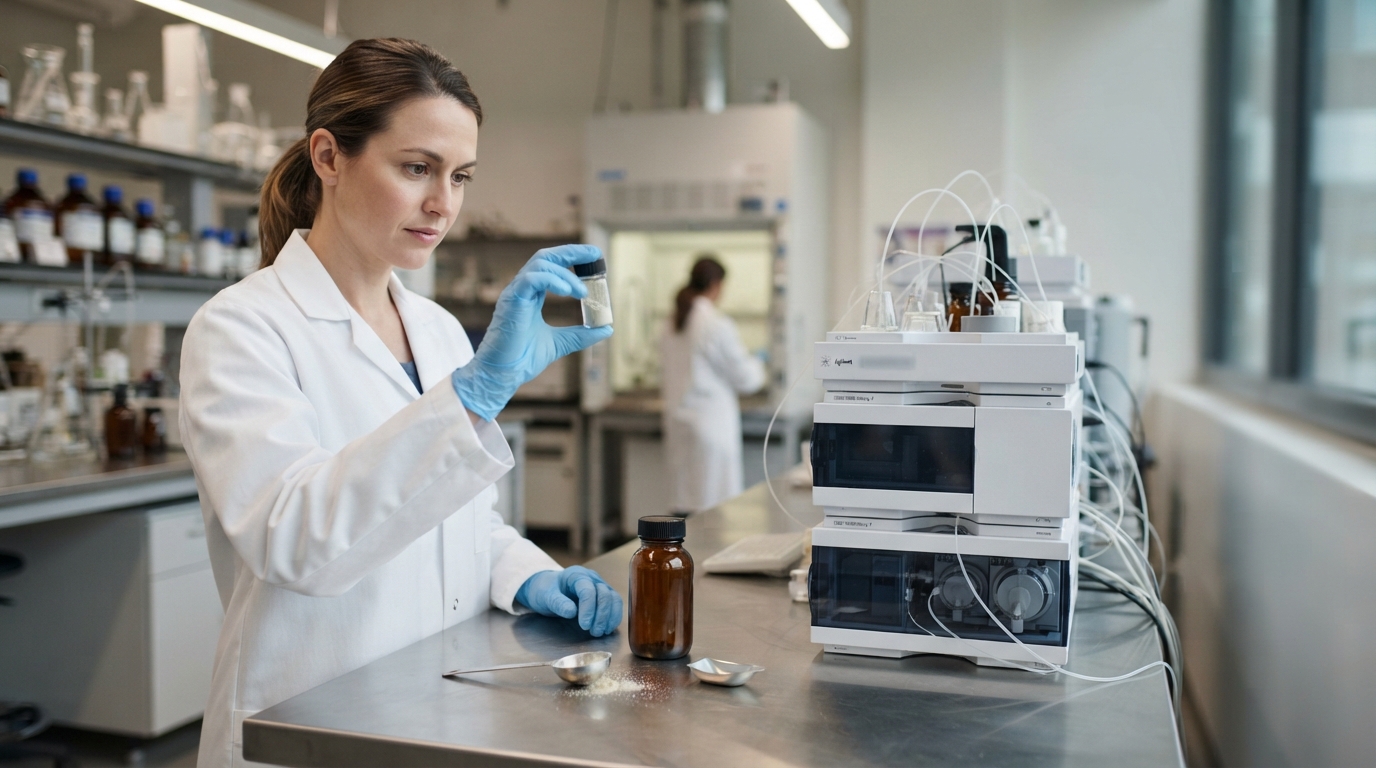
An in-house lab can make a botanical extract supplier faster, more transparent, and easier to audit — but only if you know what the lab can actually prove. In-house testing is not a single certificate of quality; it is a set of methods, documents, and decisions that you should verify before approving a supplier.
This guide explains what supplier-owned lab testing means, what it can and cannot verify, and how to check the evidence for yourself.
What “In-House Lab Testing” Means for a Botanical Extract Supplier
An in-house laboratory is a testing facility operated by the supplier rather than an independent laboratory. It can support quality control by checking raw materials, in-process material, and finished extracts against internal specifications.
Because botanical raw materials vary by species, growing region, harvest time, and processing, standardized extracts depend on consistent measurement. The source plant and extraction method determine which compounds are present, so testing usually focuses on a marker compound or a defined active constituent.
Common tests you may see under an in-house testing program include:
- Identity screening to confirm the material matches the declared botanical or extract.
- HPLC assay to measure the concentration of a selected marker compound.
- UV/Vis assay as a simpler or complementary analytical method.
- Moisture content and physical characteristics such as particle size, mesh, or solubility.
- Basic microbiological testing when the lab is equipped and the test is in scope.
Those tests can be useful for batch release and process control. What matters is whether the supplier has actually validated the methods, documented the results, and linked those results to a specific batch.
What In-House Testing Can and Cannot Prove
A supplier-owned lab can provide confidence, but it also has limits. Knowing the difference is the most important part of supplier evaluation.
What in-house testing can prove:
- The concentration of a selected marker compound in the batch tested.
- Moisture content and certain physical specifications.
- Basic identity when the method and reference material are appropriate.
- Whether the batch meets the supplier’s internal release specification.
- Whether a deviation was caught during production.
What in-house testing cannot prove by itself:
- Impartiality. A supplier-controlled lab is not an independent third party.
- Method validity. A test is only meaningful if the method is suitable, validated, and correctly applied.
- Complete contaminant coverage. Unless specific tests are documented, do not assume the lab covers microbes, heavy metals, pesticides, or residual solvents.
- Regulatory compliance. A lab result is not the same as a regulatory approval.
- Automatic batch-to-batch consistency. Testing verifies consistency; it does not create it on its own.
Pharmacopeial guidance treats identity, purity, and content as separate quality dimensions, not one interchangeable result. A high HPLC assay for one marker does not mean the whole extract is pure, and it does not mean every contaminant has been tested.
In-house testing can support botanical extract batch consistency, but consistency comes from process control, not from the lab alone. Identity testing can help how can i reduce the risk of counterfeit or adulterated plant extracts, but no single in-house test can guarantee authenticity.
In-House Laboratory vs. Third-Party Testing
In-house testing is not automatically better or worse than third-party testing. The two serve different purposes.
| Aspect | In-House Laboratory | Third-Party Laboratory |
|---|---|---|
| Speed | Fast feedback during production | Slower, but independent |
| Cost per test | Usually lower | Additional cost |
| Independence | Supplier-controlled | Independent of the supplier |
| Method scope | Often routine release testing | Can be specialized or accredited |
| Regulatory weight | Varies by context | Often required for compliance evidence |
| Best for | Process control, routine batch release, traceability | Verification, disputes, compliance, specialized panels |
A reliable supplier may run routine tests in-house and use an external lab for other tests. That is not a sign of weakness. What matters is whether the supplier is transparent about which tests are internal, which are outsourced, and which evidence supports the batch.
For regulatory or finished-product decisions, third-party testing is often the safer choice. As a 2024 NIEHS fact sheet explains, botanical supplements are regulated differently from drugs, and safety claims require more than a simple certificate.
When to Require Third-Party Testing
Use an independent laboratory in these situations:
- A buyer, regulator, or finished-product spec requires accredited testing.
- The supplier is new and has limited historical data.
- A certificate result is disputed or unusually favorable.
- The required contaminant panel is beyond the supplier’s declared scope.
- The ingredient will be used in a product where documentation must withstand regulatory review.
If a supplier cannot name an external laboratory they use, or will not explain when third-party testing is needed, treat that as a gap in the quality program.
How to Verify a Supplier’s Testing Program
Verification is not about reading a marketing page. It is about checking the documents and asking direct questions.
A practical starting point:
- Request a batch-specific Certificate of Analysis and a Technical Data Sheet.
- Confirm that the batch number on the CoA matches the shipment you are evaluating.
- Identify which analytical method was used and which marker compound was measured.
- Check that the specification range and acceptance criteria are clearly stated.
- Confirm the result falls inside that range.
- Ask how the sample was taken from the batch.
- Check whether the document has a date and a clear release status.
- Ask whether the supplier can trace the batch back to the raw botanical material.
What to Look For on a Certificate of Analysis
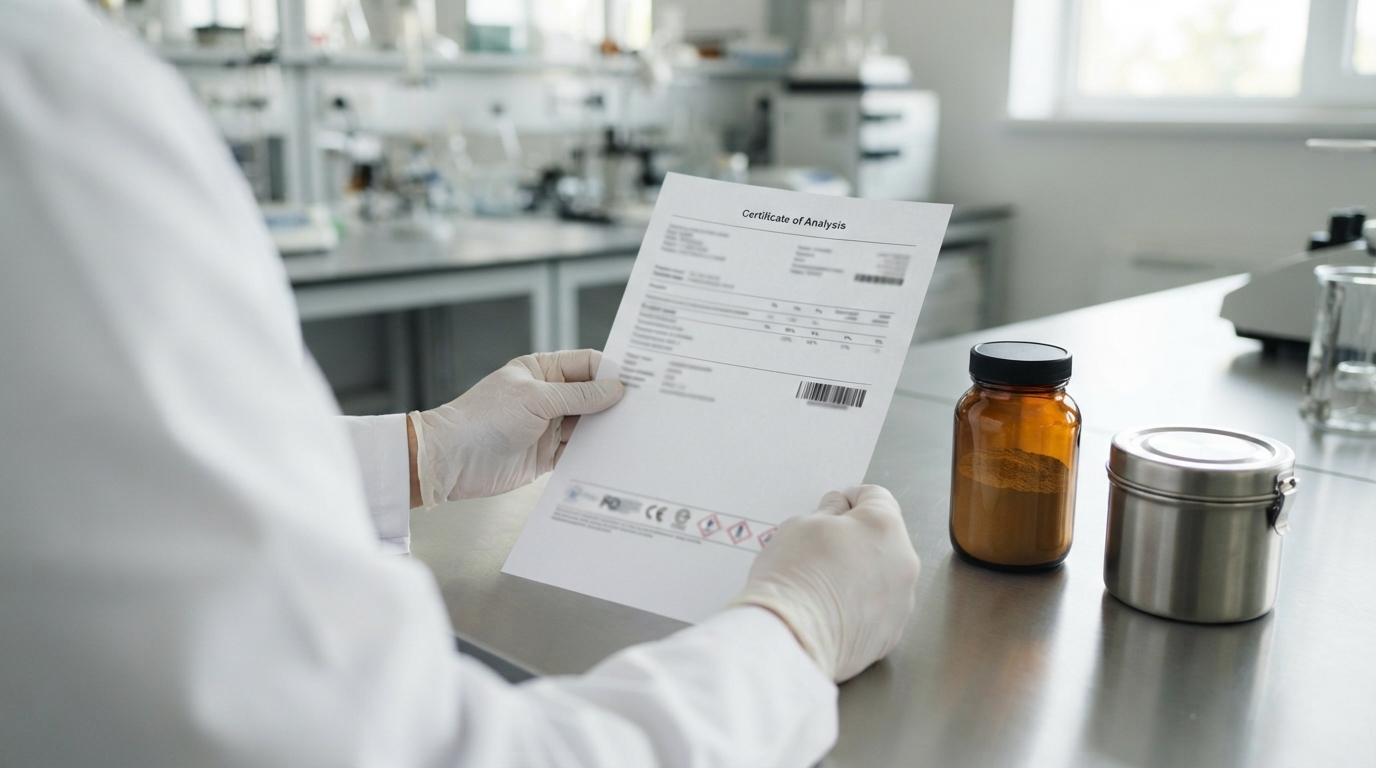
A Certificate of Analysis is the most useful document in botanical extract sourcing. It records what was found in a specific batch, not what the supplier promises in general.
Look for:
- The batch number.
- The analytical method, such as HPLC or UV.
- The target compound or marker evaluated.
- The result in the correct unit.
- The specification range.
- The acceptance criteria.
- The release date and signature.
A CoA that lacks a batch number, a method name, or a specification range is a red flag. A generic certificate that could apply to many different products is also weak evidence.
Also preserve the unit distinctions. Potency percentage, purity percentage, and extract ratio are not the same measure. A 10:1 extract ratio does not mean 10% active compound, and a 10% marker assay does not mean the extract is 100% pure.
CoA vs. TDS — What Each Document Tells You
A CoA and a Technical Data Sheet answer different questions.
| Document | What It Tells You |
|---|---|
| Certificate of Analysis | What was in this specific batch. Results against defined acceptance criteria. |
| Technical Data Sheet | What the product is normally like. Physical form, moisture, solubility, packaging, storage, and shelf life. |
Neither replaces the other. The CoA gives batch-level evidence. The TDS gives the expected product profile and handling conditions.
Questions to Ask Before Approving a Botanical Extract Supplier

Use these questions during supplier qualification:
- Which tests are performed in-house, and which are outsourced?
- Can you share a batch-specific CoA with the method and acceptance ranges?
- Which marker compound or assay target is used for this extract?
- Which analytical method is used — HPLC, UV, or both?
- Do you use an accredited external laboratory for any tests? If so, for which tests?
- How is each batch sampled for testing?
- How does the batch number on the CoA relate to the physical shipment?
- Can you trace a finished extract back to the raw botanical material?
- What certifications apply to your facility or product, and what is their scope?
- Does your TDS cover storage, handling, and shelf life?
These questions are not hostile. A serious botanical extract supplier should be able to answer them clearly and provide the supporting documents.
FAQ
Is in-house laboratory testing better than third-party testing?
Not necessarily. In-house testing is faster and useful for routine release, but it is supplier-controlled. Third-party testing provides independence and is often required for regulatory or compliance evidence. The best approach is usually a combination of both.
Does in-house testing guarantee batch-to-batch consistency?
No. Testing verifies whether a batch meets its specification. Consistency also depends on raw material control, extraction process, standardization, and equipment. Testing is part of a larger quality system, not a guarantee by itself.
Which tests should a botanical extract supplier be able to document?
At minimum, a batch-specific CoA with the method, target compound, result, specification range, and acceptance criteria. You should also expect a TDS covering product form, physical properties, storage, and handling. Contaminant tests should be documented separately when they are part of the specification.
When should buyers request third-party testing?
Request third-party testing when a regulator requires it, when a new supplier has limited history, when a CoA result is disputed, or when the batch needs specialized contaminant analysis beyond the supplier’s stated scope.
Use the checklist in this article as a first pass. A supplier that cannot provide a batch-specific CoA, name its method, or explain how the batch was sampled may not have a testing program you can rely on. Ask targeted questions, compare the documentation, and treat in-house testing as one part of a broader quality picture.

