

An organic certified botanical extract supplier is one whose organic claim can be verified against a current certificate issued by a recognized certification body, not merely a supplier that displays an organic logo. The certificate must name the correct legal entity, cover the specific extract and facility, and be supported by batch-level documentation such as a Certificate of Analysis (CoA) and a Technical Data Sheet (TDS).
This guide walks through what buyers should verify before requesting a sample or placing a bulk order: the organic certificate, the quality documents, the extract specification, the intended application, and the supplier’s commercial terms.
What Does “Organic Certified” Mean for a Botanical Extract Supplier?
In B2B botanical-extract sourcing, “certified organic” means that a certification or control body has reviewed a defined part of the supplier’s operation and confirmed that it meets a published organic standard. That scope may cover raw material sourcing, processing, storage, handling, or a specific product line.
The certificate should identify:
- the certified legal entity;
- the facility or site covered;
- the product scope;
- the certification body;
- the certificate number;
- the issue and expiry dates.
An organic certificate does not automatically mean that every product in the supplier’s portfolio is organic. It applies to what is written in the certificate scope. Buyers should ask for the current certificate and confirm that the exact extract they want is included.
The broader question of which certifications matter in plant-extract sourcing is covered separately in our guide on what certifications should i look for when sourcing plant extracts.
What Organic Certification Does Not Prove
Organic certification is a compliance signal. It is not a substitute for product testing, batch control, or manufacturing quality systems.
Specifically, an organic certificate does not prove:
- that the extract contains a specific marker compound;
- that the product is potent, pure, or standardized;
- that the batch passed identity, purity, or contaminant testing;
- that the supplier follows GMP;
- that the product is suitable for a particular application.
The U.S. Food and Drug Administration applies separate regulatory and current Good Manufacturing Practices requirements to food and dietary supplements, and those requirements are distinct from organic certification. For context, see the FDA’s guidance on Current Good Manufacturing Practices for Food and Dietary Supplements.
Organic vs. GMP vs. ISO: A Buyer’s Comparison
| Certification or Claim | What It Covers | What It Does Not Cover |
|---|---|---|
| Organic certification | Organic sourcing, processing, and chain-of-custody compliance within a defined scope | Potency, purity, batch testing, or GMP compliance |
| GMP / cGMP | Manufacturing quality, hygiene, process control, and documentation systems | Organic status or product efficacy |
| ISO certification | Management-system standards such as quality, environment, or safety | Organic status or specific product quality |
| CoA | Batch-specific results for identity, assay, and contaminants | General company-wide certification |
These systems answer different buyer questions. Organic status tells you how the botanical was grown and handled. GMP tells you how the manufacturing process is controlled. A CoA tells you what was found in a specific batch.
How to Verify an Organic Certificate Before You Buy
Use this verification sequence before accepting any organic claim.
- Confirm the legal entity. The certificate holder should match the company you are buying from. A certificate from a parent company does not automatically cover a trading arm or a different site.
- Check the certificate number. Record it and, if possible, verify it with the certification body.
- Review the scope. Confirm that the certified product category, process, and facility match the extract you need.
- Check the dates. A certificate may be valid for only one year. Reject expired certificates or certificates that will expire before shipment.
- Request the most recent version. Suppliers sometimes send older PDFs. Ask specifically for the current certificate.
- Confirm organic chain of custody. The organic claim should be traceable from the raw botanical material through processing to the finished extract.
- Ask how the certificate applies to your order. If the certificate covers one product line but not the specific extract, the supplier should say so clearly.
Red Flags on an Organic Certificate
- A logo or badge with no certificate number.
- A certificate that names a different legal entity.
- A certificate that expired before the proposed delivery date.
- A scope statement that does not include the product category or manufacturing site.
- Vague language that never names products, sites, or processes.
- A supplier that refuses to share the current certificate or the matching batch CoA.
Documents Every Buyer Should Request: CoA, TDS, and Traceability Records
A complete supplier dossier should include more than the organic certificate. Buyers should request the following documents and check them together.
| Document | What It Is | What It Shows | Batch-Specific? |
|---|---|---|---|
| Certificate of Analysis (CoA) | Analytical report for a specific batch | Identity, assay, purity, contaminant data, method, limits, date | Yes |
| Technical Data Sheet (TDS) | General product description | Physical form, solubility, moisture, packaging, storage, shelf life | No |
| Organic certificate | Organic compliance document | Certified entity, site, product scope, validity | No, but applies to a defined scope |
| Traceability records | Supply-chain documentation | Movement from raw material to finished product | Yes |
The most important check is simple: the batch number on the CoA should match the batch number on the product label, the shipping documents, and the invoice.
CoA vs. TDS: What Each Document Proves
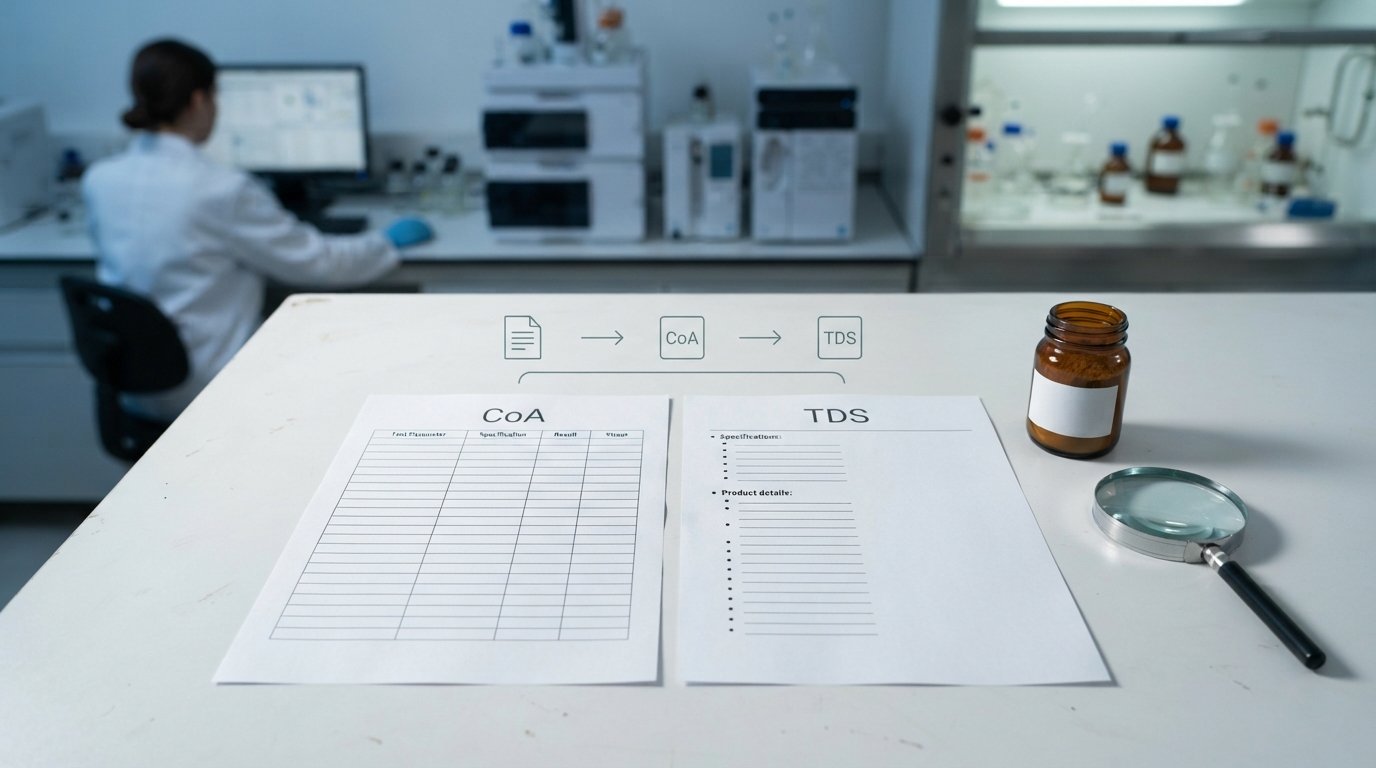
| Question | CoA | TDS |
|---|---|---|
| Does this batch pass the stated assay? | Yes | No |
| What is the typical physical form? | Sometimes | Yes |
| What are the packaging and storage conditions? | Sometimes | Yes |
| What are the contaminant limits for this batch? | Yes | Not usually |
| Is the document tied to one production lot? | Yes | No |
Do not accept a TDS as a substitute for a CoA. The TDS describes the intended product. The CoA proves what a specific batch actually contained.
How to Evaluate the Botanical Extract Specification
The specification tells you what you are buying. It should be precise enough for your quality team and your intended market.
Botanical Identity, Origin, and Extraction Method
Verify the following details with the supplier:
- Latin binomial and common name of the plant.
- Plant part used, such as root, leaf, seed, fruit, or bark.
- Country or region of origin.
- Whether the material is wild-harvested or cultivated.
- Extraction method and solvents used.
- Whether the organic claim covers the raw material and the processing chain.
A botanical’s identity matters because the same common name can refer to different species with different chemical profiles. The plant part also matters because constituents vary across roots, leaves, seeds, and fruits.
Potency, Purity, Extract Ratio, and Concentration
These terms are often confused, and the confusion can lead to costly sourcing mistakes.
| Term | What It Means | Example |
|---|---|---|
| Potency / standardization % | Amount of a marker compound in the extract | Echinacea extract standardized to 4% polyphenols |
| Purity % | Degree to which a compound is present without other components | Purity of an isolated compound |
| Extract ratio | Ratio of starting plant material to finished extract | 10:1 extract |
| Concentration | Amount of a specific substance in a specified base | 100 mg of extract per serving |
An extract ratio is not an assay. A 10:1 extract does not guarantee a particular percentage of any active compound. The CoA should state which method was used to measure the marker, such as HPLC or UV, and the specific result for that batch.
Form, Solubility, Stability, and Packaging
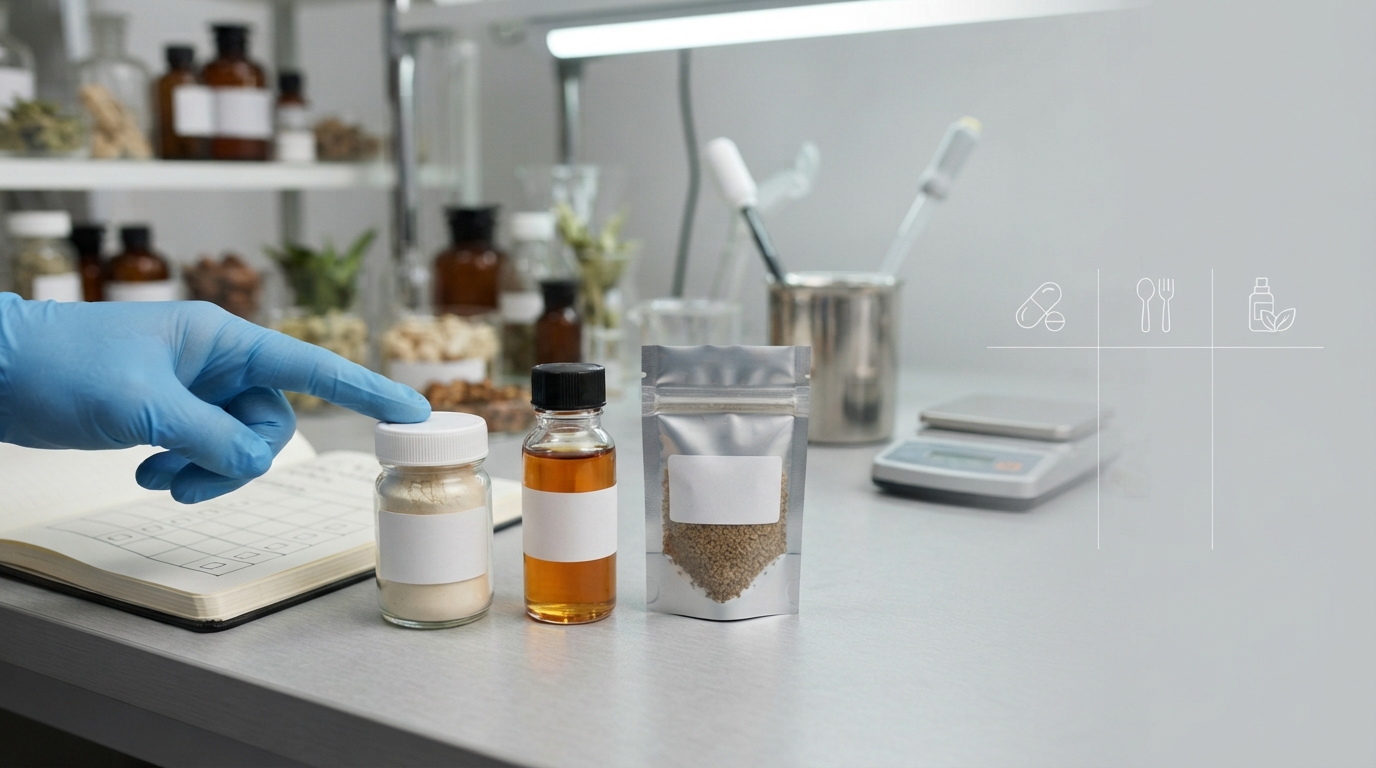
The specification should also cover:
- Physical form: powder, granule, or liquid.
- Solubility or dispersibility in water, alcohol, or oil.
- Particle size or mesh size.
- Moisture content.
- Shelf life.
- Storage conditions.
- Packaging that protects against moisture, light, and oxygen.
These details determine whether the extract will work in your formulation, how it should be stored, and how long it can remain stable.
Organic Botanical Extract Applications and Formulation Fit
The same botanical may be offered in different forms for different applications. Buyers should match the specification to the target product and market.
| Application | Key Considerations |
|---|---|
| Dietary supplements | Identity, assay, contaminant limits, batch CoA, and regulatory compliance |
| Functional foods and beverages | Solubility, taste, stability, and food-appropriate documentation |
| Cosmetics and skincare | Purity, solvent residues, skin compatibility, and stability |
| Pharmaceutical ingredients | Higher documentation demands, stricter testing, and supply-chain transparency |
If the intended application requires a natural colorant, a dedicated botanical pigment supplier may be more relevant than a general extract supplier.
How to Qualify a Supplier from First Inquiry to Bulk Order
Commercial qualification should be a structured process, not a conversation about price.
- Request the current certificate and confirm the legal entity, scope, and validity.
- Request a batch-specific CoA and TDS for the exact extract under evaluation.
- Request a sample. Test it against the specification, not just visually.
- Compare the sample to the bulk specification. Ask whether the bulk lot will be produced to the same specification and tested before shipment.
- Confirm that the batch documentation will accompany the shipment.
- Clarify commercial terms: MOQ, lead time, packaging, shelf life, and storage conditions.
- Clarify what happens if the bulk lot does not match the approved sample.
The goal is to ensure that the supplier’s documentation, product quality, and commercial terms can be maintained at scale.
Why Verification Matters: Risks and Red Flags
Skipping supplier verification is one of the highest-risk mistakes in botanical-extract sourcing.
Common failures include:
- Supplying a different plant species than the one ordered.
- Using an incorrect plant part.
- Adjusting the extraction process to lower cost, which changes the constituent profile.
- Providing a certificate that does not cover the product.
- Providing a CoA that does not match the shipped batch.
- Treating a marketing logo as proof of quality.
The National Institute of Environmental Health Sciences notes that botanical dietary supplements are not regulated in the same way as conventional foods and drugs, and safety information for botanicals can be limited. That makes supplier diligence more important, not less. See the NIEHS botanical dietary supplements fact sheet for background.
Verification is not just a paperwork exercise. It protects formulation consistency, regulatory compliance, and brand trust.
Sourcing Botanical Extracts from B-Thriving
B-Thriving I/E Co., Ltd. presents itself as a supplier of herbal extracts, APIs, and natural ingredients. Its website describes a broad botanical-extract and nutraceutical-ingredient portfolio, but buyers should still confirm product-specific details directly.
Before contacting B-Thriving, define the following:
- Target botanical and plant part.
- Required organic certification, if any.
- Desired potency, standardization, or extract ratio.
- Physical form and solubility requirements.
- Intended application and target market.
- Required documentation, such as CoA, TDS, and current organic certificate.
- Volume and delivery requirements.
B-Thriving positions itself as a botanical extract supplier across multiple ingredient categories, but specifications, certifications, and capabilities should be verified for each specific extract and order.
Next Step: Request the Exact Product and Documentation You Need
The fastest way to qualify a supplier is to ask a precise question.
State exactly which botanical you need, the required organic certification, the target specification, the application, the documentation your quality team expects, and the volume you are considering. Then ask the supplier to confirm — in writing — whether the certificate, the batch CoA, and the product specification can all be matched to your order.
That single request will tell you more than a homepage, a logo, or a price list.

