
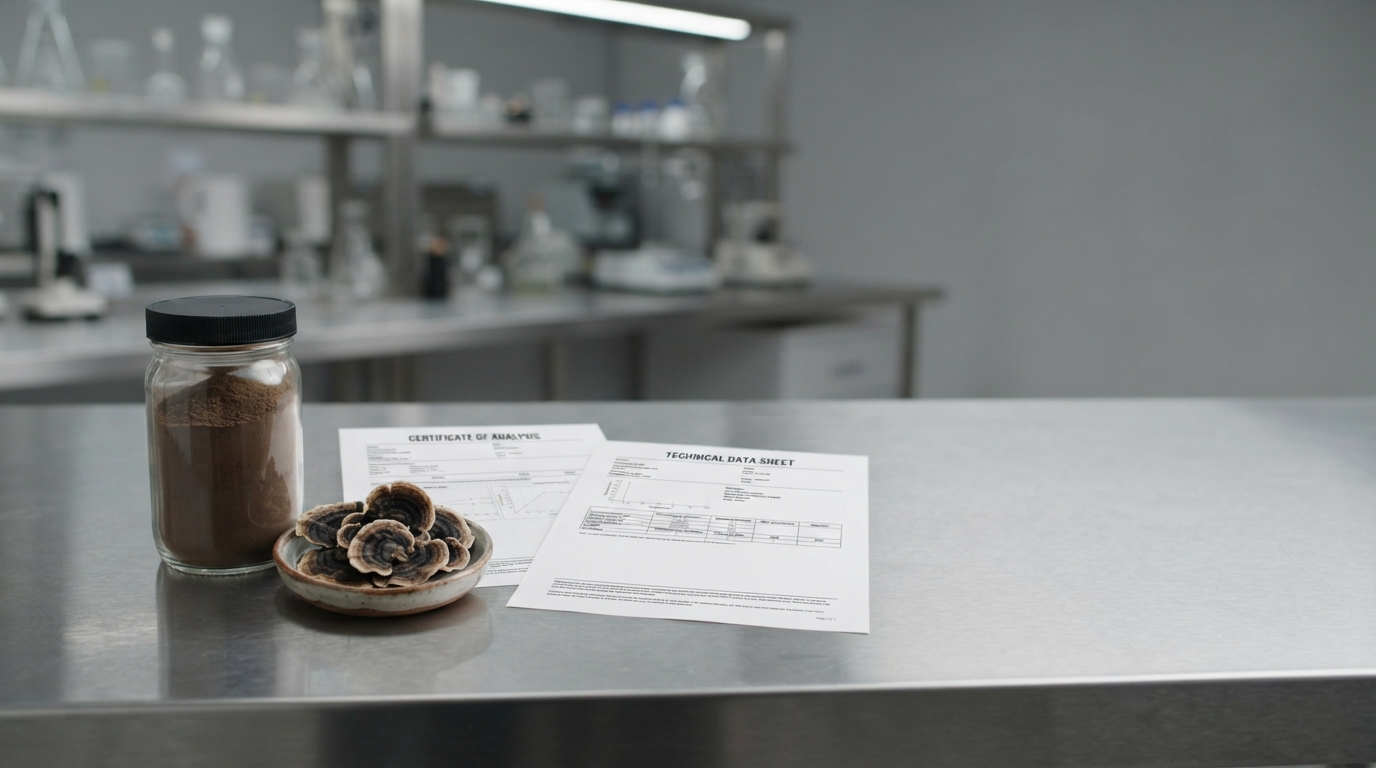
A turkey tail mushroom extract supplier should provide verified Trametes versicolor identity, documented source material, a defined extraction method, quantified marker compounds, batch-specific Certificates of Analysis (CoA), a Technical Data Sheet (TDS), contaminant-testing results, and clear commercial supply terms. If any of these elements is missing, it becomes difficult to evaluate whether the extract will meet your formulation and quality requirements — or whether the next batch will match the first.
This guide sits within the broader mushroom extract supplier category, but its scope is specific: helping manufacturers qualify a supplier of turkey-tail mushroom extract. When you finish this page, you should know exactly which specifications and documents to request before approving a supplier.
<!– Parent pillar URL must be inserted in the link above before publication. –>
What Is Turkey Tail Mushroom Extract and Why Does the Source Matter?
Turkey tail is the common name for the fungal species Trametes versicolor, a polypore mushroom that grows on dead hardwood in forests worldwide. The name comes from the fan-shaped, multicolored bands on the fruiting body, which resemble the tail feathers of a turkey. In older scientific literature, the species may appear as Coriolus versicolor; both names refer to the same organism.
A turkey tail extract is produced from mushroom tissue by a defined extraction process — almost always involving hot water — that concentrates water-soluble polysaccharides, including beta-glucans, the primary marker compounds studied in mushroom research.
For a manufacturer sourcing turkey tail, however, the most important distinction is what actually went into the extract. Fruiting body, mycelium, and mycelium-on-grain are three different materials that can appear under the umbrella phrase “mushroom extract.” They are not interchangeable.
Trametes versicolor and the Turkey Tail Species
Trametes versicolor is the accepted scientific name for turkey tail. Suppliers should state it on their product specification sheets and Certificates of Analysis, and the identity should be confirmed by macroscopic and microscopic examination, DNA barcoding, or another validated analytical method. If a supplier cannot provide species-level identity testing, the ingredient should not be approved.
The synonym Coriolus versicolor appears regularly in older research and product labels. It is the same species, but naming consistency matters for traceability. Peer-reviewed studies of turkey tail polysaccharides use the species name Trametes versicolor: see, for example, this review of Trametes versicolor polysaccharides. A commercial extract should be traceable to the species named in any research you plan to reference.
Fruiting Body vs Mycelium vs Mycelium-on-Grain
| Source material | What it is | Typical composition concern | What the buyer should expect |
|---|---|---|---|
| Fruiting body | The mushroom’s reproductive structure — the visible “turkey tail” | High fungal polysaccharide and beta-glucan content; low starch | The standard starting material for mushroom extract production |
| Mycelium | The vegetative root-like tissue of the fungus | Lower polysaccharide density than fruiting body; composition varies with growth conditions | More variable composition; must be labeled accurately |
| Mycelium-on-grain | Mycelium cultivated on grain (rice, oats, etc.) and processed whole | Significant starch and alpha-glucan content from the grain | Beta-glucan content per gram will be diluted by the grain substrate |
The distinction is not academic. If a supplier labels a mycelium-on-grain product as “turkey tail mushroom extract,” the actual beta-glucan content will likely be far lower than a fruiting-body extract — because the grain is mostly starch. The FDA’s regulatory docket on fungal ingredients includes industry technical commentary that explains exactly why the alpha-glucan contribution from grain substrates complicates polysaccharide claims, as well as broader fungal-ingredient labeling context. Buyers should require the supplier to state which source material was used and to back that statement with product documentation.
What Should a Turkey Tail Extract Supplier Provide? Key Specifications to Verify
Extraction Method: Hot Water, Dual, and Alcohol Extraction
The extraction method determines which compounds end up in the finished ingredient. Hot-water extraction is the conventional approach for mushroom polysaccharides: it dissolves the long-chain polysaccharides into the water phase and concentrates them in the final powder. Dual extraction adds an alcohol step before or after the water step, pulling out a broader range of constituents such as triterpenoids and other alcohol-soluble compounds. Because turkey tail research focuses mainly on polysaccharides, hot-water extraction is the process most commonly documented by mushroom extract suppliers.
The buyer’s key question is not which method is “better” in the abstract. It is whether the method matches the claim. If a supplier quantifies beta-glucans on the CoA, the extraction method must be able to retain those beta-glucans. Ask the supplier to state the extraction method, solvent profile (water vs. water-plus-alcohol), and the analytical method used to verify the result.
Beta-Glucans vs Total Polysaccharides vs Extract Ratio
This is the most frequently confused set of specifications in mushroom extract procurement.
| Specification term | What it actually tells you | Why it matters |
|---|---|---|
| Beta-glucan content (%) | The percentage of the product that is fungal beta-glucan | The most meaningful mushroom-specific quality marker |
| Total polysaccharides (%) | The percentage of product measured as polysaccharides by a given assay | Can include starch and other non-fungal carbohydrates — especially when mycelium-on-grain is used |
| Extract ratio (e.g., 10:1) | The amount of starting material used to produce one unit of extract | A production descriptor; not a potency measurement |
| Purity (%) | The percentage of a defined compound in the product | Only meaningful when the compound is clearly identified |
A 10:1 extract ratio is not evidence of potency. A 10:1 hot-water extract may contain a very different beta-glucan percentage than a 10:1 extract from another supplier using different raw material and processing conditions.
Beta-glucans should be measured by a method designed for fungal material. The enzymatic beta-glucan assay (Megazyme) is widely used for yeast and mushroom beta-glucans when applied with the correct procedural adaptation. General “total polysaccharide” assays that detect any polysaccharide will also measure starch-derived alpha-glucans. That is why a “30% polysaccharides” claim on a mycelium-on-grain product can be technically accurate while still containing far less beta-glucan than a fruiting-body extract. For more on this compound group, see our beta glucan mushroom extract page; for the broader polysaccharide category, see fungal polysaccharide extract.
Two more compounds deserve a clear boundary. PSK (polysaccharide-K) and PSP (polysaccharide-peptide) are specific turkey-tail-derived preparations with extensive research histories. They are not generic labels. A supplier cannot claim that its turkey-tail powder “contains PSK” merely because it shares the same species. PSK and PSP are isolated, standardized preparations with defined production processes. If your finished-product marketing relies on PSK or PSP research, you must verify that the extract was manufactured by a documented PSK/PSP process — not assume the research transfers to any commercial turkey-tail powder.
Quality Documentation and Testing: CoA, TDS, and Lab Tests
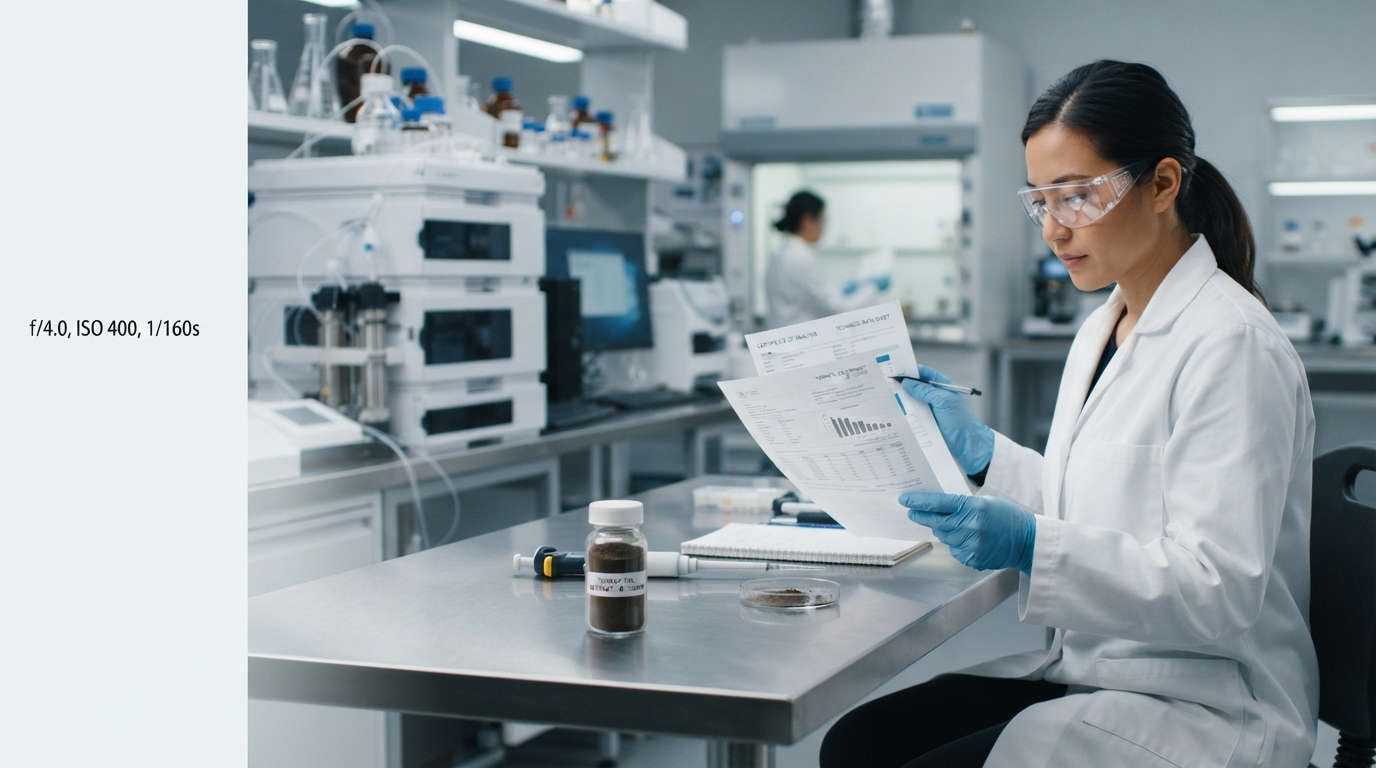
Manufacturers sourcing turkey-tail extract should request three documents from a supplier:
| Document | Full name | What it does | When you need it |
|---|---|---|---|
| CoA | Certificate of Analysis | Reports batch-specific test results: identity, assay, contaminants, moisture, microbiology | Before approving a batch and with every shipment |
| TDS | Technical Data Sheet | Describes physical and chemical product characteristics: appearance, particle size, solubility, bulk density, shelf life, storage | During initial evaluation and formulation development |
| SDS | Safety Data Sheet | Provides health, handling, storage, transport, and emergency information | Before first shipment, and as required by your own safety obligations |
At the inquiry stage, ask for all three. At the batch-approval stage, the CoA is the critical document: it must carry the batch number, the assay result for the stated marker, the identity test result, and the contamination-test results described below.
Which Tests Should Appear on a Turkey Tail Extract CoA?
Use this list as a minimum test-review checklist:
- Identity — confirms the species. Acceptable methods include macroscopic/microscopic examination and DNA barcoding.
- Marker assay — e.g., beta-glucan %, with the analytical method stated on the document.
- Moisture content — reported in %; high moisture shortens shelf life and increases microbial risk.
- Total ash — indicates mineral content and can flag adulteration.
- Heavy metals — at minimum lead, arsenic, cadmium, and mercury.
- Pesticide residues — especially relevant if the raw material is wild-harvested or conventionally cultivated.
- Microbiological limits — total plate count, yeast and mold, E. coli, Salmonella, and, where applicable, Staphylococcus aureus.
- Residual solvents — required only if a solvent other than water was used during extraction.
A CoA without a batch number is not a usable CoA. The batch number is the link between the document and the physical material you receive.
Batch Consistency and Traceability
A single CoA proves only that one batch met specification. For manufacturing, the real question is whether batch number 42 will match batch number 41. Ask the supplier:
- Are retained samples kept for every batch?
- Is a batch-internal number printed on both the CoA and the packaging?
- Can the raw material be traced back to its original cultivation or harvest site?
- Is there a documented change-control policy, so that a change in raw-material source, extraction parameters, or testing site will be communicated before shipment?
If any of these answers is “no,” the supplier is not yet qualified for a manufacturing relationship.
Application Fit: Choosing the Right Turkey Tail Extract Format
Turkey tail extract is not a single specification; the right format depends on the product you are manufacturing.
| Application | Typical format requirement | Key specification to check |
|---|---|---|
| Capsules and tablets | Fine, free-flowing powder | Particle size / mesh, moisture content |
| Functional beverages | Water-dispersible powder that does not sediment | Solubility, dispersibility, flavor profile |
| Functional foods | Powder that blends without affecting texture or taste | Particle size, moisture, flavor-masking options |
| Sports nutrition | Usually powder or beverage-ready format | Beta-glucan %, solubility |
| Cosmetics / skincare | Requires separate safety and formulation testing | Source material, microbial limits, heavy metals |
| Pet nutraceuticals | Species-specific dose and safety review required | Species-appropriate safety data, contaminant limits |
Request a sample and run application-specific testing rather than assuming that an extract that works in capsules will also work in a beverage. For cosmetics and pet products, additional regulatory and toxicological review is required — human supplement data alone is not sufficient.
If you are comparing mushroom species for a product line, see also our reishi extract benefits side effects and usage page and our cordyceps extract bulk supplier page.
Turkey Tail Supplier Qualification Checklist: Questions to Ask Before You Buy
The following checklist consolidates this guide into a practical supplier-qualification sequence:
- Identity: Is the species confirmed as Trametes versicolor on the CoA?
- Source material: Is it fruiting body, mycelium, or mycelium-on-grain? Is that stated on the TDS?
- Cultivation vs. wild harvest: Is the source cultivated for consistency, or wild-harvested with greater variability?
- Extraction method: Is hot-water, dual, or solvent extraction documented?
- Marker and assay: Which compound is standardized — ideally beta-glucans? Which analytical method was used? What is the specification range?
- Documentation: Does the supplier provide a batch-specific CoA, a TDS, and an SDS?
- Contaminant suite: Are heavy metals, pesticides, and microbiological limits measured per batch?
- Sample policy: Will the supplier send a sample with its current CoA?
- Packaging and storage: What is the packaging format (drum, bag, vacuum-sealed)? What are the storage conditions and shelf life?
- Commercial terms: What are the MOQ, lead time, and packaging configuration?
- Traceability and change control: Does the supplier maintain batch traceability and a formal change-notification process?
Any “no” or “unclear” answer is a risk factor. For a serious manufacturing relationship, the correct response is documentation — not a verbal reassurance.
Regulatory Boundaries for Turkey Tail Extract Claims
Turkey tail research — including work on preparations such as PSK and PSP — is real and substantial. But most of that research was conducted on defined preparations, not on a random supplier’s commercial extract powder. Manufacturers should assume that the research cannot be used directly to market a finished product as a treatment for cancer, immune disease, or any other medical condition.
The U.S. FDA has taken enforcement action against companies that marketed turkey-tail products with disease-treatment claims. In 2020, the FDA issued a warning letter to a company selling turkey-tail dual-extract products with claims that violated the Federal Food, Drug, and Cosmetic Act. In 2025, the agency issued an online advisory letter addressing similar turkey-tail extract marketing concerns. The pattern is consistent: disease claims require drug approval, and a dietary supplement cannot legally promise to treat, cure, or prevent disease.
This does not mean turkey tail is difficult to market. It means the claims must stay honest. A dietary supplement manufacturer can describe the ingredient, its composition, its role in general wellness, and its intended use in a supplement — but cannot promise to treat an illness. Make sure the regulatory review of your finished product is completed before the marketing team starts writing.
How to Request a Quote, Sample, and Specification Package
The most effective way to evaluate a turkey-tail extract supplier is to send a clear specification request. Include the following in your inquiry:
- The intended application (capsules, beverage, powder blend, etc.)
- The target marker and specification (e.g., beta-glucan ≥ 20%)
- The source-material requirement (fruiting body, no mycelium-on-grain)
- The documents you want sent with the sample (batch-specific CoA, TDS, SDS)
- The volume you plan to source, so the supplier can respond with appropriate MOQ and lead-time information
A complete specification request also filters the market quickly: a supplier with a quality product will respond with documentation; a supplier that is only repackaging commodity material will hesitate. That hesitation is the first useful signal in your supplier evaluation.

