
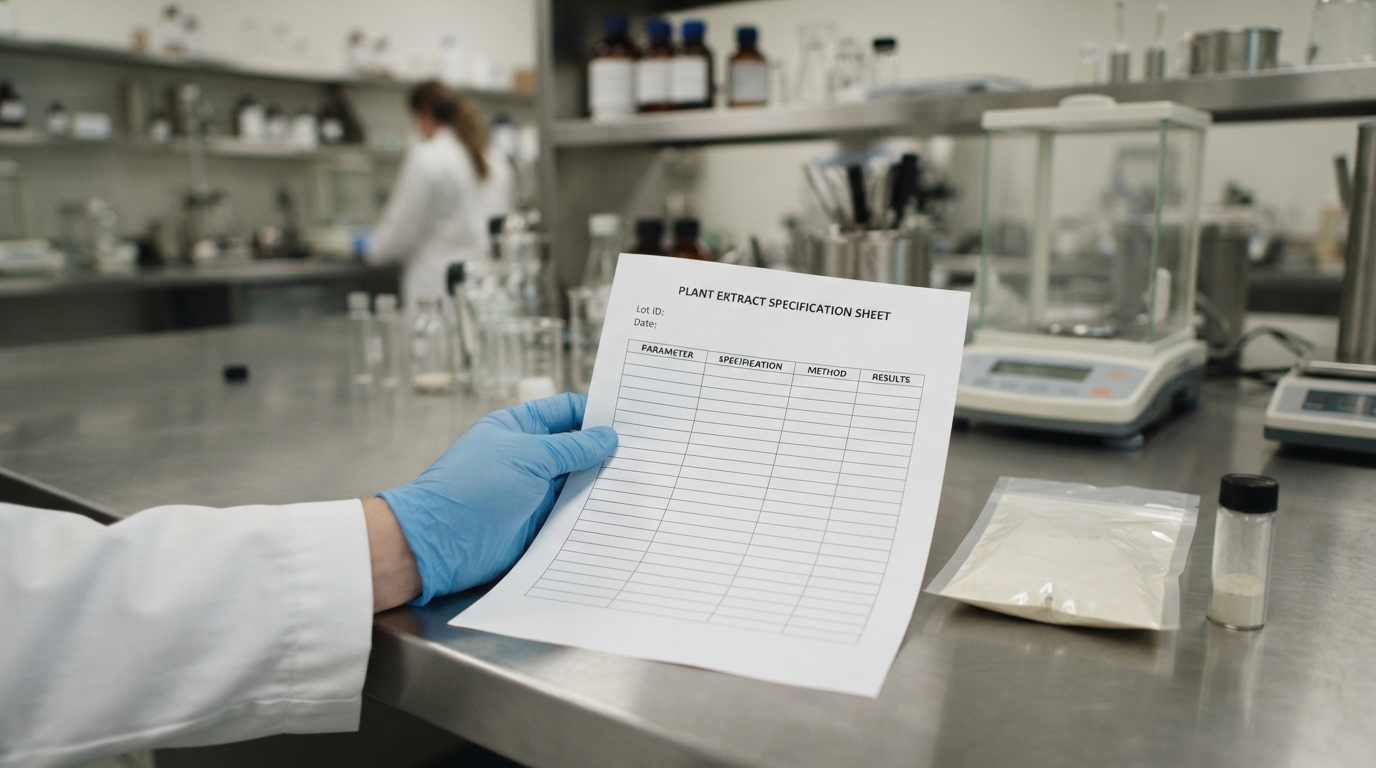
A plant extract specification sheet is a product-level document that defines the required identity, source, extraction, potency, physical, purity, stability, packaging, and quality-control criteria for a botanical extract. It is not the same as a certificate of analysis (CoA), which records the actual test results for a specific batch.
Buyers, formulators, and quality teams use specification sheets to evaluate an ingredient before purchase and to confirm that a supplier understands exactly what is being supplied. A complete specification sheet answers one core question: What should this extract be, and how will we know when it meets the requirement?
What Is a Plant Extract Specification Sheet?
A specification sheet is a forward-looking document. It states the target characteristics and acceptance criteria for a botanical extract, typically before production or batch release.
A well-written specification sheet should be:
- Product-specific – it describes one extract, not an entire category of botanicals.
- Botanically precise – it identifies the correct plant species and the part used.
- Technically measurable – it lists values that can actually be tested, such as assay percentage, moisture, or contaminant limits.
- Batch-connected – it can be linked to a specific product code, version, and, when needed, a lot number.
The specification sheet is the reference point. The CoA then shows whether a particular batch meets that reference point.
What Fields Must a Plant Extract Specification Sheet Include?
No single template works for every botanical extract. An extract used in a dietary supplement may need different fields from one used in a cosmetic or beverage application. However, a credible specification sheet should cover the major areas below.
Product Identity and Source
The first job of a specification sheet is to confirm exactly which botanical material is being described.
Key fields include:
- Product name and supplier product code
- Latin binomial name (genus and species)
- Plant part used (root, leaf, seed, bark, fruit, flower, or whole plant)
- Source or geographic origin, when relevant
- The intended form of the ingredient (standardized extract, full-spectrum extract, powder, granule, liquid, etc.)
- Botanical identity is a foundational quality requirement. Without a precise species and plant part, the rest of the document can be misleading.
Extraction and Processing Information
The extraction process affects the composition of the finished extract, so the specification sheet should state how the product was made whenever that information is material to quality.
Relevant fields include:
- Extraction method (e.g., hot water, ethanol/water, supercritical CO₂)
- Extraction solvent or solvent system
- Extract ratio when applicable (e.g., 10:1)
- Carrier, excipients, or diluents used in the final extract
- Any concentration or drying steps that affect the final form
General quality-control guidance for botanical ingredients identifies solvents and carriers as important specification information. If a supplier omits the solvent, the buyer cannot fully assess composition or potential residue concerns.
Standardization, Potency, and Analytical Testing

This is the section most buyers check first, and it is also where documents are most often misunderstood.
A specification sheet should state:
- The marker compound or active constituent being measured
- The standardization target, such as a minimum or range of potency
- The assay or potency value, expressed clearly (usually % or mg per unit)
- The analytical method used (HPLC, UV/Vis, titration, etc.)
- A method reference when available
The potency value only means something when the measured constituent and the method are both identified. A specification sheet that says only “20% actives” is incomplete. A sheet that says “20% bacosides by HPLC” is actionable.
USP-related literature on botanical quality describes quality in terms of identity, purity, and content. That means a potency claim should not be treated as the whole quality story; it needs to sit alongside identity testing and contaminant controls.
NIST also provides reference materials and analytical methods specifically intended to support botanical dietary supplement quality control. Using recognized methods and reference standards makes a specification sheet more reliable.
Physical and Chemical Characteristics

Physical characteristics matter because they affect handling, formulation, and product stability.
Common fields include:
- Appearance, color, and odor
- Physical form: powder, granule, liquid, or other
- Mesh size or particle size distribution, when relevant
- Moisture content or loss on drying
- Solubility or dispersibility, where the application requires it
- pH, for liquid extracts or where formulation compatibility matters
Not every physical test is necessary for every product. A fine powder intended for tablets may need particle size data; a liquid extract intended for beverages may need solubility and pH data. The specification sheet should match the product’s intended use.
Contaminant and Safety Limits
A credible specification sheet does not stop at potency. It also defines what is not acceptable in the extract.
Relevant contaminant fields include:
- Microbiological limits: total aerobic count, yeast and mold, and specified pathogens
- Heavy metals or elemental impurities: lead, arsenic, cadmium, mercury, and others where required
- Pesticide residue limits
- Residual solvent limits, especially when solvents were used in extraction
- Other adulteration or identity checks, where the product is at risk
The appropriate limits depend on the product, the target market, and the intended application. A specification sheet should state which limits apply, and preferably which test method will be used.
Food-safety guidance for botanical ingredients also highlights adulteration as a key concern. A specification sheet that addresses purity and identity testing helps reduce that risk.
Packaging, Storage, and Shelf Life
Stability information tells the buyer how long the extract is expected to remain within specification and how it should be handled.
Useful fields include:
- Shelf life under stated storage conditions
- Recommended storage temperature and protection from moisture or light
- Packaging format, including moisture-resistant or light-protected packaging
- Retest date, where applicable
These fields may seem administrative, but they directly affect formulation planning and supply chain decisions.
Document Control and Approval Information
A specification sheet should also identify itself clearly.
Document control fields include:
- Product code and specification version or revision number
- Effective or issue date
- Prepared, reviewed, and approved signatures or roles
- Reference to applicable methods, pharmacopeia monographs, or related documents
Without document control, the buyer cannot know whether they are looking at the current specification or an outdated version.
Specification Sheet vs. CoA vs. TDS vs. SDS
These four documents are often confused. Each plays a different role.
| Document | Purpose | Typical Content |
|---|---|---|
| Specification sheet | Defines target requirements for the product | Identity, potency, physical properties, contaminant limits, storage, shelf life |
| Certificate of Analysis (CoA) | Verifies actual results for a specific batch | Batch number, test results, methods, and conformance status |
| Technical Data Sheet (TDS) | Provides broader technical and application information | Physical data, solubility, recommended use, formulation guidance |
| Safety Data Sheet (SDS) | Explains hazards and safe handling | Hazards, first aid, PPE, storage, transport, disposal |
A buyer often needs all four. The specification sheet defines what the product should be. The CoA proves what a particular batch actually was. The TDS explains how to handle and use it. The SDS covers safety.
For a more detailed look at the broader technical document, see our botanical extract technical data sheet guide.
Potency, Extract Ratio, and Purity: Key Differences
One of the most common sourcing mistakes is treating extract ratio, potency, and purity as interchangeable numbers.
- Extract ratio describes the relationship between the starting plant material and the finished extract. A 10:1 extract means 10 parts of botanical material were used to produce 1 part of extract. It does not tell you how much of a specific active compound is present.
- Potency or assay measures a defined marker or active constituent. A statement like “20% bacosides by HPLC” is more meaningful than “10:1 extract” because it is tied to a measurable compound.
- Purity means the material is free from unintended substances. Purity is not automatically the same as assay. An extract can be high in one marker but still contain unwanted contaminants.
- Concentration in mg is sometimes used for liquids or dosage-specific products. It should not be converted to an extract ratio without verified input data.
When comparing two botanical extracts, compare like-for-like: same marker, same method, same unit. Otherwise the numbers can be misleading.
How to Review a Specification Sheet Before Approving an Ingredient
A short review process can prevent costly sourcing mistakes.
- Verify the botanical identity. Check that the Latin name and plant part are present and match your intended ingredient specification.
- Confirm the marker and target range. Look for a clearly named constituent and a defined potency range, not just a vague active percentage.
- Check the analytical method. Potency should be linked to a method such as HPLC or UV/Vis. A number without a method is difficult to verify.
- Check whether the values are targets or actual results. A specification sheet defines limits; a CoA reports actual batch results. Do not confuse the two.
- Match physical and form data to your application. If you need a water-soluble powder for a beverage, solubility and particle size matter.
- Review contaminant coverage. Confirm that microbiology, heavy metals, and other relevant limits are included.
- Ask for the supporting documents. Request the batch-specific CoA, the TDS, and the SDS alongside the specification sheet.
Red Flags to Watch For
Some specification sheets look complete but are not technically reliable. Watch for these warning signs:
- Missing Latin binomial name or plant part
- No marker compound or analytical method
- Only an extract ratio, with no potency assay
- Vague terms such as “pure” or “natural” without a measurable definition
- No contaminant or microbiological limits
- No product code, version, or batch reference
- Certification claims without certificate scope, product applicability, or evidence
- Appearance and odor used as the only identity checks
Identity testing is especially important. Botanical materials can be substituted or adulterated. DNA-based methods can provide plant-material identification and complement chemical and chromatographic analysis, according to the USDA Agricultural Research Service. If a supplier’s documentation does not address identity beyond appearance, ask for more evidence.
Certification claims deserve the same scrutiny. A general statement like “GMP certified” does not tell you which product, which site, or which standard applies. When you evaluate certificates, check the scope and the issuing body. For more detail on what to look for, see what certifications should i look for when sourcing plant extracts.
Using the Specification Sheet in Supplier Qualification
A specification sheet is one of the most useful documents in supplier qualification because it shows whether the supplier can define their product precisely. If a supplier cannot provide a clear, complete specification sheet, batch-level documentation is unlikely to be much better.
When you evaluate suppliers, ask for a product-specific specification sheet before committing to a sample or order. Then compare it against the checklist above.
B-Thriving, for example, is positioned on its official website as a supplier of herbal extracts, APIs, and natural ingredients. Any botanical-extract supplier, including B-Thriving, should be able to provide specification sheets and supporting documents that meet the same review standards described here.
A complete specification sheet does not guarantee a perfect batch, but it is the first sign of a supplier who understands the product. Use it as the starting point for a documentation set that includes the batch CoA, the technical data sheet, and the safety data sheet. Together, those documents give you the confidence to move forward with a sourcing decision.

