

A liposomal ingredient supplier is a B2B provider that supplies active ingredients incorporated into a liposomal delivery system, together with the batch documentation, technical specifications, samples, and support needed to evaluate them for commercial formulation. Liposomal delivery systems are used across dietary supplements, functional foods and beverages, cosmetics, and related products where the active ingredient may benefit from association with a phospholipid carrier.
This guide is for formulators, supplement brand owners, procurement managers, and contract manufacturers who need to compare bulk liposomal ingredients and choose a supplier they can rely on. It focuses on the specifications, documents, and sourcing steps that separate a well-documented liposomal ingredient from an unsubstantiated one.
What Is a Liposomal Ingredient Supplier?
A liposomal ingredient supplier sells bulk liposomal ingredients for use in finished products, rather than selling finished consumer supplements directly. The ingredient is typically an active compound — such as a vitamin, mineral, botanical extract, or specialty nutrient — that has been incorporated into or associated with a liposomal delivery system.
A credible supplier should provide more than a product name and a price. At minimum, a supplier should be able to provide:
- A clear description of the active ingredient and its concentration
- Information about the phospholipid carrier system
- Batch-specific documentation, including a Certificate of Analysis (CoA)
- A Technical Data Sheet (TDS) with physical properties and handling guidance
- Stability and storage information
- Samples for formulation testing
- Practical guidance on how the ingredient behaves in different dosage forms
The broader category of liposomal nutraceutical ingredients includes many possible actives and delivery formats. The supplier’s role is to make the ingredient easy to evaluate, easy to formulate, and easy to trace back to a specific manufacturing batch.
Essential Product Specifications to Compare
When comparing liposomal ingredients, the goal is not to match one number. The goal is to understand the complete specification profile and whether it fits your target product.
The most useful specifications fall into two groups: those that describe the active ingredient and those that describe the delivery system.
| Specification | What It Tells You | Typical Units |
|---|---|---|
| Active ingredient identity | Which compound is being delivered | Ingredient name, CAS number, botanical source if relevant |
| Assay | How much active is present | %, mg/g, or mg/mL |
| Purity | How free the ingredient is from unwanted related substances | %, with the analytical method defined |
| Phospholipid carrier | What the liposome is made from | Soy lecithin, sunflower lecithin, phospholipid content |
| Particle size | How large the liposomes or particles are | Nanometers (nm) or micrometers (μm) |
| Encapsulation efficiency | How much of the active is associated with the delivery system | %, with the measurement method used |
| Solubility or dispersibility | How the ingredient behaves in a liquid or powder blend | Qualitative or quantitative description |
| Moisture content | How much water is present in a powder | % |
| Shelf life and storage conditions | How long the material remains within specification | Months, with recommended conditions |
There is no single “best” liposomal ingredient. The right specification depends on your active ingredient, your dosage form, and your production process.
Potency, Assay, and Purity — Keep the Units Straight
One of the most common sourcing mistakes is confusing different measurements:
- Assay describes the amount of active ingredient in the product, usually reported as a percentage (%) or as mg per gram.
- Purity describes how much of the material is the desired compound versus related substances.
- Extract ratio (for example, 10:1) describes the concentration of a botanical extract, not its potency. A 10:1 extract does not automatically contain 10% of any specific compound.
- Encapsulation efficiency describes the percentage of the active that is associated with the liposomal carrier.
These are different measurements. A supplier should be able to tell you exactly which one is being reported and how it was measured.
Particle Size, Solubility, Moisture, and Stability
Physical properties matter as much as the active assay. A liposomal powder with perfect chemistry can still fail if it does not disperse properly in your formulation.
Particle size and particle-size distribution help characterize the liposome system. The FDA’s characterization work on liposomal drug products identifies size distribution, morphology, composition, purity, surface properties, and release kinetics as relevant liposome quality attributes. The same logic applies when evaluating a liposomal ingredient for a nutraceutical product: you want consistency, not just an average number.
Ask your supplier:
- What is the mean particle size?
- Is a particle-size distribution available?
- How is particle size measured?
- Does the ingredient disperse in water or in the intended formulation medium?
For powders, moisture content is also important. High moisture can affect flow, stability, and microbial risk. For liquids, you need to understand sedimentation, dosing uniformity, and preservative requirements.
Finally, request shelf-life data and storage conditions. A liposomal ingredient that looks good in a sample may behave differently after several months of storage.
CoA, TDS, and Batch Evidence

Documentation is the backbone of supplier evaluation. Without it, you cannot verify that the material you receive matches the material you approved.
Two documents are often confused: the Certificate of Analysis (CoA) and the Technical Data Sheet (TDS). They serve different purposes.
CoA Versus TDS — What Each Document Tells You
| Document | Level | Purpose | Typical Contents |
|---|---|---|---|
| Certificate of Analysis (CoA) | Batch-specific | Verifies that one specific batch meets agreed specifications | Batch number, manufacturing date, assay result, purity, contaminant results, microbiological results, analytical methods |
| Technical Data Sheet (TDS) | Product-level | Describes the general product and how to handle it | Appearance, solubility, moisture, particle size, storage conditions, shelf life, packaging |
A CoA is only valid for the batch it was issued for. It is not a permanent product specification. If the supplier cannot link a CoA to a specific batch, the document has limited value.
A TDS is more general. It describes what the product is expected to be, batch after batch. Both documents are necessary, and they should be consistent with each other.
Key Tests to Look For in a Liposomal Ingredient CoA
A useful CoA should include more than the active assay. Depending on the ingredient and its intended use, look for:
- Identity testing to confirm the active ingredient
- Assay by a validated method, such as HPLC or UV/Vis
- Purity, where relevant to the active compound
- Heavy metal testing
- Microbial testing
- Residual solvents or pesticide testing for botanical actives
- Encapsulation efficiency or related delivery-system data, if the supplier can measure it
- Batch number and traceability information
If a supplier claims “high bioavailability” or “liposomal encapsulation” but cannot provide batch-level evidence, treat the claim as marketing rather than technical proof.
Liposomal Delivery Formats and Application Fit
Liposomal ingredients are available in several bulk formats. The right format depends on the final product type.
| Format | Best Suited For | Main Questions to Ask |
|---|---|---|
| Dry powder | Capsules, sachets, tablet blends, powder mixes | Moisture content, flowability, dispersibility, particle size |
| Liquid suspension | Liquid supplements, shots, some beverages | Sedimentation, dose uniformity, preservative system, viscosity |
| Lipid paste | Softgel and specialty formulation work | Handling temperature, dispensing, compatibility with other lipids |
A dry powder may be convenient for encapsulation but difficult to disperse in a beverage. A liquid suspension may be easy to dose but require additional stability testing. The supplier should be able to explain how their format behaves in your target application.
Liposomal delivery is not the only advanced format available. If you are comparing delivery technologies, our guide to microencapsulated botanical ingredients explains how microencapsulation compares as an alternative approach for botanicals.
Evaluating Bioavailability Claims — What to Accept, What to Question
The title of this article includes “enhanced-bioavailability formulations,” but the phrase needs careful attention.
Liposomal delivery is a formulation strategy. It is not, by itself, a clinical result. Whether a liposomal ingredient improves bioavailability depends on the active ingredient, the liposome composition, the manufacturing process, the dosage form, and the way the ingredient is absorbed and metabolized in the body.
The FDA’s guidance on liposome drug products describes the chemistry, manufacturing, controls, human pharmacokinetics, and bioavailability documentation that are relevant to liposome development. While nutraceutical ingredients are not held to the same regulatory standard as drug products, the underlying principle is useful: a liposomal claim should be supported by product-specific evidence.
Ask the supplier:
- Do you have a comparative bioavailability study for this specific ingredient?
- Do you have validated in vitro data that supports the claim?
- What encapsulation efficiency was achieved for this batch?
- How does the product perform in the intended dosage form?
Peer-reviewed research also shows that liposome composition and processing conditions can affect particle diameter and encapsulation behavior. The same active ingredient can behave differently in different liposomal systems. That is why “liposomal” alone is not enough — the supplier should be willing to share technical data that explains how their specific system performs.
If a supplier cannot provide any product-specific evidence, the safest approach is to treat “enhanced bioavailability” as a claim to verify, not a guaranteed benefit.
How to Qualify a Liposomal Ingredient Supplier in Seven Steps
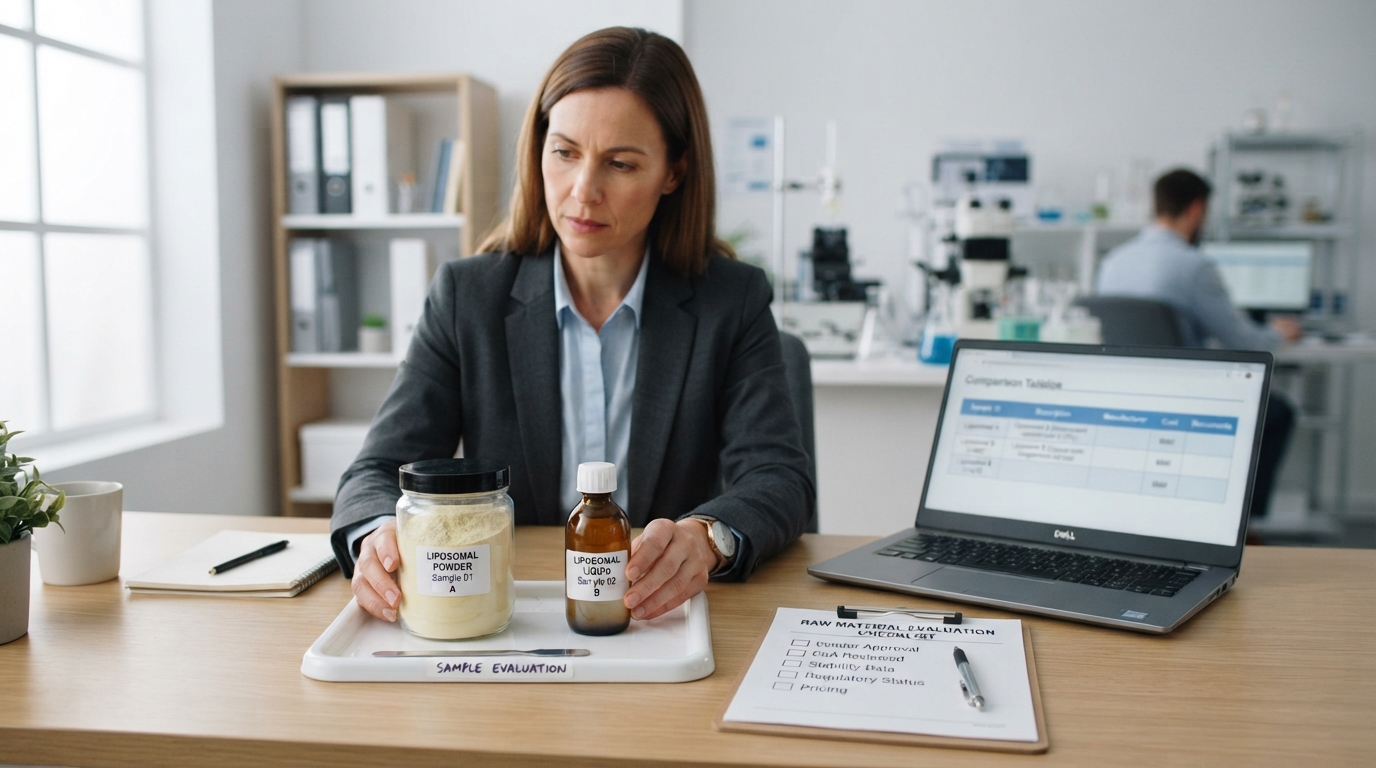
A structured sourcing process reduces the risk of choosing a supplier based on a persuasive product page rather than solid evidence.
- Define your target application and specifications. Write down the active ingredient, target dose, dosage form, and the physical properties that matter to your process.
- Identify candidate suppliers. Focus on suppliers that work with bulk liposomal ingredients and can speak to formulation fit, not just raw material supply.
- Request samples, CoA, TDS, and batch traceability. If a supplier is reluctant to share documents, move on.
- Verify identity, assay, purity, and carrier. Confirm that the active ingredient is correctly identified and that the carrier system is clearly described.
- Evaluate physical properties and stability. Test solubility, particle size, moisture, and shelf life under conditions that match your product.
- Run a small-scale formulation trial. Place the ingredient in your actual formulation. This is the only way to know whether it behaves as expected.
- Review commercial terms. Check MOQ, lead time, packaging, storage requirements, and technical support. A good ingredient is only useful if it can be supplied consistently.
Common Sourcing Mistakes and Supplier Red Flags
Some sourcing problems are easy to avoid once you know what to look for.
- “Liposomal” without data. If the word appears everywhere but no batch-level liposome data exists, the claim is unsupported.
- No batch-specific CoA. A document without a batch number, test date, or method is not a real verification.
- No TDS or unclear storage guidance. You need handling and stability information, not just an assay.
- Unit confusion. Watch for suppliers who blur assay, purity, extract ratio, and encapsulation efficiency.
- Generic certification claims. Certifications should be traceable to a specific product, facility, and issuing body. A general “GMP-certified” statement without scope or certificate details is not enough.
- No particle-size or encapsulation data. If the supplier cannot characterize the delivery system, you cannot fully evaluate it.
- Unwillingness to provide samples. A serious supplier expects you to test the material.
- Inconsistent documents. If the CoA and TDS disagree with each other, ask why.
Final Sourcing Checklist and Next Steps
Before you place an order, make sure you have a clear answer to each of these questions:
- What is the exact active ingredient and target dose?
- What assay and purity specifications are required?
- What phospholipid carrier is used, and does it meet your labeling requirements?
- What particle size and particle-size distribution are acceptable?
- How must the ingredient be stored and handled?
- What shelf life is claimed, and how was it determined?
- Is a batch-specific CoA available for every shipment?
- Does the TDS match the CoA?
- Has the ingredient been tested in the target dosage form?
- What are the MOQ, lead time, packaging, and technical support arrangements?
For an example of how supplier evaluation can be approached for a single active, see our liposomal resveratrol manufacturers guide. It shows the type of evidence and supplier questions that matter when the active ingredient is specified.
Once your requirements are clear, the next step is to request samples and documentation. Contact B-Thriving with your target ingredient, dosage form, and specification needs to evaluate current liposomal ingredient availability and formulation fit.

