
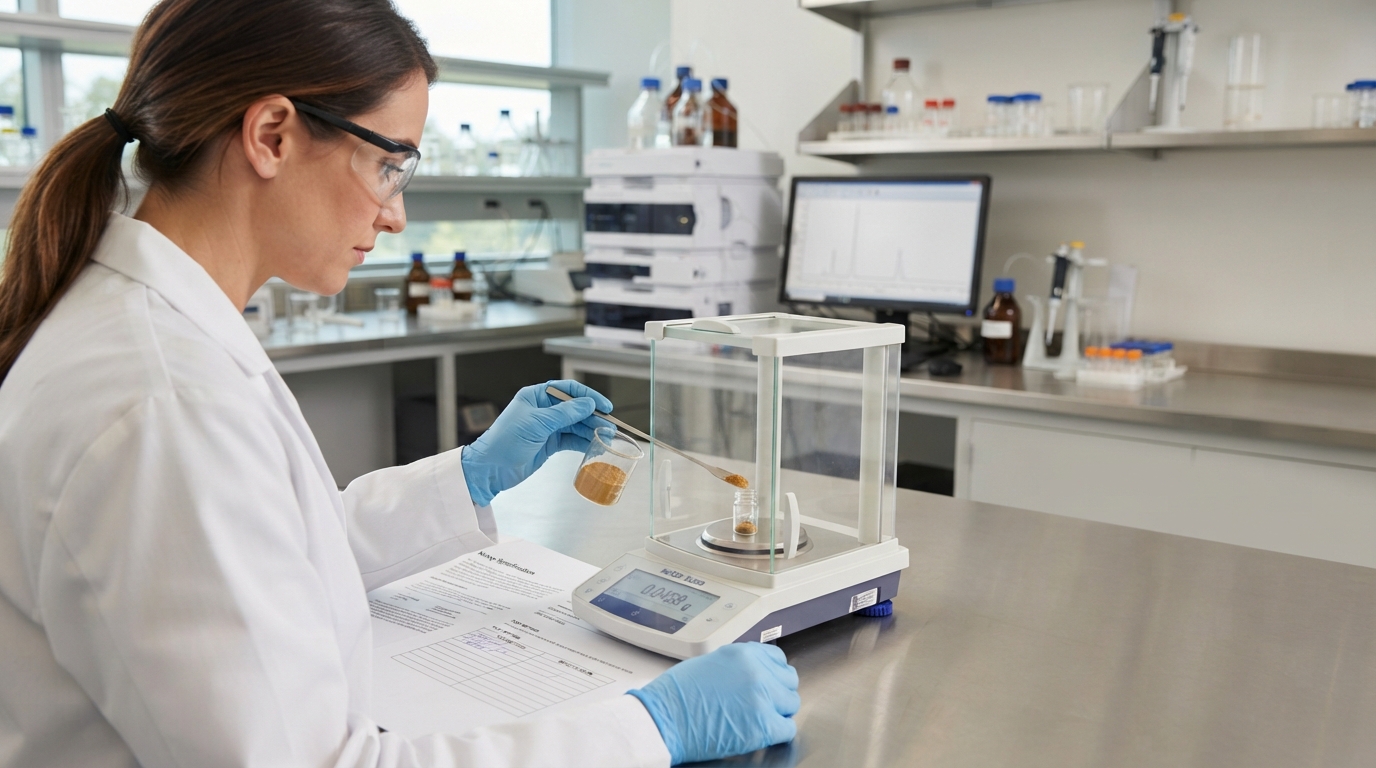
A botanical extract assay specification is the documented statement of which constituent is measured, the acceptable amount or range, and the analytical method used to verify that a specific batch meets that target. In plain terms, it defines what “potency” means for that extract and how it will be checked.
This guide focuses on the assay and potency side of botanical extract quality documentation. It explains how an assay specification is built, how laboratories verify it, and how you can confirm that a supplier’s certificate of analysis actually supports the product you are buying.
What Is a Botanical Extract Assay Specification?
An assay specification is not just a single number. It is a complete requirement that tells a laboratory what to measure, how to measure it, and what result is acceptable for a specific botanical extract.
A useful assay specification should include:
- The analyte or marker compound being measured.
- The analytical method used, such as HPLC.
- The units of the result, such as percentage (%) or milligrams per gram (mg/g).
- The acceptance range, not just a single target.
- The batch or lot connection, because the result must apply to actual material being supplied.
The specification should also be linked to the correct botanical identity, including the Latin binomial and the plant part used. An extract made from the root of a plant and an extract made from the leaves can have very different chemical profiles, even if both are labelled with the same common name.
A specification is a target. An assay result is the measured value for a particular batch. The CoA is where that result appears.
Assay vs. Potency vs. Purity vs. Standardization vs. Extract Ratio
These terms are often used as if they mean the same thing, but they answer different questions.
| Term | What It Means | What It Tells You | Typical Units |
|---|---|---|---|
| Assay | The measured amount of a defined analyte or marker compound in the extract. | How much of that specific constituent is present. | %, mg/g, mg/mL |
| Potency | An informal term for strength or concentration. It only becomes meaningful when the analyte and method are defined. | The practical meaning of “potency” depends on the assay specification. | Same as assay |
| Purity | The absence of unwanted, foreign, or non-extract materials. | How clean the material is relative to impurities. | % purity, not interchangeable with assay |
| Standardization | Controls designed to improve batch-to-batch consistency. | The product is expected to meet a defined specification from lot to lot. | No single unit |
| Extract ratio | The relationship between the starting plant material and the finished extract, such as 10:1. | How concentrated the extraction process was. | Ratio, such as 10:1 |
The most common mistake is treating an extract ratio as a potency percentage. A 10:1 extract does not mean 10% potency. The extract might contain 2%, 5%, or another level of a marker compound depending on the plant part, extraction method, and specification.
Similarly, a purity percentage is not an assay result. A material can be highly pure and still contain only a small amount of the marker compound you care about.
For a useful definition of standardization, the American Herbal Products Association describes it as a body of information and controls intended to optimize batch-to-batch consistency. That is why an assay specification matters: it turns “standardized” into something measurable.
How Are Marker Compounds and Active Constituents Selected?
An assay specification needs a measurable chemical target. That target is usually a marker compound or, when the chemistry is well understood, an active constituent.
A marker compound is a measurable chemical used to monitor the identity or consistency of an extract. It may or may not be the compound responsible for the biological effect. An active constituent is a compound known to contribute to the extract’s activity. In many botanicals, the full picture is complex, so a marker is used because it is practical and reproducible.
The choice of marker depends on several factors:
- Botanical identity — the correct species must be confirmed.
- Plant part — roots, leaves, seeds, bark, and fruit can contain different compounds.
- Extraction method — the solvent and process influence which compounds are retained.
- Intended use — the specification should reflect what needs to be controlled for the application.
A marker-based assay is useful, but it is not proof that the entire extract is identical to another batch. Two extracts with the same marker value can still differ in other constituents. That is why some manufacturers use chromatographic fingerprints or multiple markers to support a broader identity check.
How Is Potency Verified by Analytical Testing?
The assay result on a certificate of analysis is only meaningful if the analytical method is appropriate for the analyte and the extract matrix. The most common method for botanical extract potency testing is high-performance liquid chromatography, commonly called HPLC.
Understanding HPLC and Chromatographic Testing
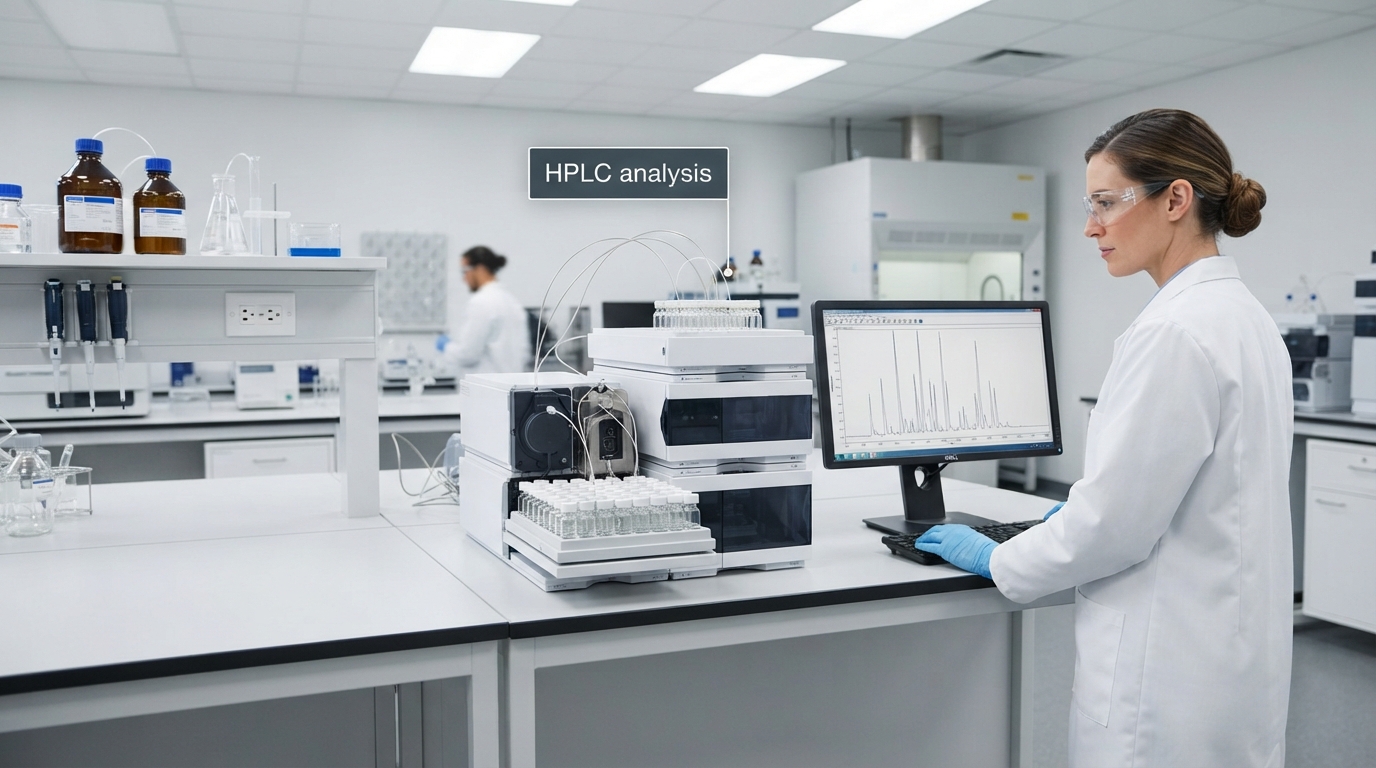
HPLC works by separating the chemical compounds in a sample and measuring the amount of the target compound against a reference standard. The general process is:
- A sample of the extract is prepared using a defined procedure.
- The prepared sample is passed through a chromatographic column.
- The column separates the compounds based on their chemical properties.
- A detector measures the target compound as it leaves the column.
- The measured response is compared with a reference standard of known concentration.
- The result is reported in the units defined by the specification.
The strength of HPLC is its specificity. It can separate the target compound from other plant constituents before measuring it. But the method is only reliable if it is suitable for the specific botanical material and the specific analyte.
Standards bodies such as NIST develop botanical reference materials and measurement tools to support this kind of label-claim verification. Measurement traceability matters because a result is only as trustworthy as the standard it is compared against.
When Are Other Analytical Methods Used?
HPLC is not the only option, and it is not always the right one.
- HPTLC is often used for identity checks and chromatographic fingerprinting. It can also be used for quantification in some cases.
- UV/Vis spectrophotometry can quantify compounds that absorb at a specific wavelength. It is simpler than HPLC but less specific, because other compounds in the extract can interfere.
- Other methods may be appropriate for certain compound classes or product forms.
What matters from a buyer’s perspective is that the method matches the analyte and the product. If a CoA does not identify the method, you cannot assess whether the assay result is credible.
How to Read the Assay Section of a Certificate of Analysis

The assay section of a CoA is where the laboratory reports the actual measured result for a specific batch. That result must be compared against the specification’s acceptance range.
Use this checklist when reviewing a botanical extract CoA:
- Confirm the batch or lot number matches the product you are actually buying.
- Locate the measured analyte or marker compound and verify it matches the specification.
- Check the analytical method so you know whether the result came from HPLC, UV/Vis, or another method.
- Compare the result against the acceptance range, not just against a single target number.
- Confirm the units used. A result reported as mg/g cannot be compared directly with a result reported as percentage.
- Check the test date and, where available, the laboratory that performed the analysis.
- Ask for a CoA that includes enough detail to understand what was tested and how.
A CoA is a batch-specific record. A Technical Data Sheet, or TDS, is different: it describes the typical product characteristics, handling, and storage information. The TDS tells you what the product is expected to be like. The CoA tells you what a specific batch actually measured.
If a CoA only says “assay passed” without identifying the analyte, method, units, or acceptance range, treat it as incomplete. It does not give you enough information to verify the potency of the material.
What an Assay Specification Cannot Prove
An assay specification is a powerful quality-control tool, but it has limits.
An assay does not prove:
- Clinical efficacy — a measured concentration does not guarantee a biological effect.
- Bioavailability — the amount in the extract is not the same as the amount absorbed by the body.
- Full-spectrum equivalence — two extracts with the same marker value can have different overall chemical profiles.
- Safety — potency testing is separate from contaminant, pesticide, heavy-metal, and microbiological testing.
- Long-term stability — the result reflects the material at the time of testing, not after years of poor storage.
Regulatory guidance for botanical drug development, for example, distinguishes chemical assays from biological assays because a chemical result is not always enough to describe activity. For commercial botanical extracts, the same principle applies: the assay is one piece of evidence, not the whole quality story.
A high assay percentage is not automatically better. The specification must be appropriate for the botanical, the application, and the intended marker. Comparing two suppliers simply by looking at their assay percentages can be misleading if they measured different markers, used different methods, or started from different plant parts.
Questions to Ask Your Botanical Extract Supplier Before You Buy
Before approving a botanical extract, ask for documentation that connects the assay specification to the actual batch you are buying.
- Which marker compound or active constituent is being measured?
- What analytical method was used to generate the assay result?
- What are the exact units and acceptance range?
- Does the certificate of analysis match the batch or lot I am purchasing?
- Were identity, purity, and contaminant tests performed on the same batch?
- Can you provide a Technical Data Sheet in addition to the CoA?
- Do any certifications apply to this specific product and batch? General company certifications are not the same as product-level evidence. For broader guidance, see what certifications should i look for when sourcing plant extracts.
- Is independent third-party testing available, or is it required for my application?
These questions are not about distrust. They are about verifying that the assay specification is meaningful, traceable, and applicable to the material being supplied.
Frequently Asked Questions
What is the difference between a Technical Data Sheet and a Certificate of Analysis?
A Technical Data Sheet describes the typical characteristics of a product, such as appearance, solubility, particle size, and storage recommendations. It is a general product description. A Certificate of Analysis records the actual test results for a specific batch. Use the TDS to understand the product and the CoA to verify the batch.
Why might an independent test result differ from a supplier’s CoA result?
Differences can come from sampling, analytical method variation, batch heterogeneity, or laboratory technique. A small difference may be normal. A large difference, or a result outside the acceptance range, should be discussed with the supplier and investigated before the material is used.
Can one HPLC method be used to test every botanical extract?
No. Different botanicals contain different compounds, and the method must be suitable for the analyte and the extract matrix. A method that works for one plant may not separate or measure the target compound properly in another. The method used should always be identified and fit for its purpose.
A clear assay specification is only useful when it is attached to a real batch. Before approving any botanical extract, confirm the specification against the batch-specific CoA and verify the result yourself. That single step prevents most documentation problems.
If you are evaluating suppliers and want to understand what to expect from a CoA-backed botanical extract supplier, B-Thriving’s botanical extract coa supplier page is a practical next step. Start with the assay, check the batch documentation, and only then move forward to sampling and quotation.

