
An ashwagandha extract manufacturer is a B2B supplier that produces or supplies a concentrated extract of Withania somnifera to a defined specification—typically one based on standardized withanolide content—and documents that specification with batch-level quality data. For procurement teams, formulators, and brand owners, the key is not just finding an ashwagandha powder supplier; it is confirming that the extract is consistent, traceable, and suitable for the finished product.
This guide explains what standardized withanolide extracts are, what quality documents a buyer should request, and how to evaluate an ashwagandha extract manufacturer. For a broader introduction to adaptogenic ingredient sourcing, see our adaptogen extract supplier overview.
What Is Ashwagandha Extract?
Ashwagandha extract is prepared from Withania somnifera, a botanical commonly known as ashwagandha or winter cherry. Extracts are typically produced from roots, leaves, or whole plant material. The plant part matters because the chemical profile of Withania somnifera is not identical across tissues.
A critical assessment of whole-plant based phytotherapeutics from Withania somnifera highlights why it is important to distinguish between root, leaf, and whole-plant extracts. Root material has traditionally been used in many ashwagandha preparations, while leaf material contains a different distribution of constituents. Whole-plant extracts combine material from both, creating a more complex phytochemical profile.
| Plant material | Typical focus | Sourcing implication |
|---|---|---|
| Root | Traditional preparations; often used in formulations positioned around stress, sleep, and vitality | Verify that the specification and label confirm root-only material |
| Leaf | Different withanolide profile; sometimes used in extracts targeting sports or energy positioning | Leaf material may not match root-based traditional positioning |
| Whole plant | Combines constituents from root and aerial parts; more complex specification | Confirm which constituents are standardized and whether the final profile suits your finished product |
A responsible manufacturer should clearly state whether the extract is made from root, leaf, or whole plant material. If the specification is unclear, the extract may not match the intended product claim or formulation.
What Does “Standardized Withanolide Extract” Mean?
Withanolides are a group of naturally occurring steroidal lactones found in Withania somnifera. Standardization means that the manufacturer controls the extraction and blending process so that the finished extract consistently contains a targeted concentration of designated marker compounds.
Total withanolides is the most common standardization target, but some commercial extracts standardize individual constituents such as withaferin A or withanolide glycosides. The distinction matters because two products labeled as “standardized ashwagandha” may be standardized to different compounds.
Three specification terms are frequently confused:
| Term | Example | What it tells you |
|---|---|---|
| Extract ratio | 10:1 | The amount of starting botanical material compared with the finished extract. It does not state how much active constituent is present. |
| Withanolide assay | 5% total withanolides | The measured concentration of marker compounds in the extract. |
| Milligrams per serving | 300 mg ashwagandha extract | The amount of extract used in a finished-product serving, not the amount of withanolides. |
An extract ratio is not a potency percentage. A 10:1 extract may contain a relatively low withanolide percentage, while a different 10:1 extract may contain more. The assay percentage is the number to compare when evaluating standardization.
A higher withanolide percentage is not automatically better. The identity of the marker compounds, the plant part used, and the overall extraction profile all influence whether the extract fits your application.
How Is Ashwagandha Extract Manufactured?
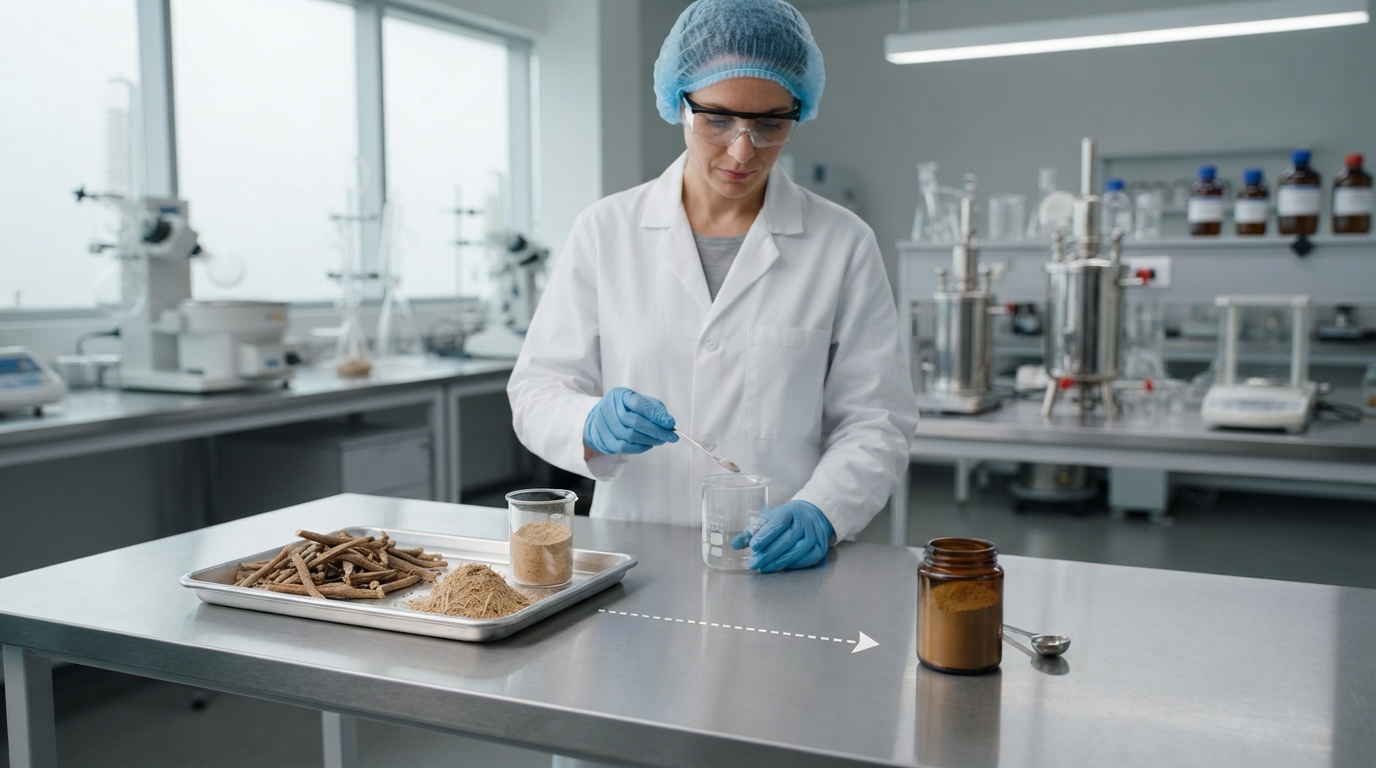
Manufacturing processes vary by supplier, but most dried powder extracts follow a similar sequence:
- Raw material sourcing and botanical identification. The supplier should verify the botanical identity of Withania somnifera before extraction.
- Cleaning and milling. Plant material is cleaned and reduced to a particle size suitable for extraction.
- Extraction. Solvents such as water, ethanol, hydroalcoholic mixtures, or other extraction systems are used to separate desired constituents from the plant material.
- Concentration and drying. The liquid extract is concentrated and dried to form a powdered extract.
- Standardization and blending. The extract is adjusted or blended to meet a target assay, such as a specified percentage of total withanolides.
- Quality control and batch release. The finished batch is tested for identity, active-marker content, physical properties, and relevant contaminants before release.
The extraction method matters because it affects which constituents are retained, the final phytochemical profile, and physical properties such as solubility. A manufacturer should be able to describe its extraction approach in concrete terms rather than relying only on generic “high quality” language.
Quality Documentation: CoA vs. TDS
Two documents should be part of every ashwagandha extract evaluation:
- Certificate of Analysis (CoA). A batch-specific document that reports the test results for a particular lot. It normally includes identity, withanolide assay, moisture, heavy metals, microbial limits, the test method used, batch number, and release date.
- Technical Data Sheet (TDS). A product-level document that describes the general physical and chemical specifications of the extract, including appearance, particle size, solubility, packaging, storage conditions, and shelf life.
| Document | Purpose | Typical contents | Best used for |
|---|---|---|---|
| CoA | Proves a specific batch met release criteria | Assay, identity, contaminants, method, batch number | Verifying the exact lot you purchase |
| TDS | Describes the general product specification | Appearance, particle size, solubility, packaging, storage, shelf life | Comparing formats and planning formulation |
Request both documents. A CoA applies to a specific batch, while a TDS describes what the supplier expects from the product on an ongoing basis. If a supplier cannot provide either, the sourcing decision becomes significantly riskier.
How to Evaluate an Ashwagandha Extract Manufacturer
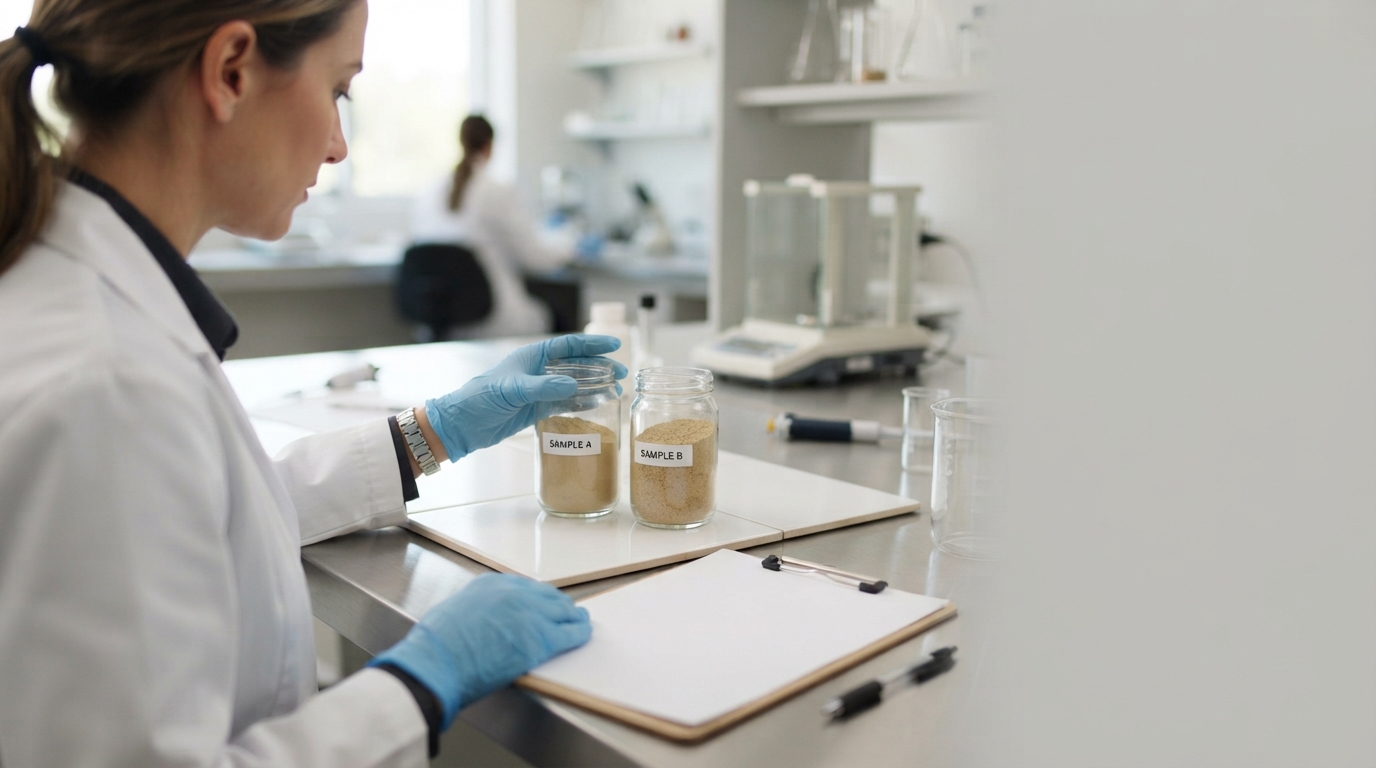
Use a short qualification checklist when comparing suppliers:
- Botanical identity and plant part. Is the extract made from root, leaf, whole plant, or a defined combination?
- Standardization target. Which marker compounds are used? Total withanolides, withaferin A, withanolide glycosides, or another specification?
- Analytical method. What testing method is used to determine the assay? HPLC methods are common, but the CoA should state the actual method.
- Extraction method. Which solvent system is used? Does the process match the stated product profile?
- Physical specifications. What are the particle size, moisture content, solubility, and appearance?
- Batch documentation. Is a CoA available for the specific batch being supplied?
- Product documentation. Is a TDS available?
- Contaminant testing. Are heavy metals, microbial limits, and pesticide residues tested and reported?
- Batch consistency. Does the supplier have a record of consistent assay results across multiple batches?
- Stability and storage. What are the recommended storage conditions and shelf life?
- Packaging. Is the extract packaged to protect against moisture and contamination?
- Sample approval. Can the buyer evaluate a sample before confirming a bulk order?
- Commercial fit. What are the MOQ, lead time, and documentation requirements?
For procurement teams, the most useful questions are also the most direct:
- Which part of the plant does this extract come from?
- Which withanolide compounds are standardized, and what is the target percentage?
- What analytical method is used?
- Can you provide a CoA for the batch you are offering?
- Does the TDS cover particle size, solubility, packaging, and shelf life?
- What contaminant limits are included in the release specification?
- Can a sample be approved before bulk ordering?
A supplier that answers these questions clearly is easier to qualify than one that relies on vague claims about premium quality or global supply.
Applications and Formulation Fit
The right ashwagandha extract depends on the finished product format and the claim the manufacturer intends to support.
- Capsules and tablets. Powdered extracts should have suitable particle size, flow, and compression behavior. The assay level should match the intended finished-product dosage.
- Powders and sachets. Solubility, dispersibility, and taste are more important. A standard powdered extract may not dissolve easily in water.
- Beverages. Water-dispersible or soluble forms may be needed to avoid sedimentation. Extraction method and excipients influence this.
- Cosmetics and topical products. The solvent profile, constituent composition, and compatibility with the formulation base matter.
- Sports nutrition. Low-dose standardized extracts may be preferred, but the individual product specification must be reviewed rather than assumed.
The application should determine the required form, potency, purity, and documentation. A manufacturer that understands application-specific needs is more likely to recommend an extract that actually works in your product.
Common Sourcing Pitfalls to Avoid
Treating extract ratio as potency. A “10:1 extract” is not a “10% extract.” The withanolide assay must be stated separately.
Assuming higher withanolides means better quality. The composition of individual withanolides and the extraction profile also matter. A pharmacokinetic review of Withania somnifera extracts notes that commercial extracts with similar total withanolide amounts may still require separate evaluation because their effects can differ.
Accepting a generic marketing claim as quality evidence. If a supplier mentions GMP, ISO, or Organic certification, ask for the actual certificate and confirm which facility, product, or batch it covers. Certifications should never be treated as universal.
Relying on a single CoA. A CoA issued for one batch does not prove future batches will match. Ask about batch-to-batch trends and release history.
Ignoring the difference between product claims and ingredient safety. Consumer-facing benefit claims are regulated differently in different regions. The raw extract specification should be evaluated separately from the finished-product claims.
Overlooking storage and shelf life. Ashwagandha extract is a dried botanical extract. Moisture, temperature, light, and packaging can all affect stability. Confirm the recommended storage conditions and shelf life before committing to bulk inventory.
FAQ
What is the difference between a 10:1 ashwagandha extract and a 5% withanolide extract?
A 10:1 extract ratio describes how much botanical material was used to produce the extract. A 5% withanolide assay describes the measured concentration of withanolides in the finished extract. Both pieces of information should be provided by the manufacturer.
Should I choose a root-only ashwagandha extract?
Root-only extracts are common and align closely with traditional use of ashwagandha. Whole-plant and leaf extracts have different constituent profiles. Choose the plant part that matches your target product positioning and the specification you are willing to defend.
What should an ashwagandha extract CoA include?
At a minimum, the CoA should include identity testing, withanolide assay, moisture content, heavy metals, microbial limits, the analytical method, batch number, and release date. If pesticide residues are a concern for your market, confirm whether they are included.
Does a higher withanolide percentage mean the extract is better?
Not necessarily. The same total withanolide percentage can be achieved with different individual constituent profiles. The extraction process, plant part, and analytical method all affect what the product actually contains.
Sourcing Ashwagandha Extract with B-Thriving
Selecting an ashwagandha extract manufacturer should be based on clear specifications, complete documentation, and fit with your formulation. A reliable supplier should be able to explain its sourcing, standardization, testing, and application support in concrete terms.
B-Thriving is a botanical and nutraceutical ingredient supplier focused on B2B sourcing. If you are evaluating ashwagandha extract for a dietary supplement, functional food, beverage, or other commercial application, contact the B-Thriving team to discuss your formulation requirements and the specifications you need.

