
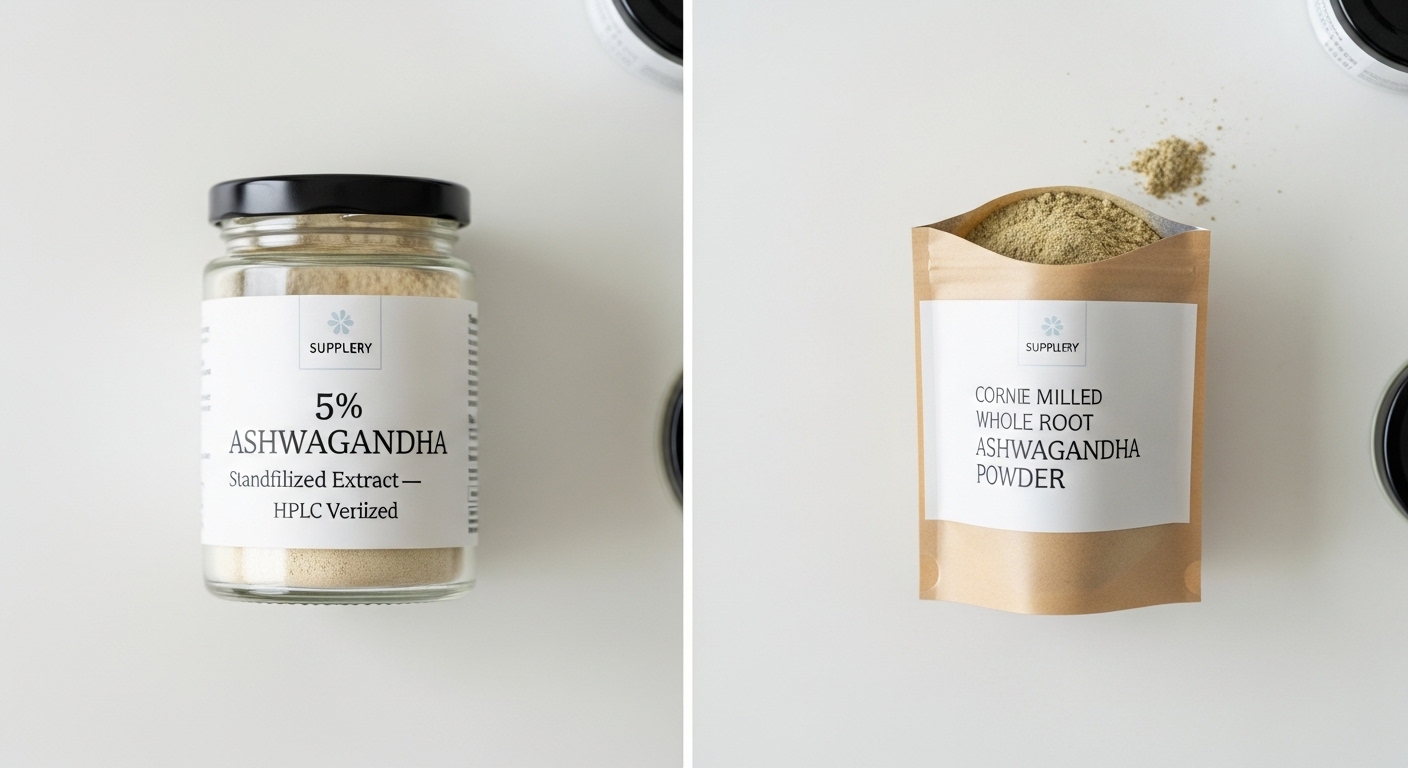
When sourcing ashwagandha for commercial formulations, the choice between standardized extract and whole root powder goes beyond potency. It affects batch consistency, regulatory compliance, label claims, and long-term product performance. Standardized ashwagandha extract delivers a defined withanolide percentage — typically 2.5%–10% — verified by HPLC or GC assay, making it the preferred choice for EU-regulated nutraceutical, pharma, and cosmetic manufacturers. Whole root powder retains the full phytochemical spectrum and suits cost-sensitive or traditional formulations where strict potency standardization is not required.
This guide helps procurement managers, formulators, and QA/RA professionals make the right sourcing decision. For a broader view of botanical ingredient categories, visit our standardized herbal extracts catalogue.
What Is Ashwagandha Standardized Extract?
Ashwagandha standardized extract comes from Withania somnifera root, concentrated and processed to deliver a consistent level of withanolides — the primary steroidal lactones responsible for the plant’s adaptogenic properties. Commercial grades range from 2.5% to 10% withanolides by weight. Manufacturers extract these compounds using water or ethanol, then spray-dry and assay the finished material via HPLC or GC to confirm specification compliance before release.
How Standardization Protects Batch Consistency
For manufacturers making label potency claims, batch-to-batch consistency is non-negotiable. Standardization controls the coefficient of variation (CoV) in active compound levels across production lots. Lot 001 and lot 050 both deliver the same withanolide percentage within specification tolerance. That consistency directly protects label claims, reduces QA rejection rates during incoming goods inspection, and lowers reformulation risk.
Extraction Methods and Their Effect on Withanolides
Water extraction preserves a broader polysaccharide profile alongside withanolides but typically yields lower withanolide concentrations. Ethanol extraction achieves higher withanolide purity and is the more common method for pharmaceutical-grade material.
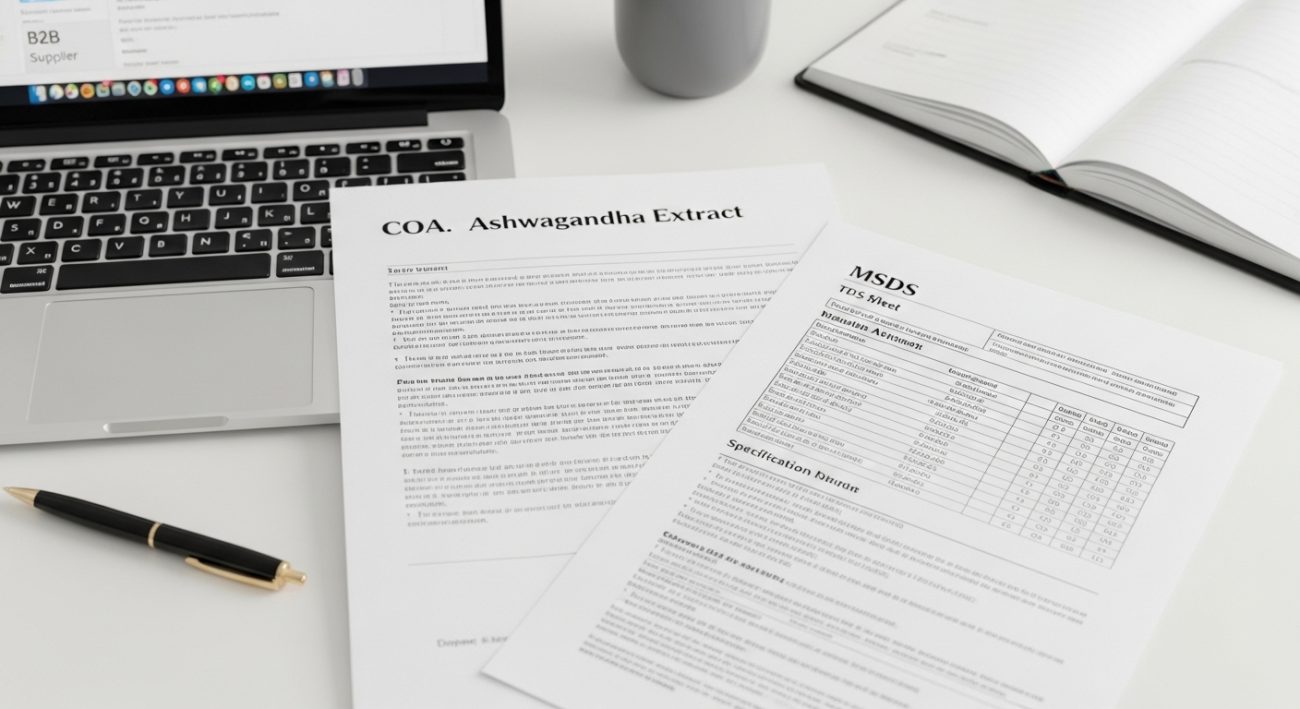
For EU buyers, the extraction method also determines solvent residue compliance under EU Regulation 2009/32/EC on extraction solvents. Always request TDS and MSDS documentation from your supplier to verify solvent processing details before placing an order.
What Is Whole Root Ashwagandha Powder?
Whole root powder is dried Withania somnifera root milled to a defined particle size. No concentration or standardization step occurs. The material retains its complete phytochemical matrix: withanolides, alkaloids (isopelletierine, anaferine), sitoindosides, saponins, and naturally present iron.
Full-Spectrum Profile: Active Compounds in Whole Root
Whole root delivers not only withanolides but also alkaloids and sitoindosides that standardized extract may partially reduce during processing. Some formulators value this full-spectrum identity for products developed within Ayurvedic or traditional herbal product (THP) frameworks, where the whole botanical — not a single marker compound — defines the product.
For EU product dossiers, this compositional distinction matters. Whole root powder carries a different botanical identity than a quantified extract, which affects health claim substantiation strategy under EU Regulation EC 1924/2006.
When Is Whole Root Powder the Right Sourcing Choice?
Whole root powder fits best when cost control drives sourcing decisions, when the formulation targets THP classification rather than a quantified extract product, or when label claims do not specify a withanolide percentage. It also suits Ayurvedic-style products where a broad phytochemical identity is part of the brand narrative.
Ashwagandha Standardized Extract vs Whole Root: Key Differences
The short answer: standardized extract wins for potency control, regulatory documentation, and label claim compliance. Whole root powder wins on cost and traditional formulation compatibility.
| Parameter | Standardized Extract | Whole Root Powder |
|---|---|---|
| Withanolide % | 2.5%–10% (HPLC/GC verified) | ~0.5%–1.5% (naturally variable) |
| Batch consistency | High — controlled CoV | Variable — crop-dependent |
| EU documentation | COA, TDS, MSDS, assay method | COA, origin documentation |
| Typical application | Nutraceutical, pharma, cosmetic | Traditional herbal, mass market |
| Cost per kg | Higher | Lower |
| Label claim suitability | High | Limited |
Potency and Withanolide Content Compared
Standardized extract at 5% withanolides delivers roughly 3–10× the withanolide content of typical whole root powder, depending on harvest quality. For formulators targeting a clinically referenced serving, standardized extract achieves the target dose in a smaller capsule fill weight — a direct manufacturing advantage.
Note that HPLC and gravimetric assay results are not interchangeable. HPLC values are typically lower but more precise. Always confirm which assay method a supplier uses before comparing specifications across vendors. This single detail prevents costly sourcing mismatches.
Bioavailability and Formulation Performance
Standardized extract delivers more predictable activity in finished product testing. The extraction process removes fibre bulk that can slow dissolution, and the defined withanolide concentration supports more reliable clinical reference traceability. Published randomized controlled trials, including a 2023 double-blind, placebo-controlled study (PMC10578737), used standardized root extract to demonstrate measurable outcomes — providing citation-grade evidence for EU product dossier development.
Cost and MOQ Considerations for Bulk Buyers
Whole root powder is significantly cheaper per kilogram, making it attractive for high-volume applications. Standardized extract carries a higher unit cost due to processing, yield loss, and assay testing. However, higher potency often means lower inclusion rates per serving, which partially offsets the price difference. For bulk negotiations, confirm MOQ tiers, lead times, and whether the quoted price includes third-party testing certificates.
EU Compliance Guide for Ashwagandha Extract Importers
EU buyers operate in a regulatory environment that varies by member state. Ashwagandha appears on the BELFRIT positive botanical list and the German positive list for traditional use, supporting food supplement classification in major EU markets. It is not currently classified as a novel food at EU level — an important market access distinction. Regulatory status, however, is not uniform across all 27 member states. Always confirm current classification with a local regulatory advisor before registering products in a new market.
EU Positive List Status and Food Supplement Classification
Products containing ashwagandha sold in France, Belgium, Italy, and Germany benefit from recognised positive list status, which simplifies food supplement notification. Products developed for broader EU distribution must comply with EU Directive 2002/46/EC on food supplements, including applicable purity criteria and labelling requirements.
Documentation Required for EU Entry
European procurement managers typically require the following before engaging a new supplier:
- COA with withanolide % and confirmed assay method
- TDS with full specification ranges
- MSDS
- Heavy metals certificate (Pb, Cd, As, Hg — per EU Regulation 2023/915)
- Pesticide residue report (per EU Regulation 396/2005)
- Origin and supply chain traceability documents
Request all of these at sample stage. A supplier who cannot provide a complete documentation package before bulk order placement is a sourcing risk for any EU-regulated product line.
Formulation Application Guide by Ashwagandha Grade
Choosing the right grade depends on your product format and target market classification.
| Application | Recommended Grade |
|---|---|
| Hard capsule / tablet | 5%–10% standardized extract |
| Softgel | 5% standardized extract |
| RTD beverage | 2.5% water-soluble extract |
| Topical / cosmetic active | 2.5%–5% standardized extract |
| Ayurvedic / THP product | Whole root powder |
| Pharma API support | 10% standardized extract (HPLC-confirmed) |
Nutraceutical and Supplement Formulation Uses
For hard capsule formats, 5% withanolides standardized extract at 300–600 mg per serving aligns with serving ranges used in published clinical reference studies — giving product development teams a defensible starting point for EU food supplement dossiers. Formulators applying the same standardized extract decision logic across multiple botanicals can reference our guides on turmeric standardized extract benefits and milk thistle standardized extract vs whole herb.
Cosmetic and Topical Formulation Considerations
Water-soluble ashwagandha extracts incorporate into aqueous cosmetic systems. Lipophilic withanolide fractions require a compatible carrier for emulsion or oil-phase applications. Confirm solubility profile and recommended use rate with your supplier before trialling. Cosmetic-grade material must also comply with EU Cosmetics Regulation EC 1223/2009, including Annex I safety assessment. Request a cosmetic-specific COA if your formulation targets this category.
How to Source Ashwagandha Extract from a Qualified Supplier
Key Questions to Ask Before Submitting an RFQ
Qualifying a Chinese botanical supplier for EU supply requires direct, specific questions:
- What is the withanolide % and which assay method confirms it — HPLC, gravimetry, or GC?
- Do you hold GMP or ISO certification? Can you provide current certificates?
- Does your standard COA include heavy metals, pesticide residues, and microbiological testing?
- What are your MOQ, lead time, and reorder stock availability?
- Can you provide a prior lot COA for batch consistency review?
These questions separate qualified manufacturers from commodity traders at the earliest stage of the process.
OEM and ODM for Custom Ashwagandha Specifications
If your product requires a non-standard withanolide percentage, custom particle size, or a specific extraction profile, confirm OEM capability before engaging. B-Thriving supports OEM and ODM programmes covering custom grades, packaging formats, and EU-aligned documentation. For a parallel sourcing example, see how we handle saw palmetto standardized extract vs whole herb for European formulators.
The fastest way to qualify any supplier is to evaluate a physical sample alongside a full COA — simultaneously. Our full standardized herbal extracts range is available for RFQ, bulk, and OEM supply with EU documentation included.
Request a free ashwagandha extract sample and COA →
Frequently Asked Questions
What is the difference between ashwagandha standardized extract and whole root powder?
Standardized extract delivers a specified withanolide percentage verified by HPLC or GC assay; whole root powder retains the full natural phytochemical matrix at naturally variable, uncontrolled withanolide levels. For EU label claim compliance, standardized extract is the more practical sourcing choice.
How many withanolides should ashwagandha extract contain for EU food supplements?
Most EU manufacturers specify 2.5%–5% withanolides as a working minimum for products referencing potency. Confirm the exact withanolide level, assay method, and serving size against applicable EU member state guidance for your specific product category.
What documents are required when importing ashwagandha extract to Europe?
You need a COA (with assay method specified), TDS, MSDS, heavy metals certificate (EU Regulation 2023/915), pesticide residue report (EU Regulation 396/2005), and origin documentation. Request all documents before committing to a bulk order.
Is ashwagandha classified as a novel food in the EU?
Ashwagandha is not currently classified as a novel food at EU level and appears on the BELFRIT and German positive lists. Classification varies by member state, so consult a local regulatory advisor before registering products outside France, Belgium, Italy, and Germany.
Why do withanolide values differ between suppliers reporting similar extract grades?
HPLC and gravimetric assay methods produce different numerical results for the same material. HPLC measures specific compounds precisely; gravimetry measures a broader fraction and typically reports higher values. Always confirm which method a supplier uses before comparing quotes across vendors.
Can whole root ashwagandha powder be used in hard capsule formulations?
Yes, but variable withanolide content makes label potency claims unreliable without accepting wide specification tolerances. For EU-regulated supplements with defined serving statements, standardized extract provides significantly stronger compliance assurance.

