
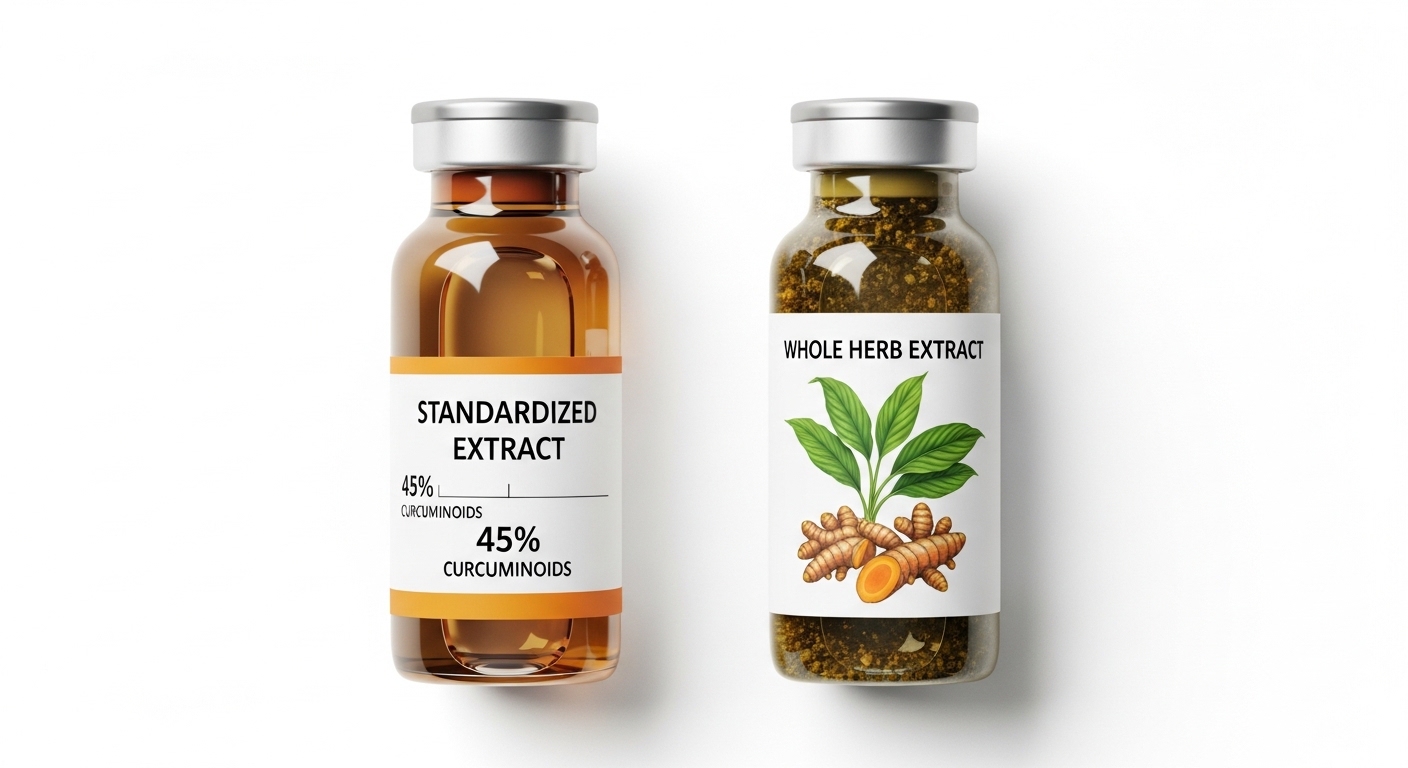
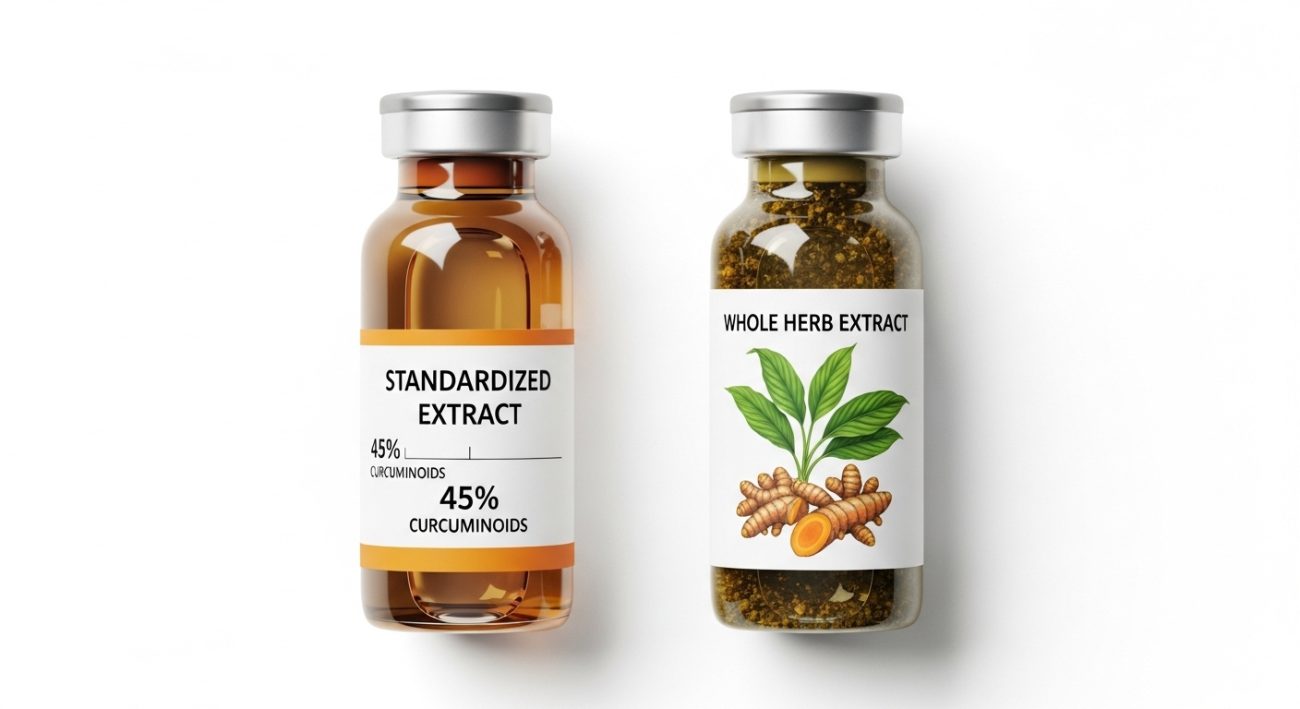
Choosing between a standardized extract and a whole herb extract is one of the most consequential sourcing decisions a formulator or procurement manager makes. Standardized extracts deliver a guaranteed minimum level of a specific marker compound — verified by HPLC or UV testing — while whole herb extracts preserve the full phytochemical profile of the plant with naturally variable potency. Neither is universally superior. The right choice depends on your product category, target market, regulatory pathway, and formulation spec.
This guide cuts through the noise and gives you a practical, compliance-aware framework for making that decision.
What Are Standardized Extracts vs Whole Herb Extracts?
A standardized herbal extract is processed to contain a defined, consistent percentage of one or more marker compounds. For example, an ashwagandha extract standardized to 5% withanolides means every batch — regardless of harvest season or growing conditions — meets that minimum assay value. This consistency is verified through analytical testing, and documented on the Certificate of Analysis (COA).
A whole herb extract, by contrast, concentrates the plant material without targeting any single compound. The complete phytochemical profile — including minor alkaloids, flavonoids, polysaccharides, and resins — remains intact. Potency varies between batches because it reflects the natural variability of the plant source.
How Standardization Defines Minimum Potency Levels
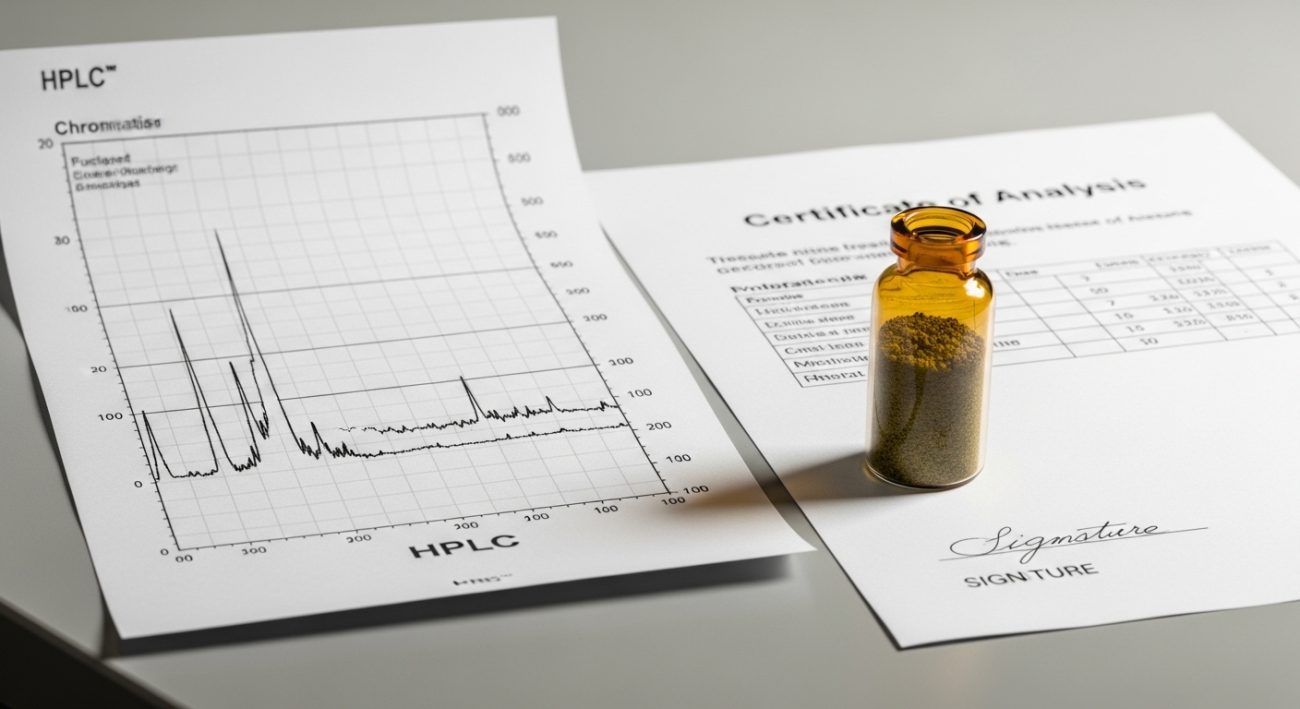
Standardization works by adjusting the manufacturing process — through solvent selection, concentration steps, and blending — until the marker compound reaches the specified assay level. A COA for a standardized extract will include an assay line such as:
Ginkgo biloba Extract: Ginkgoflavonglycosides ≥24%, Terpene lactones ≥6% by HPLC
This line is the supplier’s verifiable commitment to potency. Without it, you have no reproducible formulation baseline. If your contract manufacturer runs 10 production lots per year, batch-to-batch consistency in the incoming extract directly determines finished product consistency.
What “Whole Herb” Really Means on a Spec Sheet
On a supplier spec sheet, a whole herb extract typically shows moisture content, ash values, particle size, and a general identity test — but no assay for a specific active or marker compound. The absence of that assay line is not a flaw; it is a feature when your application requires full-spectrum phytochemistry or when clean-label positioning demands “nothing removed, nothing concentrated.”
The practical difference shows up immediately when you compare the two spec sheets side by side. One gives you a single, verifiable potency anchor. The other gives you a complete but variable phytochemical fingerprint.
Key Differences: Standardized vs Whole Herb Extracts
| Criterion | Standardized Extract | Whole Herb Extract |
|---|---|---|
| Potency consistency | Guaranteed minimum assay | Batch-variable |
| Phytochemical profile | Targeted marker compound(s) | Full-spectrum, intact |
| Testing method | HPLC, UV, GC-MS per batch | Identity test, general specs |
| EU compliance pathway | GMP Annex 7 / pharmacopoeia monographs | THMP Directive 2004/24/EC |
| Shelf life (typical) | 24–36 months | 12–18 months |
| Clean-label appeal | Lower | Higher |
| Formulation use case | Pharma-grade, nutraceutical, precise dosing | Traditional herbal, clean-label, synergy-based |
Consistency and Batch-to-Batch Reproducibility
For any product targeting a defined dose — capsules, tablets, or standardized liquid formulations — incoming material consistency is not optional. A standardized extract with a tight specification tolerance (for example, ±2% on the marker compound assay) allows your QA team to qualify the material against spec once and then verify compliance batch by batch using the COA. Whole herb extracts require more robust in-house analytical controls because you cannot rely on the supplier’s assay to define your potency range.
Phytochemical Profile: Synergy vs Precision
Researchers frequently describe the “entourage effect” — the idea that minor phytochemicals in a whole plant matrix may modulate or enhance the activity of the primary compound. Whether or not this effect is clinically meaningful depends on the specific botanical, the application, and the existing evidence base. From a formulation standpoint, the decision is simpler: if your product label makes a specific compound-level claim (e.g., “contains 300 mg standardized to 5% withanolides”), you need a standardized extract. If your label says “traditional full-spectrum ashwagandha root,” the whole herb extract fits the claim better.
Extract Ratio vs Standardized Concentration: What’s the Difference?
This distinction confuses many procurement teams. A 10:1 extract ratio means 10 kg of raw herb was concentrated into 1 kg of extract — but it says nothing about the final concentration of any specific compound. A 10% standardized extract means the finished material contains exactly 10% of the named marker compound by analytical verification. You can have a 20:1 extract with 2% of the marker compound, and a 4:1 extract with 8%. The ratio describes concentration by weight; standardization describes verified chemical content. Always request both on a spec sheet if you need to understand both the raw material input and the potency output.
When to Choose Standardized Extracts for Your Formulation
Standardized extracts suit applications where dosing precision, regulatory documentation, and quality reproducibility are non-negotiable.
Best Applications for Standardized Herbal Extracts
- Pharmaceutical-grade APIs and OTC products requiring pharmacopoeia-compliant specifications
- Nutraceutical supplements with specific active compound claims on label
- Sports nutrition products where actives drive performance positioning
- Cosmeceuticals targeting defined functional ingredients (e.g., resveratrol, EGCG, bakuchiol)
- Clinical nutrition and medical food formats requiring verifiable potency
Browse B-Thriving’s standardized botanical extract range to see available marker compounds, assay levels, and sample availability across 105+ botanicals.
Why Formulators Prefer Standardized Extracts for Scale-Up
At pilot scale, a small potency variance may not matter. At commercial scale — when you run 50,000-unit batches and face pharmacovigilance obligations or QA audits — incoming material variability becomes a real cost and compliance risk. Standardized extracts eliminate one major variable from your finished product deviation reports. They also simplify supplier re-qualification because the acceptance criteria are already written into the COA specification.
When Whole Herb Extracts Are the Right Sourcing Choice
Not every product benefits from standardization. Two categories stand out where whole herb extracts are the strategically correct choice.
Whole Herb Extracts for Traditional Herbal Medicinal Products
In the European Union, Traditional Herbal Medicinal Products (THMPs) registered under Directive 2004/24/EC require documented evidence of 30 years of traditional use — at least 15 of those years within the EU. The regulatory pathway for THMPs often specifies the herbal preparation type (e.g., comminuted herb, dry extract with defined ratio) in the monograph. Sourcing a highly standardized extract for a THMP application can complicate the dossier if the form or ratio deviates from the monograph specification. Whole herb or traditionally prepared extracts often align more cleanly with THMP documentation requirements.
Before finalizing your extract form, cross-reference the relevant EMA herbal monograph for your botanical and confirm whether the standardized or non-standardized preparation has existing traditional use documentation.
Clean-Label Formulations and Consumer Positioning
Consumer research consistently shows that a significant portion of supplement buyers prefer ingredient labels that list “whole herb” or “full-spectrum extract.” For brands competing on clean-label positioning in European health food retail, the whole herb form reduces consumer scepticism. If your B2B customer’s marketing strategy emphasizes natural integrity over potency precision, whole herb sourcing supports that commercial narrative.
EU Compliance for Standardized and Whole Herb Extracts
EU buyers face a two-tier compliance environment: the food supplement pathway (under Directive 2002/46/EC) and the herbal medicinal product pathway (under Directive 2001/83/EC and 2004/24/EC). The extract form you source directly affects which pathway is available and what documentation you need.
EU GMP Annex 7 Requirements for Herbal APIs
For herbal substances used as active pharmaceutical ingredients (APIs), EU GMP Annex 7 applies. Under Annex 7, suppliers must operate to validated manufacturing processes, maintain full batch records, and provide complete analytical testing documentation — including identification, assay, residual solvents, heavy metals, pesticide residues, and microbiological counts. A supplier’s GMP certificate should identify the specific scope (herbal APIs, finished products, or both). Before you raise an RFQ, request the supplier’s current GMP certificate and verify the scope against your product’s regulatory status.
For detailed EU regulatory context on drug interaction risks from standardized extracts, see our herbal extract drug interactions guide.
EMA Herbal Monographs: What They Mean for Your Sourcing
The European Medicines Agency publishes herbal monographs for over 150 medicinal plants. Each monograph defines accepted preparations, dosage forms, and indications for traditional use or well-established use. When a monograph specifies a particular extract form — such as a dry ethanolic extract with a defined DER (Drug-Extract Ratio) — using a different form or standardization level may require additional scientific justification in your regulatory dossier. Check the EMA Community Herbal Monograph for your botanical before locking in a supplier specification.
Key Documents to Request from Your Extract Supplier
Before approving any extract supplier for EU market supply, request the following documentation package:
- Certificate of Analysis (COA) — full analytical panel including assay, identification, heavy metals, pesticides, solvent residues, microbiology
- GMP Certificate — confirm scope covers herbal substances or APIs as relevant
- HPLC chromatogram — raw data supporting the assay value on the COA
- Residual solvent report — confirm compliance with ICH Q3C and EU pharmacopoeia limits
- Shelf life and stability data — expiry basis and storage conditions
- MSDS / Safety Data Sheet — required for import classification and logistics
Understanding the broader safety profile of standardized herbal extracts helps your QA team build a complete risk dossier before supplier approval.
How to Source Standardized or Whole Herb Extracts: Procurement Guide
Once you have confirmed your extract type and EU compliance pathway, the procurement process follows a predictable sequence.
Writing an RFQ for Standardized or Whole Herb Extracts
A well-structured RFQ reduces back-and-forth and gets you a precise quote faster. Include the following minimum information:
- Botanical name (Latin binomial) and plant part (root, leaf, fruit, seed)
- Extract type (standardized / whole herb / ratio)
- Marker compound and assay target (for standardized extracts, e.g., “≥5% withanolides by HPLC”)
- Desired quantity (initial order and estimated annual volume)
- Physical form (powder, granule, liquid)
- Required certifications (GMP, ISO, Kosher, Halal, organic)
- Target delivery market (EU — relevant for solvent residue and contaminant limits)
For standard RFQ specifications and minimum order details, visit our standard herb extract product page.
What B-Thriving Supplies: Standardized Extract Capabilities
Xi’an B-Thriving supplies HPLC-tested standardized extracts across a wide range of botanicals — including ashwagandha (withanolides), green tea (EGCG), ginkgo biloba (ginkgoflavonglycosides and terpene lactones), turmeric (curcuminoids), grape seed (oligomeric proanthocyanidins), and many others. Each batch ships with a full COA, and samples are available on request for qualification purposes. OEM standardization levels — custom assay percentages within technically achievable ranges — are available for established procurement relationships.
If you have questions about safety or tolerability data to include in a product dossier, our standardized herbal extract side effects resource provides formulator-relevant context.
Frequently Asked Questions
What is the main difference between a standardized extract and a whole herb extract?
A standardized extract guarantees a minimum percentage of a specific marker compound, verified analytically. A whole herb extract preserves the full phytochemical profile of the plant but does not guarantee any specific compound concentration.
What does “standardized to 5% withanolides” mean on a COA?
It means every batch of that extract contains at least 5% withanolides by weight, measured by HPLC. This is a supplier’s verifiable quality commitment, not a general description.
What is the difference between a 10:1 extract ratio and a 10% standardized extract?
A 10:1 ratio describes the weight of raw herb used to produce 1 kg of extract — it says nothing about compound potency. A 10% standardized extract confirms that exactly 10% of the finished extract is the named marker compound, confirmed by analytical testing.
Which extract type does EU GMP Annex 7 apply to?
EU GMP Annex 7 applies to herbal substances used as APIs, regardless of whether they are standardized or non-standardized. It governs manufacturing, documentation, and quality control requirements for the supplier.
Can standardized extracts be used for EU Traditional Herbal Medicinal Product registration?
Potentially, but only if the standardized form aligns with the preparation described in the relevant EMA herbal monograph. Deviating from the monograph specification requires additional scientific justification in the regulatory dossier.
What documentation should I request before approving an extract supplier for EU supply?
Request at minimum: COA with full analytical panel, GMP certificate with scope, HPLC chromatogram, residual solvent report, stability data, and an SDS. This package supports both initial supplier qualification and ongoing audit readiness.
Ready to compare extract specifications for your next formulation? Request a sample and COA from B-Thriving’s standardized extract range — our technical team responds with full documentation within 24 hours.

