

A specification stating “10% flavones” does not tell a supplement developer how much 8-prenylnaringenin (8-PN) a Hops Extract contains. That distinction matters when the product concept concerns menopause. Clinical studies have investigated particular hop preparations—not every extract sold under the same botanical name.
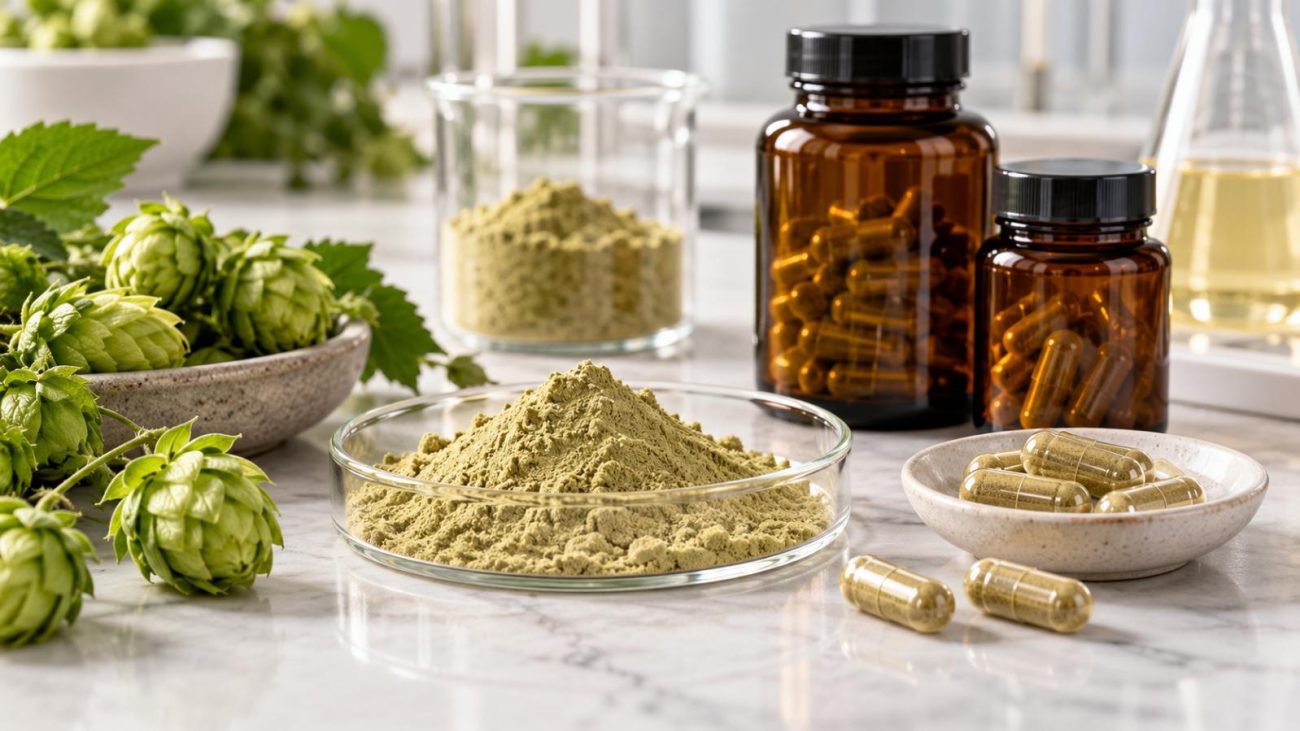
At B-Thriving, we recommend evaluating Hops Extract through three questions: Which compounds are present? What does human research actually show? And can the supplier document consistent composition?
What Makes Hops Extract Relevant to Women’s Health?
Hops Extract is produced from the female flower cones of Humulus lupulus L. The plant contains bitter acids, volatile components, and prenylated flavonoids. For women’s wellness research, the last group attracts particular attention because some members exhibit estrogen-receptor activity.
The ingredient used for beer bitterness may differ substantially from a supplement-grade Hops Extract. Botanical identity alone does not establish an appropriate active-compound profile.
The Compounds Formulators Need to Distinguish
| Compound or Marker | Scientific Relevance | Formulation Consideration |
| 8-Prenylnaringenin (8-PN) | Potent phytoestrogen with estrogen-receptor activity | Requires individual 8-PN quantification |
| Isoxanthohumol (IX) | Can be converted into 8-PN by intestinal microbiota | Conversion varies between individuals |
| Xanthohumol (XN) | Prenylated chalcone investigated in preclinical studies | Evaluate concentration and stability |
| Total Flavones | Broad compositional quality indicator | Cannot establish 8-PN concentration |
One particularly relevant complication is metabolism.
In a human and laboratory investigation, intestinal microbial conversion of IX to 8-PN varied markedly between individuals. Identical IX intake therefore need not produce identical 8-PN exposure.
A high total-flavones percentage offers no shortcut around this variability.
Does Hops Extract Help with Menopausal Symptoms?
What Clinical Trials Actually Tested
A randomized study involving 67 menopausal women examined Hops Extract standardized to 100 or 250 micrograms of 8-PN per day.
At six weeks, the lower dose showed improvement on a menopausal symptom index when compared to placebo. By twelve weeks, that difference was no longer statistically significant. The higher dose did not show a consistent dose-response advantage.
Additional clinical data include the following information:
•36-participant crossover trial: No significant overall modeled treatment effects were observed. Some favorable effects were observed in later observations.
•120-participant randomized trial: By week 12, participants in the treatment group reported improvement in menopausal symptom scores, and a reduction in the frequency of hot flashes.
Based on the current data, there is not enough information to support any conclusive findings. The available data do not support broad, unsupported use of Hops extract for the treatment of menopausal symptoms.
Trial results pertain to the preparations, doses and endpoints studied. They cannot be extrapolated to a simple 5%-10% flavones product and used to make broad statements about it.
What About Sleep and Relaxation?
Hops has a documented history of traditional use for mild mental stress and sleep difficulties.
The European Medicines Agency recognizes certain hop preparations under traditional herbal use, which is different from a finding of well-established clinical efficacy.
For women’s sleep-support formulations, developers should evaluate the relevant evidence separately from menopause-related phytoestrogen studies.
How Can Hops Extract Be Used in Women’s Wellness Formulas?
The anticipated dosage form influences the type of technical questions asked.
•Capsules: Analyze excipient uniformity of recipients and check the flow of the excipients. Assess the compatibility of excipients. Check if the marker is present in the dose.
•Tablets: The tablets were tested for the time of disintegration & loss of marker during manufacture. Evaluate the compressibility of the excipients.
•Powders and Drink Mixes: Evaluate the extent of the powder dispersion when a drink is made and assess bitterness and astringency. Assess the masking of bitterness and astringency.
•Multi-Botanical Blends: Check for incompatibility of the ingredients. Consider that the expected characteristics of a combination of ingredients may not be the same as the expected sum of individual ingredient characteristics.
Bitter constituents of hops may be a concern in beverages. Hops Extract, however, requires bench scale sensory evaluation and stability testing.
How Should Manufacturers Qualify a Hops Extract Supplier?
1. Active Marker Definition
“Standardized Hops Extract” is not very informative without definition of what is being standardized.
Bulk UV assays can not qualitatively and quantitatively assess 8-PN, IX, and X.
For formulations with 8-PN as the primary focus, request HPLC-DAD or LC-MS, and state your required detection limit.
2. Evaluate the Extraction and Processing Conditions
The extraction conditions (e.g. temperature and solvent) affect the prenylflavonoid profiles.
•What extraction solvent was used?
•How are residual solvents controlled?
•Is the botanical identity and origin (i.e. flower-derived) established?
•Is Hops Extract free-flowing?
•What are processing aids/carriers?
•Is stability information available for the proposed packaging/storage conditions?
3. Review the Lot-Specific Certificate of Analysis
| Quality Parameter | Why It Matters |
| Botanical identity | Confirms Humulus lupulus flower-derived material |
| Assay method and acceptance range | Establishes what the declared percentage measures |
| Microbiology, heavy metals, residual solvents | Supports contaminant risk assessment |
| Lot-specific marker results | Helps evaluate consistency between deliveries |
| Stability and packaging information | Supports shelf-life and formulation planning |
A total-flavones percentage cannot be used to calculate an 8-PN dose. The individual compound concentration must first be established analytically.
Discuss Your Hops Extract Requirements with B-Thriving
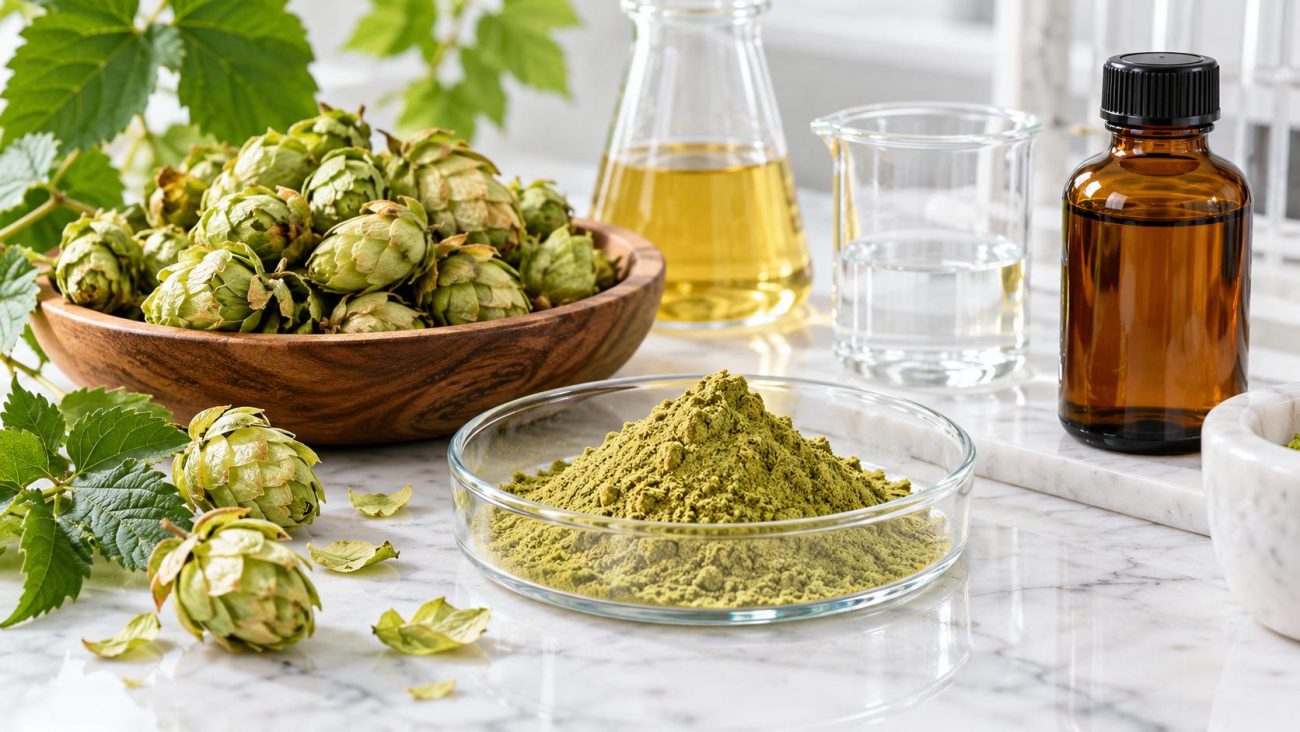
B-Thriving’s Hops Extract is offered as a Humulus lupulus flower-derived, brown-yellow fine powder containing 5%–10% flavones measured by UV spectrophotometry. This is a total-flavones specification, not a declaration of 8-PN content.
If your women’s wellness project has specific needs for an active-marker profile, dosage form or quality documentation, contact B-Thriving to discuss the available product information and assess ingredient suitability before you start formulation.
FAQs
Q1. How can supplement manufacturers source Hops Extract from B-Thriving?
Manufacturers can review B-Thriving’s Hops Extract and contact the team to discuss product specifications, quality documentation, formulation requirements, and quotations.
Q2. What is the active ingredient specification of B-Thriving’s Hops Extract?
B-Thriving lists 5%–10% flavones, measured using UV spectrophotometry. This specification does not establish individual phytoestrogen concentrations.
Q3. Does B-Thriving’s Hops Extract contain 8-prenylnaringenin (8-PN)?
Hops naturally contains 8-PN, but B-Thriving’s published specification does not quantify it. Buyers requiring a defined 8-PN concentration should request compound-specific analytical information.
Q4. How does B-Thriving test its Hops Extract?
B-Thriving lists UV spectrophotometry for flavone content measurement. Individual compounds such as 8-PN and xanthohumol require appropriate chromatographic analysis.
Q5. Can B-Thriving’s Hops Extract be used in menopause-focused supplements?
It may be evaluated as a botanical formulation ingredient. However, menopause-related efficacy cannot be assumed from total flavone content; the active-compound profile and supporting evidence must be assessed.

