
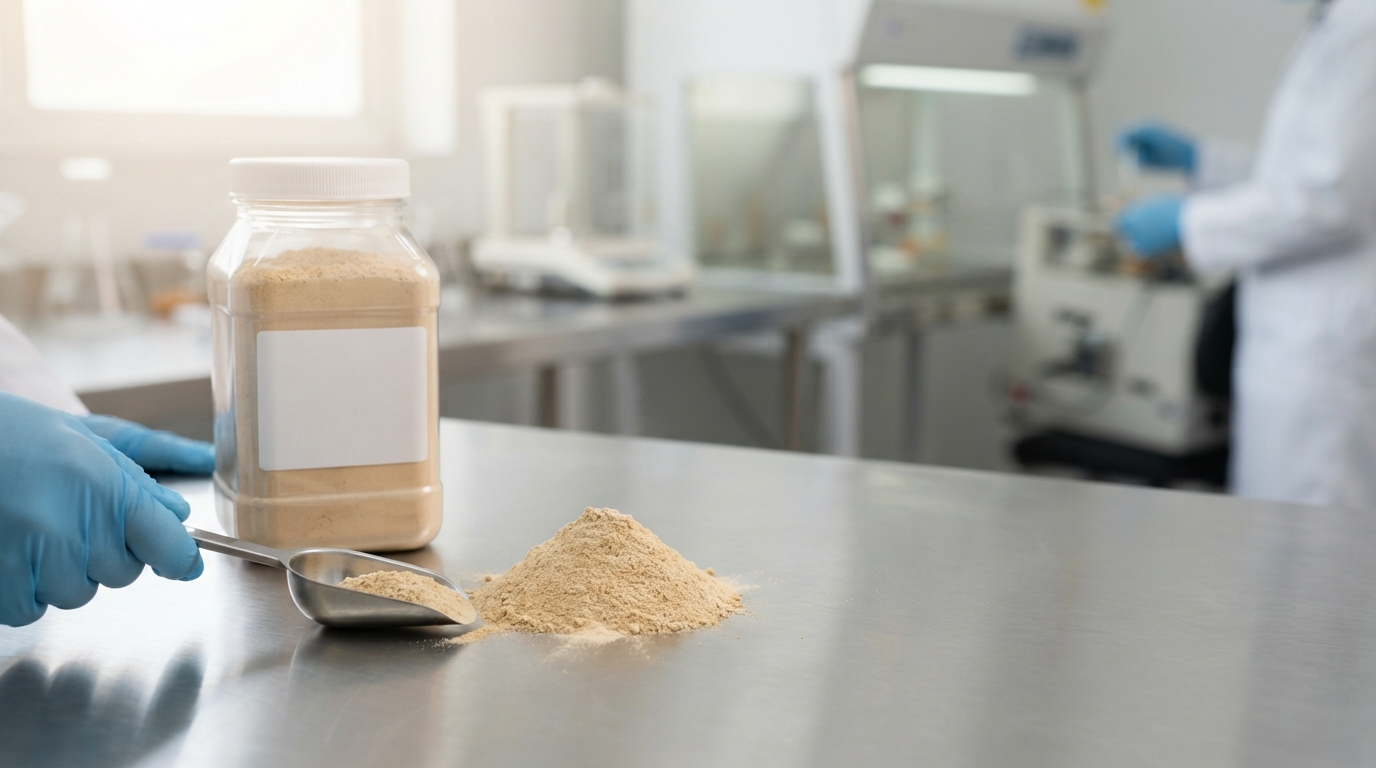
Bulk Cordyceps extract is not a single, interchangeable ingredient. A bulk Cordyceps extract supplier is a B2B source that provides manufacturers with a clearly identified, documented Cordyceps-derived extract — usually in powder or liquid form — supported by batch-level quality records and commercial terms suitable for production.
This guide explains how to define the ingredient you need, compare supplier specifications accurately, request the right documentation, and qualify a supplier before you commit to an order. If you are looking for the broader published science on Cordyceps, see cordyceps extract enhances immunity. This page focuses on sourcing and supplier evaluation.
What Does a Bulk Cordyceps Extract Supplier Actually Supply?
A professional bulk supplier should be able to tell you exactly which Cordyceps product you are buying. If the supplier can only say “Cordyceps extract,” you do not yet have enough information to compare quotes.
Three commercial identities commonly appear in the market:
| Product identity | Source material | What the buyer should verify |
|---|---|---|
| Cordyceps militaris | Fruiting body, mycelium, or fermented biomass from cultivated C. militaris | Exact species, part used, cultivation method, marker compound, and extraction method |
| Cordyceps sinensis | Traditionally an insect/fungal complex; commercial products may be cultivated or mycelial | Whether the product is authentic, cultivated, or mycelial, and which species name is actually used |
| CS-4 | Fermented mycelial biomass, often associated with Paecilomyces hepialis or Cordyceps sinensis mycelium | Fermentation method, mycelial origin, and the marker compounds used for standardization |
The product form matters too. Bulk Cordyceps extract may be supplied as powder, granule, or liquid. Each form has different handling, solubility, stability, and application characteristics.
If you are also evaluating other functional mushroom extracts, the reishi extract benefits side effects and usage guide provides a useful reference for comparing a different mushroom ingredient.
Cordyceps militaris vs. Cordyceps sinensis vs. CS-4
These are not interchangeable names for the same ingredient.
- Cordyceps militaris is a cultivated species that is widely used in supplements because it can be grown on a commercial scale. Its fruiting body and mycelium may both be processed into extracts.
- Cordyceps sinensis is the better-known traditional name, but authentic material is expensive and often scarce. Many commercial products labelled C. sinensis are actually cultivated mycelium or a related product.
- CS-4 refers to a fermented mycelial biomass product, not to a fruiting-body extract. It is a distinct commercial identity with its own production process and quality considerations.
When you send an RFQ, name the exact product identity. Do not rely on a general phrase such as “Cordyceps extract” or “mushroom extract.”
Fruiting Body vs. Mycelium vs. Fermented Biomass
The biological source material changes what the extract contains and how it should be labelled.
- Fruiting body is the reproductive structure of the fungus. Extracts made from fruiting bodies are commonly associated with a different marker profile than mycelial products.
- Mycelium is the vegetative root-like growth of the fungus. Mycelial biomass can be produced by fermentation.
- Fermented biomass is the material produced when the fungus is grown in a liquid or solid fermentation system. CS-4 products are typically in this category.
None of these is automatically “better.” The right choice depends on your target product, marker specification, label claims, and the evidence you intend to support. Your supplier should be able to state which part of the organism was used and how the material was produced.
Cordyceps Extract Specifications Manufacturers Need to Compare
Manufacturers often compare supplier quotes using the wrong specification fields. The two most common mistakes are treating extract ratio as potency and comparing marker percentages without checking the marker or the test method.
| Specification field | What it means | Example |
|---|---|---|
| Extract ratio | How much starting material is processed to produce one part of extract | 10:1 means 10 kg of starting material produces 1 kg of extract |
| Assay / potency | Measured amount of a named marker compound | “Standardized to 1% cordycepin” means 10 mg cordycepin per 1 g of extract |
| Purity | The proportion of the desired compound in the material, when defined analytically | Often expressed as % or mg/g |
| Moisture content | Water content of the powder | Usually expressed as % |
| Particle size | Coarseness or fineness of the powder | Commonly described in mesh size |
| Solubility | Whether the extract disperses or dissolves in a given liquid | Important for beverages and liquid formulations |
Always ask the supplier to state the specification with its unit. A 10:1 extract ratio and a 10% cordycepin assay are completely different pieces of information.
Extract Ratio and Assay: Why the Units Matter
A buyer might see “Cordyceps extract 10:1” and assume it means “ten times stronger.” That is not what the ratio tells you.
Extract ratio describes the concentration process. It does not tell you how much of any specific compound is present in the final powder. Two suppliers can both offer a 10:1 Cordyceps extract with very different marker levels, depending on the raw material, extraction process, and standardization.
The assay is the number that matters for potency comparison. However, an assay is meaningful only when the marker compound, the analytical method, and the reporting unit are identified.
For example:
- “Cordyceps extract, 1% cordycepin” means the extract contains 1 g cordycepin per 100 g extract or 10 mg per g.
- “Cordyceps extract, 10:1” means the concentration process used a 10-to-1 starting-material-to-extract ratio, but it does not define the marker content.
Never let a supplier use the extract ratio as a substitute for a marker assay.
Marker Compounds and Standardization
Cordyceps extracts are often standardized to one or more markers. The most common are:
- Cordycepin — a nucleoside analogue often associated with Cordyceps militaris.
- Adenosine — a related nucleoside compound.
- Polysaccharides — a broad class of carbohydrate polymers common in fungal ingredients.
- Beta-glucans — a specific type of polysaccharide often used for fungal extract characterization.
Different suppliers may standardize to different markers. That means you cannot compare two products simply because both say “standardized.” You need to know:
- Which marker was measured.
- Which analytical method was used, such as HPLC.
- What unit the result is reported in, such as % or mg/g.
- What the specification range is for that batch.
If a supplier cannot provide this information, their specification is not yet complete enough for a manufacturer to evaluate.
Quality Documents and Testing for Bulk Cordyceps Extract
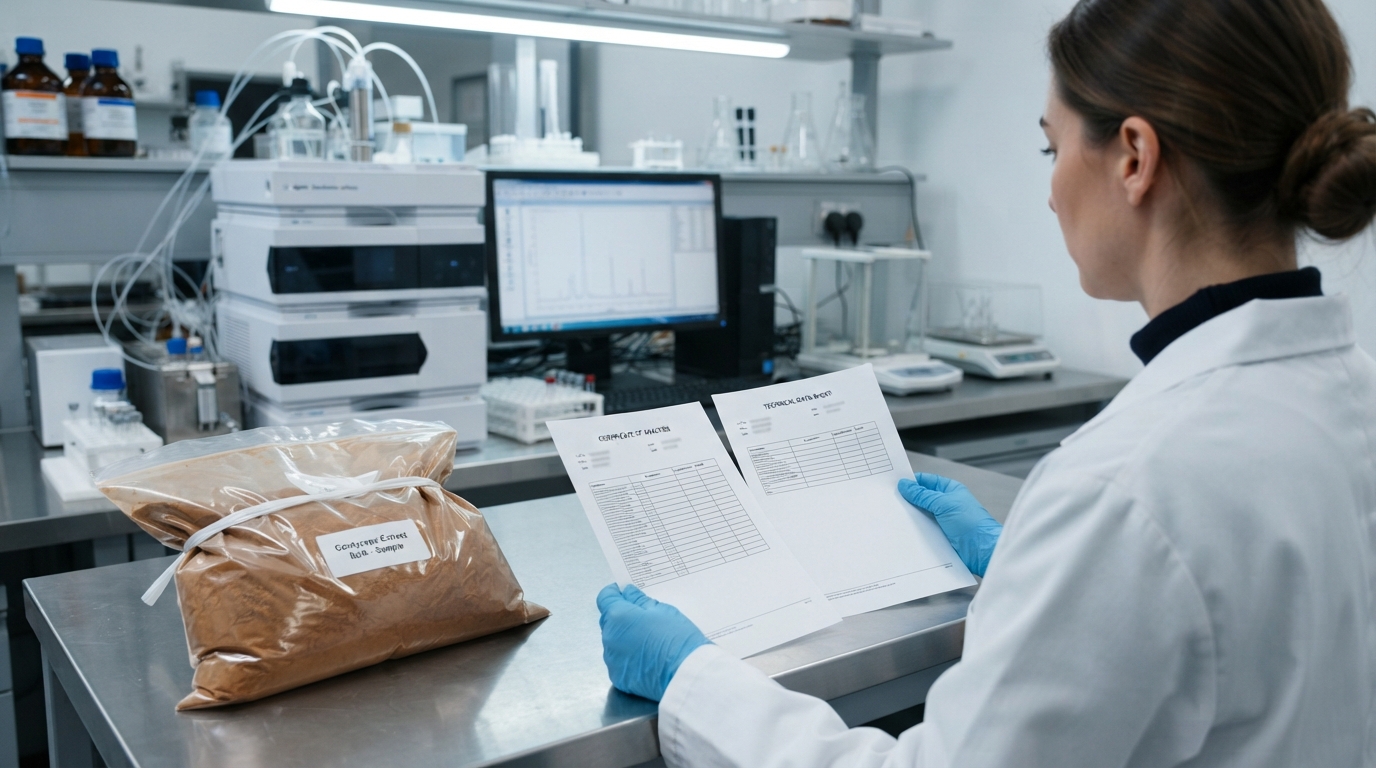
The paperwork is as important as the powder. A qualified supplier should be able to provide both a Certificate of Analysis (CoA) and a Technical Data Sheet (TDS) for the product.
CoA vs. TDS: What Each Document Does
| Document | Scope | Typical contents |
|---|---|---|
| CoA (Certificate of Analysis) | Batch-specific | Identity, marker assay, contaminant results, moisture, lot number, manufacturing date, expiry date |
| TDS (Technical Data Sheet) | Product-level | Appearance, physical form, particle size, solubility, packaging, storage conditions, shelf life, general handling information |
A CoA applies to one specific batch. It confirms what that batch contains and whether it meets the stated specification. A TDS describes the general product and how it should be handled.
Do not accept a TDS as a substitute for a CoA. You need both: one to understand the product, and one to verify the batch you are actually buying.
Potency and Contaminant Tests to Request
For a bulk Cordyceps extract, ask the supplier for test results covering at least the following areas:
- Identity — confirm that the material is the named Cordyceps species, not a substitute or adulterant.
- Marker assay — confirm the level of the selected marker using a validated method such as HPLC.
- Heavy metals — typically lead, arsenic, cadmium, and mercury.
- Microbiological testing — total microbial count, yeast, mould, and specified pathogens.
- Pesticide residues — particularly if the starting material is cultivated.
- Residual solvents — if solvent extraction was used.
Ask the supplier to provide the test method and the reporting unit for each result. A simple “pass” without a method or limit is not enough for a manufacturer to evaluate regulatory risk.
Matching the Cordyceps Extract to Your Product Application
The ideal extract specification depends on your finished product. A specification that works for a tablet blend may be unsuitable for a clear beverage.
| Application | Critical specification considerations | Why it matters |
|---|---|---|
| Capsules and tablets | Powder form, consistent particle size, good flow, defined assay, low moisture | Affects blending, compression, fill weight, and finished-product consistency |
| Functional beverages | Solubility or dispersibility, taste, pH and heat stability | Prevents sediment, poor mouthfeel, or compound degradation |
| Powders and stick packs | Dispersibility, texture, measure accuracy | Affects mixing and consumer experience |
| Sports nutrition products | Clear marker assay, batch consistency, documented specification | Supports formulation control and label accuracy |
Before contacting suppliers, define the application and the specification field that matters most. For a beverage, ask about solubility testing. For a capsule, ask about particle size and flow. For a standardized sports-nutrition ingredient, ask about the marker assay and batch-to-batch consistency.
Finished-product dosing is a separate question from bulk ingredient procurement. See cordyceps extract dosage once you move from ingredient sourcing to formulation.
How to Evaluate and Qualify a Bulk Cordyceps Extract Supplier
Use a structured checklist so you can compare suppliers fairly. The goal is not to find the cheapest quote but to find a supplier whose product identity, documentation, and commercial terms match your manufacturing requirements.
Supplier Inquiry Checklist

- Request a CoA and TDS for the exact product you are evaluating.
- Confirm the exact species and source material: C. militaris, C. sinensis, CS-4, fruiting body, mycelium, or fermented biomass.
- Confirm the extraction method and the starting material used.
- Confirm the standardization marker, analytical method, and reporting unit.
- Ask for contaminant data, including heavy metals, microbiology, pesticides, and residual solvents.
- Ask about batch numbering and traceability so you can connect the CoA to the physical product.
- Ask about packaging and storage conditions, including shelf life.
- Ask about samples, minimum order quantity, lead time, and packaging options for commercial planning.
- Verify any certification against the legal company name, certificate scope, product, and batch. Do not accept a generic certification logo without a certificate number and issuing body.
Red Flags to Avoid in a Cordyceps Extract Supplier
- The supplier cannot name the exact species or source material.
- The supplier uses “10:1” as if it were a potency percentage.
- The supplier provides a TDS but no batch-specific CoA.
- The supplier makes broad health or performance claims without supporting evidence.
- The supplier mentions certifications but cannot provide the certificate scope, number, or applicable product.
- The supplier cannot explain which marker compound was tested or which analytical method was used.
None of these red flags automatically proves a supplier is unreliable. But they should all trigger a request for documentation before you order.
Frequently Asked Questions About Sourcing Cordyceps Extract in Bulk
What is a bulk Cordyceps extract?
A bulk Cordyceps extract is a concentrated preparation derived from a specific Cordyceps species and source material, supplied in a form intended for commercial manufacturing rather than consumer retail.
What is the difference between Cordyceps militaris and CS-4?
Cordyceps militaris is a cultivated fungal species that can be processed from fruiting body or mycelium. CS-4 is a fermented mycelial biomass product with a distinct production history and product identity. They are not synonymous.
What does a 10:1 Cordyceps extract mean?
A 10:1 extract ratio means that ten parts of starting material were processed to produce one part of extract. It describes concentration, not the percentage of any specific marker compound.
What should I request from a Cordyceps extract supplier?
Request a CoA, TDS, exact species and source material, extraction method, marker assay with method and unit, contaminant data, packaging and storage information, sample availability, MOQ, and lead time.
Can Cordyceps extract be used in beverages or supplements?
Yes, but the required specification differs by application. Beverages typically require good solubility or dispersibility and acceptable taste. Capsules and tablets require a powder form with suitable particle size, flow, and assay consistency.
How to Take the Next Step with a Bulk Cordyceps Extract Supplier
Once your specification is clear, send it to the supplier. Ask for a CoA, TDS, sample availability, and commercial terms. A reliable supplier should be able to confirm whether their product matches your application, or explain exactly where it does not.
Contact B-Thriving with your product specification and sourcing requirements. The sourcing team can help you evaluate whether their Cordyceps extract documentation and specifications fit your manufacturing needs.

