

A branched chain amino acid (BCAA) supplier is a bulk ingredient source that provides manufacturers with leucine, isoleucine, and valine—the three BCAAs—along with the product documentation and supply terms needed to qualify the material for production. For procurement teams, formulators, and brand owners, the real challenge is not simply finding a supplier. It is confirming that the supplier can document composition, purity, batch consistency, and application fit.
This sourcing guide explains what to expect from a BCAA supplier, which specifications matter, how to evaluate a supplier, and the questions to ask before approving an ingredient.
What Are Branched Chain Amino Acids?
Branched-chain amino acids are three essential amino acids: leucine, isoleucine, and valine. They are called branched-chain because of their chemical structure. The body cannot synthesize them in sufficient amounts, so they must come from food or supplementation.
- Leucine — the most frequently discussed BCAA in sports-nutrition contexts.
- Isoleucine — one of the three BCAAs with a branched structure.
- Valine — the third BCAA, often included alongside leucine and isoleucine.
BCAAs are commonly used in sports nutrition because of their role in muscle protein metabolism, but they are not a complete protein replacement. According to Otsuka Pharmaceutical, BCAAs are characterized by their branched structure and are often discussed in the context of exercise. Broader amino-acid background is also available from the National Center for Biotechnology Information.
For a manufacturer, the important point is practical: BCAA supply is not a single-ingredient purchase. It is a three-component ingredient with a defined ratio, quality specifications, and documentation that must be verified.
What Does a BCAA Supplier Provide to Manufacturers?
A BCAA supplier can serve two different roles in the supply chain. Understanding the difference prevents a costly procurement mistake.
| Role | What They Provide | Typical Buyer |
|---|---|---|
| Raw-ingredient supplier | Bulk BCAA powder, TDS, batch-specific CoA, samples, packaging, MOQ, lead time | Manufacturers, brand owners, formulators |
| Finished-product contract manufacturer | Capsules, tablets, powders, or beverages made using ingredients from suppliers | Brands that need turnkey production |
A raw-ingredient supplier is not automatically a manufacturer. Some suppliers are distributors; others are manufacturers with their own production lines. The label matters less than the documentation. A reliable BCAA supplier should be able to provide:
- Technical Data Sheet (TDS) for the product.
- Certificate of Analysis (CoA) for each specific batch.
- Clear identity and assay results.
- Physical and chemical specifications.
- Packaging details and storage guidance.
- Commercial terms, including MOQ, lead time, and sample policy.
If a supplier cannot provide batch-specific documentation, that is a warning sign.
How to Choose the Right BCAA Ratio
BCAA ratio describes the relative amounts of leucine, isoleucine, and valine. It is not an extract ratio, and it is not a purity percentage. The ratio is part of the product specification and should be chosen according to the finished product concept.
| Ratio | Leucine : Isoleucine : Valine | Typical Positioning |
|---|---|---|
| 2:1:1 | Balanced ratio | Common general sports-nutrition format |
| 4:1:1 | Higher leucine | Leucine-focused formulations |
| 8:1:1 | Very high leucine | Products emphasizing leucine content |
There is no single correct ratio for every manufacturer. The best choice depends on:
- The product concept and label positioning.
- Target consumer expectations.
- Cost targets.
- Formulation compatibility with other ingredients.
A supplier should state the ratio clearly on the TDS and CoA. If the ratio is unclear, request clarification before comparing prices.
BCAA Specifications Every Buyer Should Verify
Before comparing price per kilogram, compare these specifications and documents.
Assay, Purity, and Concentration
Buyers sometimes use assay, purity, and concentration as if they mean the same thing. They do not.
| Term | What It Means | Units to Expect |
|---|---|---|
| Assay | Measured amount of the target component | % or mg/g |
| Purity | Proportion of the material that is the intended ingredient, after impurities are excluded | % |
| Ratio | Relative amounts of leucine, isoleucine, and valine | e.g., 2:1:1 |
| Extract ratio | A botanical-extract term, not a BCAA specification | e.g., 10:1 |
For BCAA, the assay confirms the active-component content. Purity reflects overall composition. Ratio defines the relative amounts of the three amino acids. Extract ratio is not relevant to BCAA and should not be used as a comparison metric.
Physical Form, Particle Size, and Solubility
BCAA is most commonly supplied as a powder, but not all powders are the same.
- Standard powder — generally suitable for capsules, tablets, and some powder blends.
- Instantized powder — processed for better dispersibility, which is useful for beverages and stick-pack products.
Particle size affects flow, blending, and compression. Solubility and dispersibility affect how well the ingredient performs in a finished drink. Ask the supplier for physical specifications rather than assuming they match your process.
CoA vs. TDS and Batch Testing
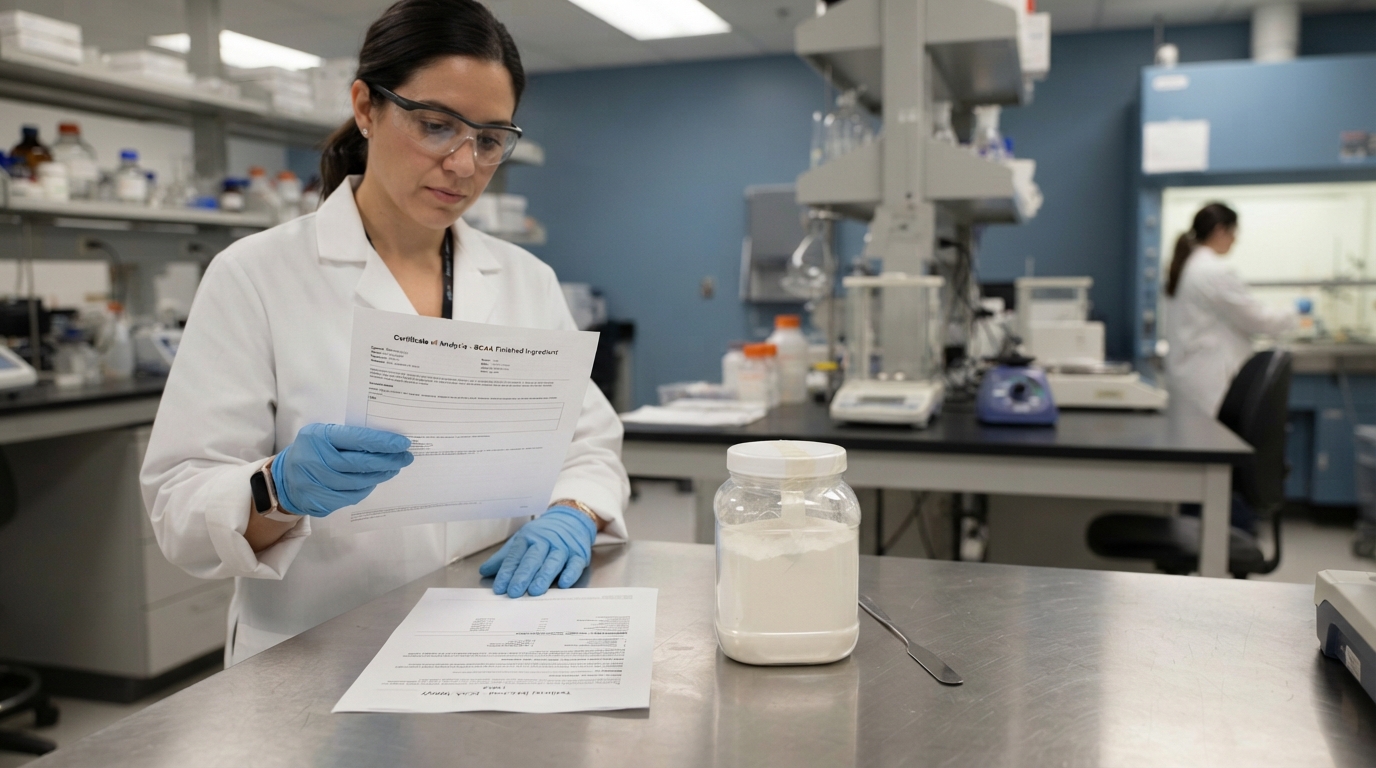
The TDS describes the product. The CoA documents a specific batch.
| Document | Scope | What It Should Show |
|---|---|---|
| TDS | Product-level technical data | Appearance, form, particle size, solubility, storage, typical shelf life |
| CoA | Batch-specific results | Identity, assay, heavy metals, microbiological results, lot number, test date |
A supplier should be able to provide both. A CoA without a batch number is not a valid batch certificate. If the supplier cannot provide a lot-specific CoA, treat that as a red flag.
For applications with stricter documentation requirements, see our guide on pharmaceutical grade amino acid.
How to Qualify a BCAA Supplier
Qualification should be a process, not a conversation. Use the following steps to evaluate a BCAA supplier before approval.
- Request the TDS and a recent CoA. Review the stated ratio, assay, purity, physical properties, and contaminant data. Confirm the CoA includes a batch number.
- Verify supplier identity and location. Confirm the company name, registered address, and contact details. Check whether the company presents itself as a manufacturer, distributor, or trading company.
- Request a sample. Evaluate the physical appearance, odor, flow, and behavior in your intended application.
- Test the sample. Send the sample to a qualified laboratory for identity, assay, and contamination testing if your internal process requires it. Do not rely only on the supplier’s CoA.
- Run a pilot batch. Use the sample in your actual manufacturing process to confirm blending, compression, dissolution, or beverage stability.
- Confirm commercial terms. Verify MOQ, lead time, packaging, shelf life, storage requirements, and the process for future batch reviews.
- Plan for batch-to-batch consistency. Ask the supplier how they manage lot traceability and what happens if a future batch does not meet specification.
A well-qualified supplier should welcome these questions. A supplier who cannot answer them clearly is not ready for serious manufacturing partnerships.
Choosing a BCAA Form for Your Application

Your final product format determines the ideal BCAA specification.
| Application | Suitable Form | What to Prioritise |
|---|---|---|
| Sports-nutrition powder | Standard or instantized powder | Dispersibility, particle size, taste |
| Capsules or tablets | Fine powder with consistent flow | Flow, compression, dosage accuracy |
| Functional beverages | Highly soluble or instantized powder | Solubility, stability, flavor masking |
No single BCAA form works perfectly for every product. The right choice depends on your equipment, product format, and consumer expectations.
For broader sports-nutrition ingredient sourcing, see our guide on sports nutrition amino acid supplier.
Common BCAA Sourcing Mistakes
Most BCAA sourcing problems come from insufficient verification.
- Accepting a generic CoA. If the certificate is not linked to a specific batch, it does not prove that batch meets specification.
- Assuming a certification applies to every ingredient. Certificates are often product- or batch-specific. Confirm scope before relying on them.
- Confusing a distributor with a manufacturer. A distributor can provide a valid product, but the supply relationship is different from a direct manufacturer relationship.
- Comparing price without checking assay and purity. A lower price per kilogram is not valuable if the active content is lower or the impurity profile is worse.
- Choosing a ratio before defining the product. The concept should drive the ratio, not the other way around.
- Ignoring storage and shelf life. BCAA powder can be stable under proper conditions, but temperature, moisture, and packaging still matter.
- Trusting performance claims without evidence. If a supplier makes a strong claim, ask for the source data.
Why Businesses Choose B-Thriving as an Ingredient Supplier
B-Thriving is a B2B ingredient supplier website. The accessible site identifies the business as Xi’an B-Thriving I/E Co., Ltd., with Xi’an, China contact details. The site lists Amino Acid as a product category, alongside botanical extracts, mushroom extracts, natural sweeteners, and related ingredient categories.
At the time of this guide, BCAA-specific availability and specifications were not publicly confirmed on the site. That distinction matters. A category listing alone does not verify product-level quality.
To evaluate B-Thriving’s BCAA offer, request the current TDS, a recent batch-specific CoA, sample options, MOQ, lead time, packaging, and shelf life. Contact B-Thriving directly and ask for BCAA-specific documentation. A qualified supplier will be able to confirm whether BCAA is currently available and provide the documents needed for your evaluation.

