
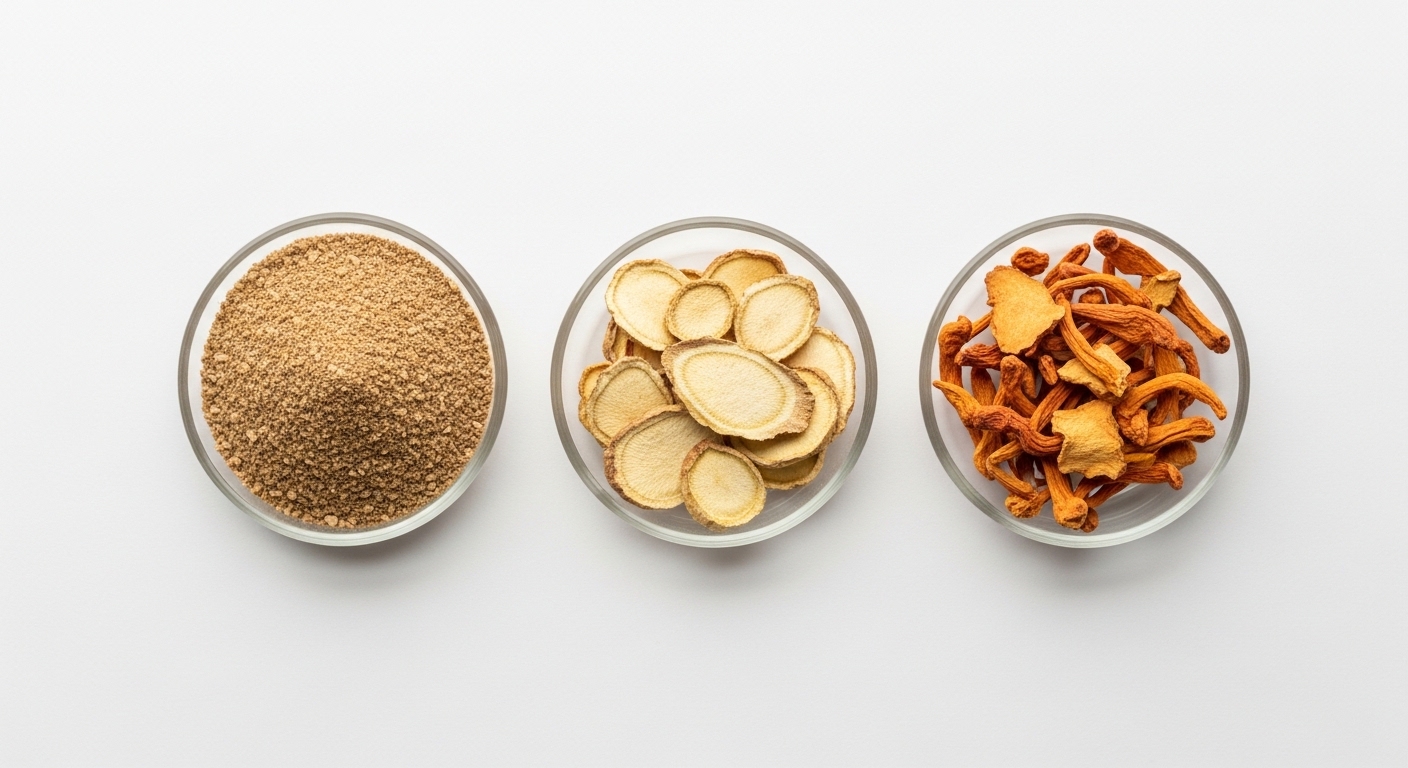
Ashwagandha, Rhodiola rosea, and Cordyceps are three of the most formulated adaptogenic botanicals in the European nutraceutical, functional food, and sports nutrition sectors. Each carries a distinct phytochemical profile, a different standardization target, and a specific formulation fit. For procurement managers and product developers, the right choice depends on the intended application, your quality specifications, and the regulatory pathway your finished product will follow.
This guide compares all three at the ingredient specification level — not the consumer claim level.
What Makes Each Adaptogen Distinct?
Before running a side-by-side comparison, it helps to know what each ingredient actually contains and what your COA should confirm for each one.
Ashwagandha: Withanolides as the Primary Marker
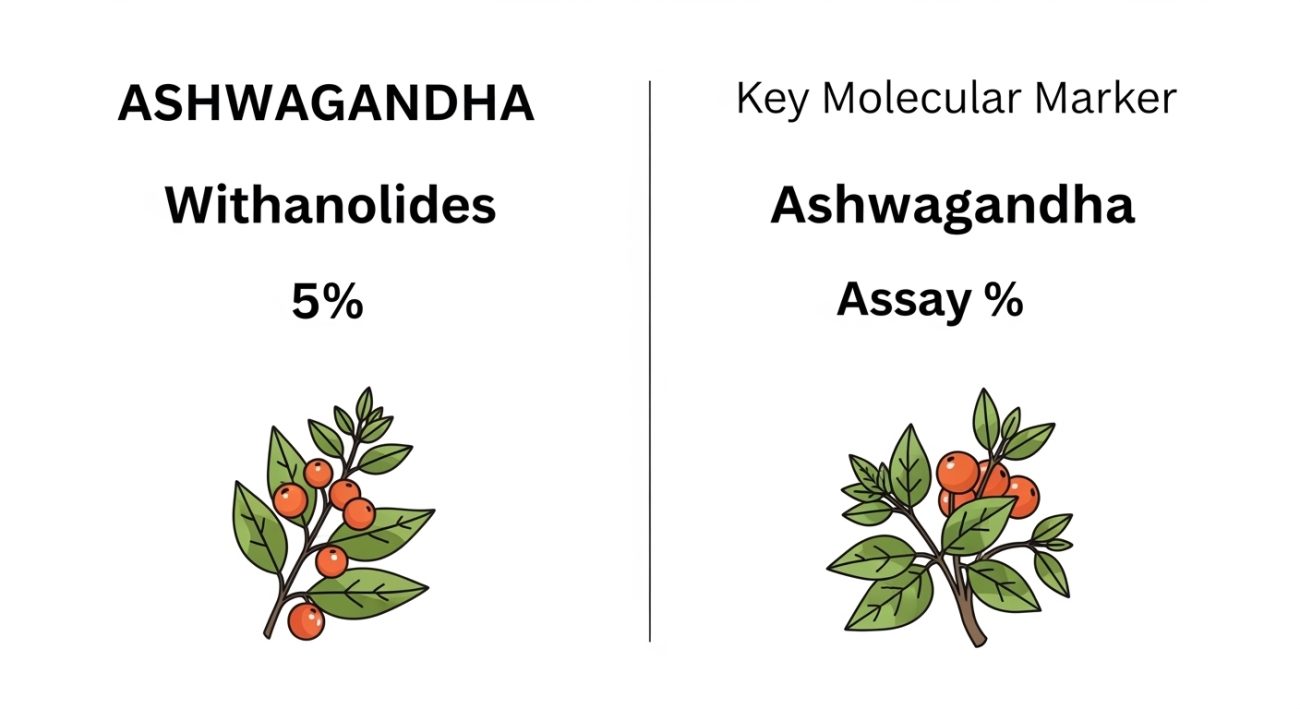
Ashwagandha (Withania somnifera) is standardized to withanolides — a group of steroidal lactone triterpenoids. Common commercial specifications run from 2.5% to 10% total withanolides by HPLC, with 5% being a widely used benchmark for standardized root extract.blog.priceplow+1
Plant part sourcing matters here. Root-only extract aligns with pharmacopoeia references (USP, Indian Pharmacopoeia, WHO monograph) and has the strongest clinical evidence base. Root-plus-leaf combinations exist and are typically lower-cost, but they carry a different phytochemical profile and are not equivalent for evidence-based product development.[vitaactives]
A quality COA for ashwagandha should confirm: withanolide assay (HPLC), heavy metals, microbiology, pesticide residues, and residual solvents if hydroalcoholic extraction was used.[essencefield]
Rhodiola Rosea: A Dual-Marker Standardization Standard
Rhodiola rosea is standardized across two marker families: rosavins (rosin, rosarin, rosavin) and salidroside. The widely accepted benchmark is 3% rosavins and 1% salidroside, which mirrors the composition used in clinical evidence reviewed by the European Medicines Agency.pmc.ncbi.nlm.nih+1
The ratio between these markers matters for formulators. Salidroside-dominant extracts (e.g., 3% salidroside) tend to produce more stimulating functional profiles, while rosavin-dominant extracts exhibit a calmer, more adaptogenic character. Some suppliers deliver only one marker — always check your COA confirms both if you’re formulating against clinical precedent.[nootropicsdepot]
The EMA’s herbal monograph for Rhodiola rosea (2011) approved its traditional use for temporary relief of fatigue and stress symptoms, providing EU-relevant regulatory backing for food supplement labelling in aligned markets.[nektium]
Cordyceps: Polysaccharides, Cordycepin, and Source Complexity
Cordyceps (Cordyceps sinensis) introduces additional procurement complexity because of sourcing. Wild-harvested Cs-4 mycelia are extremely scarce and expensive. Most commercial supply is mycelium cultured on grain substrate — a legitimate and cost-effective format, but one that requires specification clarity on the COA.[novanat]
Standardization typically targets polysaccharides (20%–40% by UV), with secondary markers including cordycepin and adenosine confirmed by HPLC. A typical advanced specification reads: 40% polysaccharides (UV), 0.01% cordycepin, 0.2% adenosine, 7.0% cordycepic acid (HPLC). Any supplier offering Cordyceps without HPLC confirmation of nucleoside markers should be treated as a non-standard specification.[vitaactives]
Head-to-Head: Formulation Decision Matrix
| Specification Factor | Ashwagandha | Rhodiola Rosea | Cordyceps |
|---|---|---|---|
| Primary marker | Withanolides (HPLC) | Rosavins + Salidroside (HPLC) | Polysaccharides (UV) + Adenosine (HPLC) |
| Common assay target | 2.5–10% withanolides | 3% rosavins / 1% salidroside | 20–40% polysaccharides |
| Plant part (spec-critical) | Root only (preferred) | Root and rhizome | Mycelium (source matters) |
| EMA monograph | No | Yes (2011, traditional use) [nektium] | No |
| EFSA status | National positive list (varies by EU member state) | National positive list (varies) | Novel Food considerations may apply [efsa.europa] |
| Primary formulation fit | Stress/sleep nutraceuticals, sports recovery | Cognitive, energy, sports performance | Athletic performance, immune, functional food |
| Intake timing consideration | Evening / calming profile | Morning / energising profile [nektium] | Flexible — pre-workout, immune applications |
| Solvent concern for EU | Hydroalcoholic (check residuals) | Aqueous-ethanol (well-established) | Water extraction standard |
EU Compliance: What Differs Across All Three
Regulatory status is not uniform for these three botanicals across EU member states. The EU does not operate a centralised authorisation procedure for botanicals in food supplements — authorisation is a national competency under Regulation (EC) No 178/2002.[efsa.europa]
Practical consequences for procurement:
- Ashwagandha and Rhodiola appear on multiple national positive lists (e.g., BELFRIT, Germany’s Pflanzenliste) for food supplement use, but market access in specific countries requires individual verification.[cbi]
- Cordyceps faces potential Novel Food scrutiny in certain EU markets. If the specific extract form was not in documented use as a food in the EU before 15 May 1997, it may require EFSA authorization before commercial sale as a food supplement. QA/RA teams must assess this per product-country combination.[cactusbotanics]
- The EMA’s 2011 herbal monograph for Rhodiola rosea gives it a clearer regulatory pathway for traditional herbal medicinal product (THMPD) registration compared to the other two.[nektium]
Always verify applicable regulatory categories with your own RA/legal team before finalizing product specifications.
Which to Choose: A Procurement Guide by Application
The right adaptogen depends on three things: your target health context, your formulation format, and your quality infrastructure for COA verification.
Choose Ashwagandha when:
- Your product targets stress management, sleep quality, or sports recovery
- You need a well-documented clinical evidence base aligned with a 300–600 mg standardized dose[essencefield]
- Your QA team can verify HPLC withanolide assay and confirm root-only sourcing
Choose Rhodiola rosea when:
- Your formulation targets cognitive performance, energy, or fatigue resistance
- You need EMA-backed traditional use status for EU THMPD registration
- You’re targeting dual-marker standardization (3% rosavins / 1% salidroside) for evidence-aligned product development[pmc.ncbi.nlm.nih]
Choose Cordyceps when:
- Your product category is sports nutrition, immune support, or functional food
- You require polysaccharide standardization with HPLC-confirmed nucleoside markers
- Your RA team has assessed Novel Food status for your target EU markets[cactusbotanics]
Some high-performance product developers formulate stacks combining two or all three — typically Ashwagandha plus Rhodiola for a stress-energy dual application. If you’re exploring a multi-adaptogen blend, ingredient interaction and combined COA traceability become additional QC priorities.
What to Ask Your Supplier Before Placing an RFQ

A supplier’s documentation quality signals as much as their product quality. Before committing to a bulk order or requesting samples, confirm the following from any botanical extract supplier:
- HPLC assay report confirming the exact marker compound percentage per batch — not just a generic specification sheet
- Method reference: is the HPLC method validated (in-house validated or against USP/Ph.Eur. standards)?
- Plant part declaration: root-only vs root-plus-leaf for Ashwagandha; mycelium vs fruiting body for Cordyceps
- Residual solvent data: particularly relevant if hydroalcoholic extraction is used
- Heavy metals and microbiology panel: minimum: lead, arsenic, cadmium, mercury + total plate count, yeast/mould, pathogens
- GMP certificate: manufacturing site should hold valid GMP certification for food or pharmaceutical category depending on your finished product type
B-Thriving supplies standardized herbal extracts across all three adaptogen categories with full COA documentation and sample availability for batch qualification. For EU-bound procurement, GMP-grade documentation packages can be arranged on request.
Frequently Asked Questions
What is the difference between Ashwagandha, Rhodiola, and Cordyceps?
They are three distinct adaptogenic botanicals with different active compounds, mechanisms, and formulation applications. Ashwagandha (withanolides) suits stress and sleep applications; Rhodiola rosea (rosavins/salidroside) targets energy and cognitive performance; Cordyceps (polysaccharides/adenosine) serves athletic and immune formulations.
Which adaptogen has the most EU regulatory backing?
Rhodiola rosea holds the strongest EU regulatory footing, supported by a 2011 EMA herbal monograph approving its traditional use for stress-related fatigue. Ashwagandha and Cordyceps rely on national positive lists and require country-by-country verification.[nektium]
What standardization should I specify for Rhodiola rosea?
The clinical and regulatory benchmark is 3% rosavins and 1% salidroside by HPLC. Confirm both markers on the COA — some suppliers report only one.cambridgecommodities+1
Does Cordyceps require Novel Food authorization in the EU?
It depends on the specific extract form and the EU member state. Certain Cordyceps preparations may trigger Novel Food requirements under EU 2015/2283 if pre-1997 consumption history cannot be established. Your RA team must assess this per market and product format.[cactusbotanics]
Can I formulate a blend of all three adaptogens?
Yes, multi-adaptogen blends are commercially active. Each ingredient requires its own COA, and combined specification sheets should clearly identify individual assay values per botanical. Inform your supplier at the RFQ stage so they can provide ingredient-specific documentation.
What is the typical bulk MOQ for standardized adaptogen extracts?
MOQ varies by supplier and specification grade. B-Thriving supports sample requests for quality qualification before bulk commitment — browse available standardized botanical extracts or submit an RFQ with your target assay, form factor, and annual volume.
How do I verify a COA for withanolides in Ashwagandha?
A valid COA should report withanolide percentage by HPLC with method validation reference, lot number, and testing date. Common commercial grades are 2.5%, 5%, and 10% — confirm which withanolide fractions are included in the total assay.blog.priceplow+1
Ready to specify a standardized adaptogen extract for your next formulation?
Request a sample, COA package, or bulk RFQ directly — response within 24 hours for qualified European buyers. Browse our standardized botanical extracts →

