
A standardized herb extract is a botanical extract that’s made and tested to consistently meet a specified level of one or more measurable compounds (often listed as a percentage on the label/COA), so each batch delivers repeatable potency for formulation, manufacturing, and quality control.
For European B2B buyers, “standardized” isn’t a marketing adjective—it’s a specification. The real question is: standardized to what, by which method, and supported by which documentation? If you’re new to the concept, start with this quick definition and then use the procurement checklist below to evaluate suppliers with confidence.
Standardized extract, in one sentence
A standardized herb extract is an extract verified by analytical testing to consistently contain a defined amount of a target compound (or compound group)—so the ingredient behaves predictably in product development and manufacturing.
What “standardized” actually controls (and what it doesn’t)
Standardization can significantly improve batch-to-batch consistency, but it does not mean everything about the botanical is identical across suppliers or batches.
Standardization typically controls:
- A target assay value (e.g., “≥ 10% marker compound”)
- A defined range for the targeted compound(s)
- A repeatable testing method used for release (commonly HPLC/UPLC for markers)
Standardization does not automatically control:
- The full phytochemical profile (unless explicitly specified)
- Taste, color, odor, or solubility (these can still vary)
- Contaminant risk (micro, heavy metals, pesticides) unless tested and controlled
- Extract ratio/DER (unless declared and controlled)
- Solvent system, processing aids, or excipients (unless specified)
That’s why procurement and QA/RA teams should treat “standardized” as one line of a broader specification, not the whole story. If you want a deeper process explanation, see: How is a Herb Extract Standardized?
Two common ways extracts are “standardized”
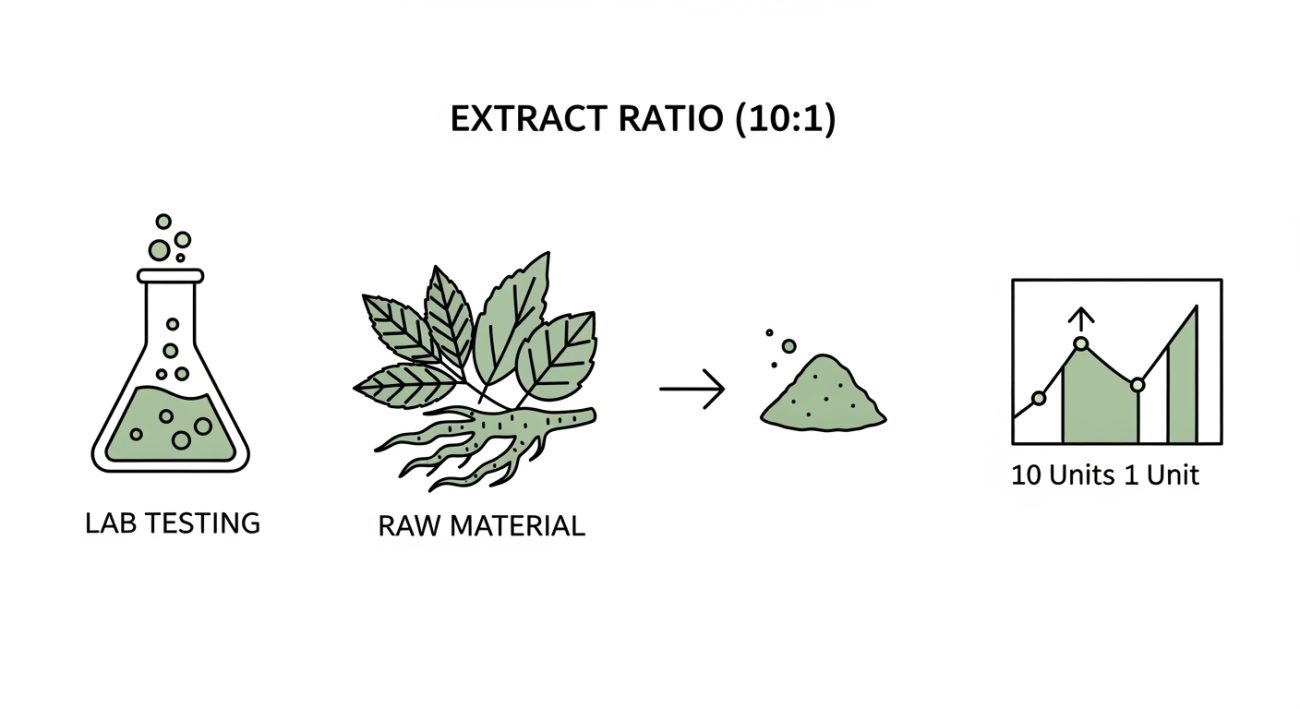
In practice, suppliers may use the word “standardized” in two different (sometimes overlapping) ways. Understanding both helps you avoid sourcing surprises.
Standardized by extract ratio (e.g., 10:1)
An extract ratio (often written as 10:1, 20:1, etc.) describes how much raw botanical was used to produce a given amount of extract—but it does not automatically confirm the content of a specific bioactive compound.
How to interpret it (in plain language):
- “10:1” suggests 10 parts of raw herb produced 1 part extract (by weight).
- It’s a manufacturing descriptor, not a potency guarantee—unless paired with an assay for target compounds.
Why buyers care:
- Ratio alone can be misleading if botanical quality, extraction conditions, or standardization targets differ.
- In many regulated procurement settings, ratio/DER is useful but insufficient without an assay and contaminant controls.
Best practice: If a supplier claims “standardized” and only provides an extract ratio, ask what compound(s) are being measured—or whether the standardization is simply the ratio itself.
Standardized by marker/active compound percentage
This is the most common B2B meaning of standardization: the extract is tested so it consistently contains a defined percentage of a target compound (or compound group).
Examples of what you’ll see in specs/COAs:
- Assay: “Marker compound A: 10%”
- Assay range: “8–12%” (depending on grade and standard)
- “Total [compound family]” (when multiple related compounds are measured)
This approach can be highly effective for formulation consistency, because it ties standardization to a measurable number.
Marker compound vs active compound: why both appear
A marker compound is a measurable component used to confirm consistency and identity. An active compound is the component(s) primarily associated with the intended technical function in a formulation (which may or may not be the same as the marker).
Why this matters in procurement:
- Some botanicals are standardized to a marker because it’s reliable and easy to measure.
- The marker may not represent the entire functional profile of the botanical.
- Different suppliers can standardize the “same” botanical to different markers—creating performance differences in real-world formulation.
If you want the conceptual grounding, see: Active compound from herbs
Why standardized extracts are used in products and studies
Standardized extracts are popular in nutraceutical, pharma-adjacent, and cosmetic supply chains because they reduce variability—especially when a formulation requires consistent sensory performance, stability, or label claim compliance (within what regulations allow).
Key benefits for B2B product development:
- Repeatable potency across batches (better process control)
- Simpler formulation math (less batch-specific adjustment)
- More predictable performance (especially in standardized functional roles)
- Easier supplier qualification when testing and documentation are consistent
- More robust QA because pass/fail criteria can be defined and verified
Standardization is not a silver bullet, but it’s often a practical bridge between the natural variability of plants and the consistency expectations of industrial manufacturing.
If you’re weighing why standardization may be required by your internal QA or customer specs, see: Why is Standardization Important in Herbal Extracts?
Standardized vs full-spectrum vs whole-herb extracts
“Standardized” is often compared to “whole herb” or “full-spectrum.” The best choice depends on your application, claim strategy, and tolerance for variability.
When standardized extracts make the most sense
Choose standardized extracts when you need:
- Consistent assay targets for product uniformity
- A specific compound level tied to your formulation design
- Repeatable performance across multiple manufacturing sites or CMOs
- Simplified incoming QC acceptance criteria
- Easier reformulation control when botanical sources shift seasonally
Standardization is especially helpful when your product needs to behave consistently across scale-up, stability, and multi-market manufacturing workflows.
When full-spectrum or whole-herb may be preferred
Full-spectrum or whole-herb extracts can be preferred when:
- The formulation goal relies on a broader phytochemical profile
- Your product philosophy is “whole plant profile” (common in some consumer segments)
- You accept more natural variability and manage it with broader spec ranges
- The targeted marker does not represent the intended functional profile
The important part is clarity: “full-spectrum” and “whole herb” still require strong supplier controls (identity and contaminants) to be procurement-ready. For a deeper comparison, see: Full-Spectrum vs Standardized Extracts
How a supplier produces a standardized herb extract
A standardized extract isn’t created by one single step—it’s the output of a controlled process plus verification testing. While exact workflows vary, a procurement-ready supplier typically follows a consistent logic:
- Botanical identity and raw material control (species, plant part, origin, moisture, adulteration risk)
- Extraction under defined parameters (solvent system, time, temperature, concentration)
- Concentration/purification as needed (without damaging the intended profile)
- Standardization step (blending batches or adjusting concentration)
- Analytical testing to confirm target assay
- Release documentation (COA + supporting documents per buyer needs)
If you want the step-by-step version, see: How is a Herb Extract Standardized?
Identity, contamination, and assay testing at a glance
For EU buyers, the supplier’s testing approach often determines whether an ingredient is “easy to qualify” or becomes a risk sink. At minimum, your evaluation should separate three different purposes of testing:
- Identity testing: confirms the botanical is what it claims to be
- Assay testing: confirms the standardized compound level meets spec
- Contaminant testing: confirms the batch meets safety and quality limits
A supplier who only emphasizes assay (“10% marker!”) without strong identity and contaminant control is not necessarily procurement-ready.
What you should see on a COA
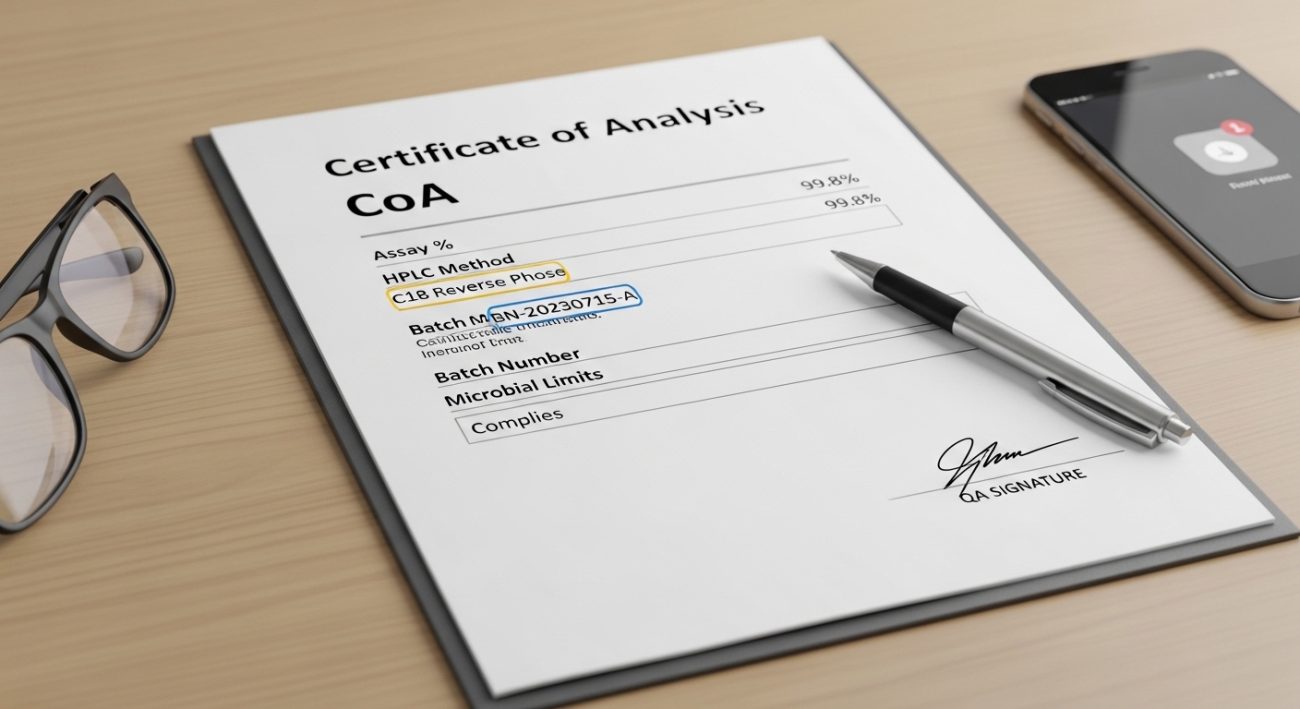
A COA is only useful if it’s readable, complete, and ties clearly to your acceptance criteria. A strong COA for standardized extracts commonly includes:
- Product name + botanical name (and plant part if applicable)
- Batch/lot number and manufacture date
- Assay result for the standardized marker(s), with method reference
- Appearance, loss on drying/moisture (as relevant)
- Microbial limits (typical categories and results)
- Heavy metals limits/results (with method reference if possible)
- Pesticide or residual solvent statements/results (where applicable)
- Sign-off by QA
If you want a dedicated checklist for evaluating standardized extract quality, see: How Can I Check the Quality of a Standard Herb Extract?
Buyer checklist: how to specify and RFQ standardized extracts
If you’re sourcing standardized botanicals for EU markets, the best outcomes come from an RFQ that’s precise enough to avoid ambiguity—but not so rigid that it blocks supply.
Below is a procurement-friendly checklist you can copy into your RFQ template.
Minimum specs to include in an RFQ
1) Standardization target
- Target compound(s) or compound family
- Required level (%, mg/g, or range)
- Preferred method (if you have one) or “supplier to state method”
2) Extract basis
- Plant part (if relevant)
- Extraction solvent(s) and any restrictions (e.g., ethanol/water only)
- Carrier/excipients (if any), and maximum allowed
3) Physical requirements
- Powder or liquid
- Mesh size / particle distribution (if relevant)
- Solubility expectations (if relevant to formulation)
4) Quality and safety requirements
- Microbial limits required by your category
- Heavy metals limits required by your internal standard
- Pesticide requirements (if applicable)
- Residual solvent requirements (if applicable)
5) Documentation expectations
- COA for each batch
- SDS and technical data/spec sheet
- Allergen / GMO / irradiation statements as required by your QA
6) Supply reliability
- MOQ, lead time, and typical availability
- Sampling policy and retention sample policy (if available)
A practical tip: if you don’t specify the standardization target and assay method, different suppliers may quote different grades that are not comparable—creating hidden requalification work later.
Documents EU buyers commonly request
EU procurement and QA/RA teams commonly request a “documentation pack” for ingredient qualification. What’s considered standard varies by company and end market, but many buyers ask for:
- COA (lot-specific)
- Specification sheet / TDS (grade definition)
- SDS (handling and safety)
- Allergen statement (where applicable)
- GMO statement (where applicable)
- Residual solvent and contaminant information aligned to your internal requirements
If your supplier can provide these quickly and consistently, qualification becomes smoother—and RFQs convert faster.
FAQ
It means the extract is tested and released so that a specified compound (or compound group) is present at 10% by weight (or within an agreed range). Always confirm which compound is being measured and how it’s tested, because different markers or methods can produce different results.
No—standardized extracts are still complex botanical mixtures; they are simply controlled to contain a consistent level of a target compound. Isolated compounds (monomers) are typically purified to a much higher concentration and behave more like single-entity ingredients.
An extract ratio describes the manufacturing concentration relationship between raw herb and extract, while standardization describes meeting a measured compound level (usually a percentage assay). A 10:1 ratio can exist without any standardized marker level unless the supplier provides assay data and controls.
Not always—standardization is beneficial when you need repeatable potency and predictable formulation behavior, but non-standardized or full-spectrum extracts may be preferred when a broader phytochemical profile is important. The “better” choice depends on your product goal, QC strategy, and acceptance of natural variability.
Most suppliers confirm standardization by testing the target compound(s) with appropriate analytical methods (often chromatography-based methods such as HPLC/UPLC) and releasing the batch only if it meets the agreed assay range. For procurement, testing is meaningful only when it’s paired with identity confirmation and contaminant controls.
Look first for the assay result for the standardized compound(s), the method reference, and clear batch identification—then check identity-related details and contaminant results (micro, heavy metals, and other limits relevant to your category). If you need a full checklist, use: How Can I Check the Quality of a Standard Herb Extract?
Ready to source a standardized herb extract?
If you’re evaluating standardized botanicals for EU formulations, the fastest path is to align on standardization targets, assay methods, and documentation upfront.
- Need a COA/spec pack for review?
- Want a sample for internal testing?
- Have an RFQ with marker %, solvent system, and quality limits?
Start with your requirements and we’ll match the correct grade and supporting documentation.

